
Converting crop straw into stable soil organic matter (SOM) is essential for sustainable farming and climate resilience—but it’s notoriously inefficient in saline-alkaline soils. A recent study explored whether tiny, naturally derived organic molecules could provide a microbial boost.
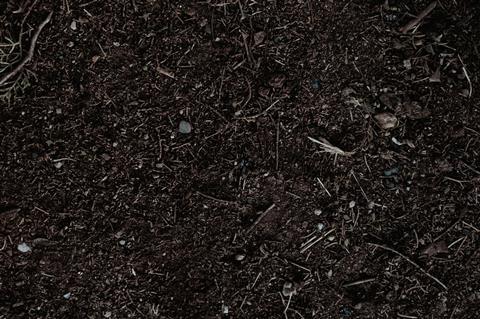
By adding lignin- and humus-based small molecules (LSMs and HSMs) to straw-amended soils, researchers observed remarkable gains in the formation of stable mineral- and particulate-associated carbon. These changes were driven by shifts in microbial communities and enhanced cross-trophic interactions. In particular, humus-derived compounds significantly reduced soil sodicity and improved microbial processing of straw. The findings offer a promising pathway for regenerating degraded agricultural soils.
Soil organic matter plays a foundational role in agricultural productivity, climate mitigation, and ecosystem balance. Straw return—a widely used strategy to enrich soil organic matter (SOM)—suffers from low conversion efficiency, especially in sodic soils where high sodium levels suppress microbial activity. Attempts to boost this process with microbial inoculants have often failed, as introduced microbes struggle to compete with native communities or survive in harsh soil conditions.
Meanwhile, studies suggest that small-molecule organics can shift microbial populations and stimulate decomposition. Due to these limitations and emerging insights, there is a growing need to investigate whether small molecules can catalyze microbial processes and improve SOM formation in stressed environments.
Soil experiment
To explore this question, a team of scientists from the Chinese Academy of Sciences and South China University of Technology conducted a 15-week experiment, published (DOI: 10.1016/j.pedsph.2024.05.012) in Pedosphere in June 2025. They introduced biopolymer-derived small molecules—extracted from lignin (LSMs) and humus (HSMs)—into both sodic and non-sodic soils along with ¹³C-labeled straw.
The study examined how these amendments influenced microbial community structure, enzymatic activity, and the formation of stable SOM fractions. Their findings revealed that humus-derived small molecules not only reduced soil sodicity but also enhanced microbial pathways responsible for straw degradation and long-term carbon stabilization.
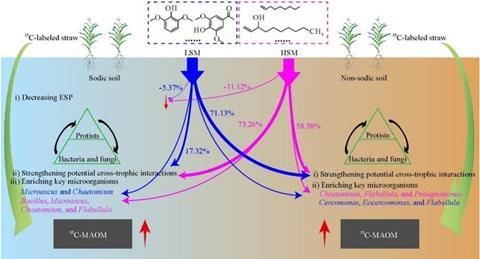
The addition of HSMs and LSMs significantly boosted the conversion of straw into 13C-labeled mineral-associated (MAOM) and particulate organic matter (POM), with HSMs achieving greater efficiency. In sodic soils, HSMs reduced exchangeable sodium percentage by over 11%, easing stress on microbial communities. Microbial diversity increased markedly, with higher richness of bacteria, saprotrophic fungi, and phagotrophic protists. Notably, beneficial taxa such as Bacillus, Chaetomium, and Flabellula were enriched.
Cross-trophic interactions
Network analysis revealed strengthened cross-trophic interactions—particularly between decomposers and protist predators—following small molecule addition. These interactions played a pivotal role in carbon stabilization, alongside elevated enzymatic activities (β-glucosidase and β-xylosidase) and microbial necromass accumulation. Random forest modeling confirmed cross-trophic interactions as the top predictor of SOM formation. Collectively, the results indicate that biopolymer-derived molecules activate complex microbial pathways that lead to more efficient and stable carbon incorporation in soil.
“Our study demonstrates how strategic use of natural small molecules can reshape the soil microbiome to benefit carbon cycling,” said Dr. Jiabao Zhang, corresponding author of the study. “By stimulating microbial cross-feeding and enzymatic processing, especially under saline stress, we saw a notable increase in stable soil organic matter. These findings could help reimagine how we manage straw residues and rehabilitate degraded soils—using tools already present in nature.”
Soil health
The research presents a scalable, biologically aligned strategy to improve soil health and carbon retention, especially in saline-affected regions. Adding humus-derived small molecules to straw-return systems could enhance SOM formation, increase microbial biodiversity, and mitigate sodic stress—all without relying on synthetic amendments.
As global agriculture faces increasing pressure from soil degradation and climate change, this method offers a promising nature-based solution. Future field studies are needed to validate these lab-scale results across different soil types and cropping systems, and to evaluate the long-term persistence of microbially stabilized carbon in real-world conditions.
Topics
- Agriculture
- Asia & Oceania
- Bacillus
- Chaetomium
- Chinese Academy of Sciences
- Climate Action
- crop straw
- Ecology
- Flabellula
- Food Security
- Healthy Land
- humus-based small molecules
- Jiabao Zhang
- lignin-based small molecules
- Research News
- saline-alkaline soils
- Soil & Plant Science
- soil organic matter
- South China University of Technology
- Strategies for Sustainability




No comments yet