
Whirlpools are mostly associated with death and danger on the high seas, but these glowing vortices are working to help humanity.
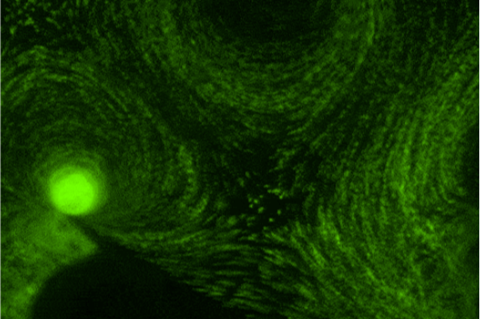
One of the most difficult steps in creating diagnostic tests is purifying samples to remove unwanted particles while concentrating biomarkers of interest. Due to the specific wavelengths of vibrations used to create these whirlpools, they efficiently trap cells, bacteria and other larger bioparticles found in saliva while leaving antibodies and viruses free to flow forward through multiple biosensing chambers.
Created by Tony Jun Huang, the William Bevan Distinguished Professor of Mechanical Engineering and Materials Science at Duke, and his Acoustofluidics Lab, they represent the first step in a new single-chip diagnostic prototype that can detect viral RNA and a full spectrum of antibodies to enhance our ability to navigate and neutralize future pandemics.
READ MORE: Nanorobot hand made of DNA grabs viruses for diagnostics and blocks cell entry
READ MORE: New method builds fluorescent nanotubes to detect bacteria and viruses
CITATION: “Rapid and Comprehensive Detection of Viral Antibodies and Nucleic Acids via Acoustofluidic Integrated Molecular Diagnostics Chip: AIMDx.” Jiao Qian, Jianping Xia, Samantha Chiang, Jessica F. Liu, Ke Li, Feng Li, Fang Wei, Mohammad Aziz, Yong Kim, Vinson Go, James Morizio, Ruoyu Zhong, Ye He, Kaichun Yang, Otto O. Yang, David T. W. Wong, Luke P. Lee, and Tony Jun Huang. Science Advances, 2025.






No comments yet