

Applied Microbiology International’s 2026 Member Survey paints a picture of an organisation with strong foundations, a genuinely global reputation, and a highly engaged membership community, particularly among early-career microbiologists.
Yet the findings also reveal a challenge shared by many modern scientific societies: how to transform broad interest and goodwill into sustained participation, visibility, and long-term belonging.
How do our members see us?
Applied Microbiology International’s 2026 Member Survey paints a picture of an organisation with strong foundations, a genuinely global reputation, and a highly engaged membership community, particularly among early-career microbiologists.
Yet the findings also reveal a challenge shared by many modern scientific societies:
How to transform broad interest and goodwill into sustained participation, visibility, and long-term belonging?
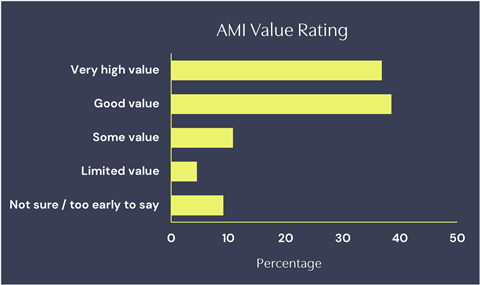
At the headline level, the results are very positive. Around three-quarters of respondents rated AMI membership as “good” or “very high” value, while 90% said they would recommend membership to colleagues. Members consistently described AMI as credible, supportive, inclusive, and mission-driven. The organisation’s vision - that applied microbiology can help solve some of the world’s greatest challenges - is widely recognised and strongly supported.
However, the survey also highlights several areas requiring attention. Members are not calling for AMI to fundamentally change direction. Instead, they are asking for clearer pathways into the organisation, greater awareness of existing opportunities, stronger regional accessibility, and more targeted support for students and early-career researchers. In many cases, the challenge is not the absence of value, but ensuring members can easily see, access, and benefit from what already exists.
Early-career excellence
One of the clearest findings was the exceptionally strong participation from early-career microbiologists. More than a third of respondents identified as early-career professionals, while nearly half of all respondents fell into either student or early-career categories when combined.
This level of engagement is notable. In many membership organisations, students and early-career members can be among the least likely groups to participate in surveys. In this survey, they emerged as one of the most active and vocal groups.
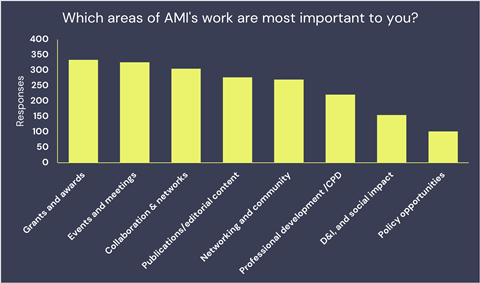
Their feedback was remarkably consistent. Early-career members want mentorship opportunities, clearer career development pathways, access to grants and funding, more opportunities to volunteer or contribute, and practical support for publishing, placements, and professional development.
Many respondents also expressed uncertainty about how to become more involved in AMI activities. This was not due to lack of enthusiasm, but instead, comments frequently referred to time pressures, uncertainty about where to start, and difficulty navigating available opportunities.
“The findings suggest that early-career microbiologists do not simply want to consume content or attend events; they want to participate, contribute, and build professional identities within the AMI community. This creates a major opportunity.”
By developing a clearer member journey - from student to early-career researcher, through to leadership and advisory roles - AMI should be able to significantly strengthen long-term retention and deepen member engagement. Proposed initiatives such as mentorship programmes, clearer volunteer pathways, targeted grants, and structured career-development resources directly reflect the needs identified in the survey.
Global networks
Another defining feature of the survey is AMI’s international reach. Africa represented the single largest regional block of respondents, followed by Asia-Pacific, the UK, and continental Europe. The findings reinforce the extent to which AMI is already recognised as a global organisation rather than simply a UK-based society with overseas members.
Importantly, this international presence is not passive. Respondents from Africa and Asia-Pacific frequently described strong feelings of connection to the AMI community and highlighted the value of international recognition, grants, and professional networks.
At the same time, the survey revealed clear regional differences in how members experience accessibility and value.
Members in lower and middle-income regions were significantly more likely to mention membership costs, limited access to travel funding, grant eligibility barriers, and difficulties engaging with activities scheduled in UK or European time zones.
These findings do not undermine AMI’s global reputation; rather, they reflect the growing expectations of an increasingly international membership base.
Room to improve
Respondents suggested a range of practical improvements, including growing the number of regional ambassador networks, more time-zone-friendly webinars, international student chapters, more regionally relevant journal and magazine content, and partnerships with universities and local scientific organisations.
There was also interest in expanding communication methods beyond traditional channels. While LinkedIn and email newsletters remain dominant, some respondents highlighted interest in more informal or region-specific platforms such as Slack, WhatsApp groups, and Chinese social media channels.
The survey further demonstrated the importance of visibility and communication in shaping member satisfaction.
Although overall satisfaction levels were high, many respondents who rated membership as “limited value” or said they were “not sure” about its value had one thing in common: they were often unaware of the full range of benefits available.
Similarly, a large proportion of members reported limited engagement with activities over the previous year, but this did not necessarily indicate disengagement from AMI’s mission or objectives. Instead, members frequently described practical barriers, including lack of time, uncertainty about how to participate, and limited awareness of opportunities.
Reading The Microbiologist Magazine emerged as the most widely accessed membership benefit, underlining the publication’s continuing importance as a visible and valued touchpoint between AMI and its members.
The findings suggest that improving onboarding and communication could unlock substantial additional engagement.
Recommendations emerging from the survey include creating a dedicated “Start Here” hub for new members, expanding automated onboarding communications, using personalised prompts to encourage use of under-accessed benefits, and developing clearer signposting around grants, volunteering, and participation opportunities.
How do we compare?
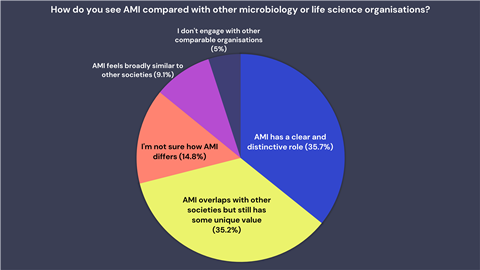
There is also evidence that AMI’s distinctiveness becomes clearer the more actively members engage.
Among highly involved members, for example, particularly those serving on advisory groups, participating in editorial activities, or accessing grants and professional development programmes, AMI was often described as uniquely supportive, mission-driven, and community-focused.
By contrast, members with lower levels of engagement were more likely to view AMI as broadly similar to other scientific societies.
This highlights the importance of being clear and consistent with the narrative and positioning of AMI’s vision, mission and values.
The survey indicates that AMI’s differentiation is strongest when members experience its culture directly through international collaboration, volunteering, publishing, or networking. Increasing access to these experiences may therefore be as important as traditional marketing in strengthening long-term member loyalty.
The findings also reflect a degree of continuity and positive change within the organisation.
Most respondents felt the 2022 transition from SfAM to AMI successfully reflected the organisation’s broader ambitions and international role.
Rather than resistance to change, these comments often reflected a desire to preserve continuity of culture and connection as the organisation evolves.
Ultimately, the 2026 survey presents a highly encouraging picture. AMI is clearly seen as a respected and trusted organisation with strong advocacy, a genuinely international membership, and a compelling mission rooted in the real-world impact of applied microbiology.
“The challenge ahead is not one of relevance or demand. Instead, it is about accessibility, visibility, and participation: ensuring that members across different career stages, regions, and backgrounds can easily understand how to engage, where to contribute, and how AMI can support their professional journeys.”
If AMI succeeds in making those pathways clearer and more accessible, the survey suggests the organisation is exceptionally well positioned not only to grow its membership, but to strengthen its role as a truly global community for applied microbiology.





No comments yet