
Antimicrobial resistance (AMR) is one of the most critical global health challenges, according to the World Health Organization (WHO). AMR also threatens food safety, animal health, and economic development. Addressing this challenge requires coordinated international research efforts and continued investment in innovative scientific approaches.
AMR development across different ecosystems is complex. Antibiotics and climate change continue to shape microbial ecosystems. Researchers increasingly recognise the importance of understanding resistant pathogens, but also the wider microbial communities that influence human health and disease. In particular, the human gut microbiota has emerged as a critical area of investigation in the fight against AMR.
Understanding AMR in the context of the gut microbiome
The gut is the body’s largest reservoir of organisms resistant to antimicrobial drugs because its dense microbial communities (inoculum effect) enable (i) the dilution of drug effects due to the amount of available drug targets and (ii) intense horizontal gene transfer - especially conjugation - driven by abundant mobile genetic elements such as plasmids, transposons, and integrons. When the microbiota is disrupted or modulated by antibiotics, diet and other lifestyle-related aspects, infections, or medical interventions, these ecological shifts can either suppress resistance or create conditions that favour the expansion and exchange of resistance genes across species. This is a constantly adapting evolutionary bottleneck for the bacterial community. This bottleneck creates conditions that shape the community composition and the emergence and persistence of resistant organisms. Despite advances in microbiota science, understanding how these communities dynamically respond to antibiotic exposure or inflammation within physiologically relevant environments and systems remains a major scientific challenge.
“Conventional models cannot fully capture host–microbe interactions”
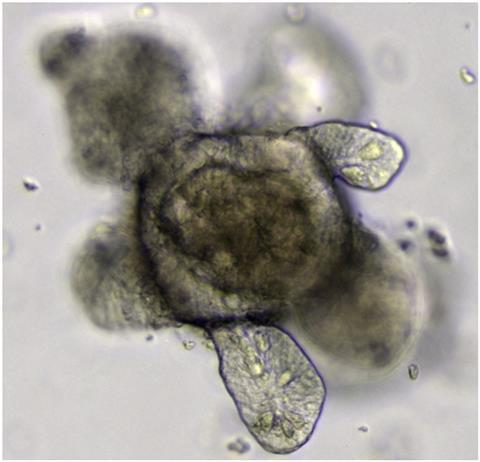
Traditional in vitro approaches often fail to fully replicate the complexity of host–microbiota interactions. This has driven increasing interest in advanced experimental systems such as organoids and organ-on-chip platforms, which offer more representative models of human biology and infection.
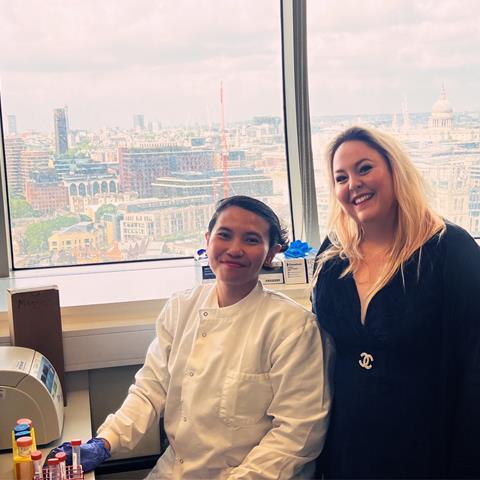
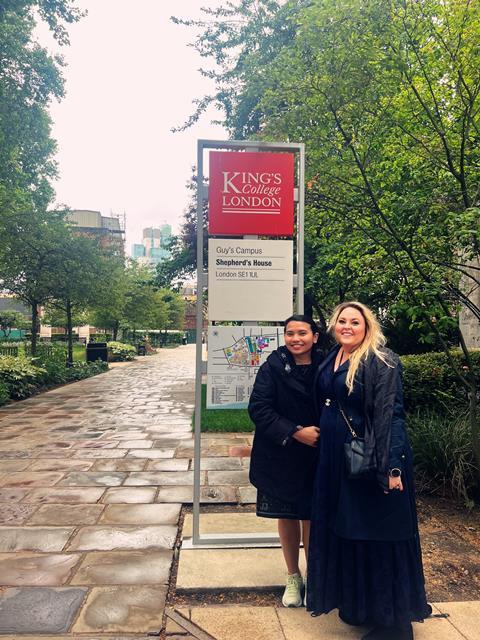
To investigate this topic, a short-term academic research exchange was conducted at the Centre for Host–Microbiome Interactions, King’s College London, from 18–22 May 2026. The program focused on research and scientific exchange in microbiome science, organoid systems, organ-on-chip technology, and AMR research. The program was undertaken by doctoral researcher and clinical microbiologist Dr. Ni Luh Putu Harta Wedari from the Institute of Medical Microbiology, University of Zurich, under the supervision of Dr. Lindsey Ann Edwards, a Principal Investigator at the Centre for Host–Microbiome Interactions, the PROMISE Feacal Microbiota Transplant Program Research Director, and Lead of R-BiOME. Dr. Edwards is an internationally recognised expert in antimicrobial resistance, translational microbiology and host–microbe interactions.
“Understanding microbial community responses is essential for addressing antimicrobial resistance in the gut”
Bridging the gap with organoid and organ-on-chip technologies
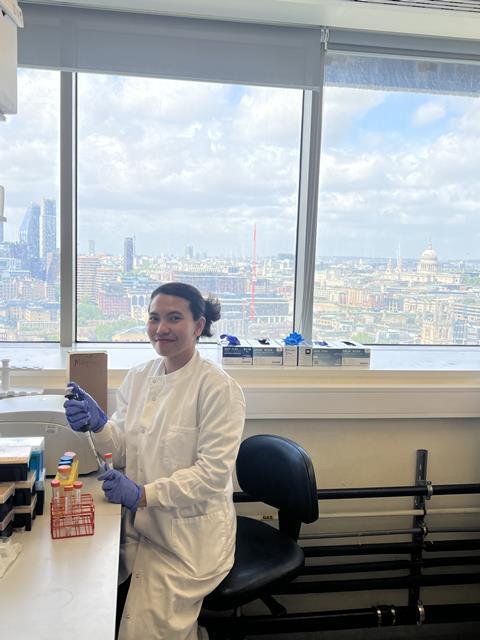
The primary aim of the exchange program was to gain hands-on exposure to advanced translational models that will improve the study of microbial dynamics under antibiotic selection pressure.
Organoid systems are three-dimensional cellular models derived from primary (human or animal) cells that mimic the architecture and function of tissues. These systems provide powerful platforms to investigate host–microbiota interactions under controlled physiological conditions. Thereby, for researchers working in clinical microbiology and infectious disease, these technologies offer exciting opportunities to bridge the gap between laboratory experimentation and human disease processes.
During the exchange program, training activities included observation of experimental workflows, participation in laboratory discussions, and engagement with ongoing microbiota and AMR research activities within the host laboratory. Emphasis was placed on translational approaches relevant to anaerobic gut bacteria and microbial community analysis.
The experience provided valuable insight into how advanced experimental systems can be applied to better model microbiome disruption, microbial resilience, and antimicrobial resistance mechanisms.
“Organoid models enable more physiologically relevant modelling of microbial behaviour”
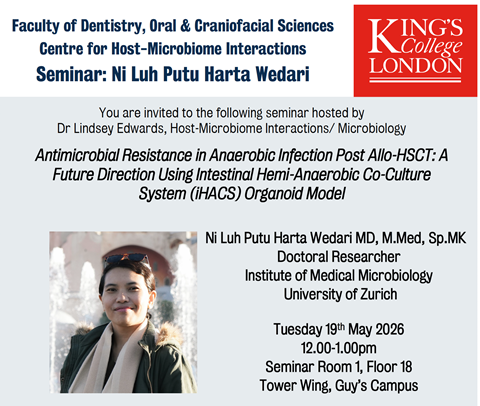
During the visit, Dr. Wedari had the opportunity to present a seminar outlining the future direction of her doctoral research. The seminar was attended by members of the Organoid Research Interest Group (ORIG), including experts in organoid biology and related fields. Through this opportunity, she received valuable feedback, constructive comments, and insightful suggestions that helped refine her research objectives, strengthen her experimental approaches, and promote Applied Microbiology International.
Dr. Wedari delivered a seminar outlining the future direction of her doctoral research, which focuses on the development and application of the intestinal hemi-anaerobic co-culture system (iHACS) organoid model.
Strengthening translational microbiology research
The exchange was enabled as an ongoing doctoral research project performed within the MD-PhD program of the University of Zurich. Dr. Wedari investigated AMR and the community dynamics of anaerobic gut bacteria under antibiotic selection pressure.
By engaging directly with an internationally recognised research group, the program enabled scientific exchange across disciplines and institutions while supporting methodological development in translational microbiology.
The collaborative environment at King’s College London also highlighted the importance of interdisciplinary research in addressing global health problems such as AMR. Integrating microbiology, bioengineering, clinical science, and systems biology is increasingly essential for developing effective strategies to combat resistant infections and microbiota-associated disease.
International collaboration and scientific exchange
Beyond technical training, the program also emphasised the value of international scientific collaboration. Developing a partnership between the University of Zurich and King’s College London reflects a broader effort to strengthen global cooperation in microbiome and microbiota science and AMR research. The international networking and scientific engagement of this visit was supported through the role of being a Global Ambassador for Applied Microbiology International (AMI), and the University of Zurich. The visit provided opportunities to promote knowledge exchange across institutional and national boundaries while strengthening connections within the international microbiology community.
“I am grateful for the generous support of the AMI program”
“Many thanks to Dr. Edwards for hosting us despite her busy schedule, this is greatly appreciated and certainly not taken for granted.” Dr. Wedari added.
The project aligns closely with the mission of Applied Microbiology International to advance microbiological science for global benefit through research collaboration, scientific dissemination, and capacity building.
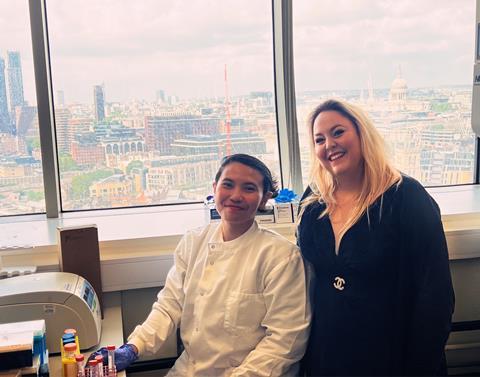
Dr Lindsey Ann Edwards’ leadership within major international microbiome and AMR initiatives, including the R-Biome Antimicrobial Resistance Consortium and multiple European collaborative networks, provided an ideal environment for advanced training and scientific exchange.
Long-term impact
The long-term impact of this training extends beyond a single research visit and training. Exposure to advanced experimental methodologies will strengthen future doctoral research by enabling more physiologically relevant modelling of gut microbial dynamics under antibiotic pressure. The experience will also enhance the ability to contribute to clinically relevant antimicrobial resistance research and support future work aimed at improving strategies for microbiome preservation and infection management.
As AMR continues to evolve as a global crisis, developing innovative research models and strengthening international collaboration will remain essential. The AMI support enables combining methodological training, translational science, and global scientific engagement represent an important investment in the future of microbiology research. The integration of microbiome science, organoid technology, and antimicrobial resistance research demonstrates how collaborative scientific efforts can contribute to advancing both academic discovery and global health outcomes.
Gratitude for professional development support from AMI
This opportunity was made possible through the Professional Development Support Grant from Applied Microbiology International (AMI), whose commitment to advancing microbiological science and supporting early-career researchers continues to foster meaningful international collaboration and scientific development. The support provided by AMI has enabled valuable knowledge exchange, advanced methodological training, and strengthened global engagement in antimicrobial resistance and microbiome research.
This research also contributed directly to United Nations Sustainable Development Goal 3 (Good Health and Well-being) by supporting research into infectious disease mechanisms and antimicrobial resistance. It also reflects Sustainable Development Goal 17 (Partnerships for the Goals) through the development of international collaboration, e.g., between Switzerland and the United Kingdom.
Dr. Wedari is deeply committed to promoting diversity, equity, and inclusion in all aspects of academic and professional work. As a Doctoral Researcher and Global Ambassador of Applied Microbiology International, Dr. Wedari actively supports inclusive scientific collaboration that values diverse perspectives across geography, gender, and career stage. Research in antimicrobial resistance and microbiome and microbiota science benefits greatly from international and interdisciplinary engagement, and Dr. Wedari aims to contribute to environments where equal opportunity and accessibility in science are prioritised.



No comments yet