
On 18th June 2026, the annual Letters in Applied Microbiology Early Career Scientist Research Symposium (LAMECS) returned for its fifteenth year. This year the Symposium took place at the Manchester Metropolitan University Business School, and brought together almost 100 delegates for a day of scientific presentations, posters, careers talks, and many opportunities for discussion and networking.
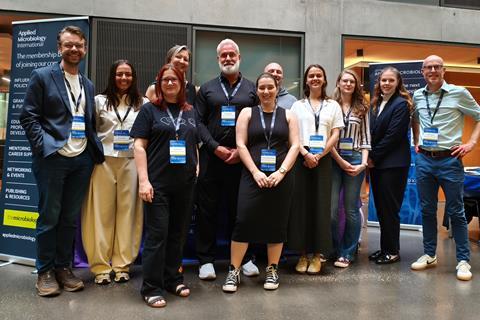
LAMECS is a highlight of the calendar for many early career microbiologists who are looking for an introduction to showcasing their work at conferences and a chance to expand their networks within the field.
I was excited to attend LAMECS for the first time this year, and as I was welcomed by some of the organisers on the registration desk I could already feel how friendly and supportive an environment the Symposium would be. A few months prior I had joined the AMI team for an internship, and so I enjoyed taking some time to catch up with the team before everyone headed into the auditorium for the first talks of the day.
Microbes in space
Following a brief welcome from Conference Chair, Dr Terry Bilverstone, lecturer at The Open University, and AMI Chief Executive Dr Lucy Harper, LAMECS 2026 began with the keynote speech given by Dr Michael Macey.
Michael is a Senior Lecturer at The Open University and member of the AstrobiologyOU group, who research microbial life in extreme environments – both on earth, and on other planets!
He spoke about his group’s work on microbes in hypersaline environments, which can be considered analogous to the conditions present on early Mars.
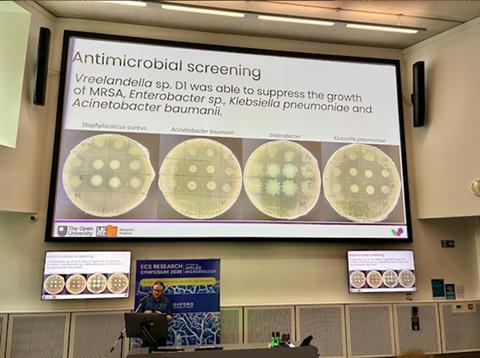
As well as offering insights into how microbial communities can survive in such harsh environments, their research also has applications in informing planetary protection protocols and for extraterrestrial biotechnology. I thought his talk was a fascinating and exciting insight into the extremes of microbial life, and very topical given recent media sensation around the launch of Artemis II and the hit film Project Hail Mary!
From human guts to volcanoes
We then moved into the first early career presentations of the day. Two sessions of 15-minute talks, one in the morning and one in the afternoon, put a huge range of research on display, from analysis of antimicrobial resistance in the gut microbiome, to the ecology of microbial communities in volcanic soils.
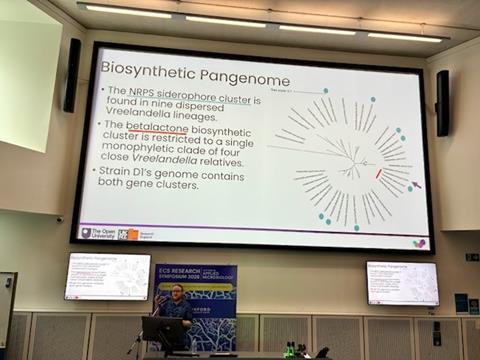
A personal highlight for me was a talk from James Lawrence, Northumbria University, about the first ever study of microbial communities found over 2 km deep under Antarctic glaciers. I was amazed that we can find active microbial communities in such an extreme environment, which is so isolated from the rest of the biosphere.
The prize for Best Talk was awarded to Ioanna Chatzigiannidou, Technical University of Denmark, who spoke about antimicrobial resistance in the infant gut microbiome, and how this is shaped by the interactions between the different microbes present. A particularly interesting finding was that colonisation of the infant gut with bifidobacteria inhibits the growth of resistance gene-rich species such as E. coli, and therefore that probiotic treatments may help to curb the spread of AMR in human guts.
MICROBIOLOGY ON TAP: Get full access to all The Microbiologist articles from just £2.17 a month
I was very impressed by the standard of research shared and by how engaging all the speakers were, and, as always, it was amazing to see the diversity of problems microbiologists across the world are tackling!
Posters and flash talks
During lunch – the food was excellent! – we had the opportunity to view over 30 posters presented by more early career scientists. I presented a poster on my own PhD work: I study the ecological and evolutionary dynamics of cystic fibrosis airway-associated pathogens.
My poster spurred some very interesting and insightful discussions, both with researchers working in similar areas and with those working on widely different aspects of microbiology, and so I am grateful to AMI for the opportunity to present.
The Poster Prize was awarded to Hayden Edwards, University of Nottingham, whose use of cartoon graphics to aid explanation of his work on engineering synthetic mimics of pathogenic fungi added an element of fun to the poster session.
The afternoon began with flash talks, where a selection of the poster presenters were challenged to summarise their research in under a minute. There were some impressively concise and creative synopses, including by the winner of the Flash Talks Prize, Nazia Patel, De Montfort University.
Get a hobby!
Following the second session of early career scientist talks and another opportunity for poster viewing and networking, we moved into a series of talks given by professionals who have taken their expertise in microbiology to sectors outside academia.
Particularly memorable was a talk from Cerys Maryan, an environmental scientist in local government, who spoke about the importance of investing time in your own wellbeing alongside your research – she encouraged us to ‘get a hobby!’ – and how relevant an academic skillset can be to alternative careers.
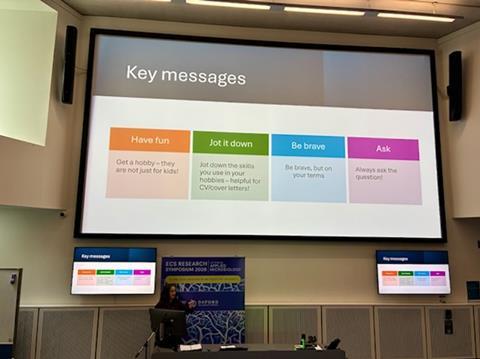
We also heard about pathways into governmental policy and scientific consultancy with the NHS. At an event like LAMECS, where so many delegates are Undergraduate, Master’s, or PhD students considering their next steps, it was really valuable to hear in depth about various alternative career options.
Wrapping up LAMECS 2026
We wrapped up the Symposium with closing remarks from the conference organisers, and by awarding the prizes. I was very happy to win a set of GIANTmicrobes plush toy keyrings in the AMI Policy Quiz competition (although I will admit that my previous internship with AMI may have given me an advantage in the quiz!).
The atmosphere of the Symposium throughout the day was fantastic – everyone was friendly, engaged, and enthusiastic, and it was an amazing chance for so many early career microbiologists to experience presenting their work.
A huge thank you to AMI for the generous support of their Student Travel Bursaries that allowed me and many others to attend LAMECS this year, and to all the conference organisers for putting on such a great event!
Jemima Swain is a PhD Student at the Welch Lab, Department of Biochemistry, University of Cambridge.
The next highlight in our packed events programme is a fascinating free webinar taking place today.
’The Nexus of Food Systems, Ecosystems and Human Health: Considering the More-Than-Humans who Co-produce Health’ will air today, 11am – 1pm EDT, as part of the Microbes and Social Equity 2026 Speaker Series and delivered by Dr Sarah Elton PhD, Assistant Professor, Social and Behavioural Health Sciences, University of Toronto and Eakin Chair in Critical Qualitative Health Research Methodology.
Topics
- Applied Microbiology International
- Be inspired
- Cerys Maryan
- Community
- De Montfort University
- Early Career Research
- Events
- Hayden Edwards
- Ioanna Chatzigiannidou
- James Lawrence
- Letters in Applied MIcrobiology
- Letters in Applied Microbiology Early Career Scientist Research Symposium
- Lucy Harper
- Michael Macey
- Nazia Patel
- Northumbria University
- Technical University of Denmark
- Terry Bilverstone
- UK & Rest of Europe
- University of Nottingham
- Young Innovators



No comments yet