
I am sincerely grateful to Applied Microbiology International (AMI) for awarding me the AMI Scientific Event Travel Grant, which enabled me to attend the Letters in Applied Microbiology Early Career Scientist Symposium (LAMECS 2026) held on 18 June 2026 in Manchester, United Kingdom. Receiving this support made it possible for me to participate in an international scientific meeting that would otherwise have been difficult to attend as an early-career researcher and doctoral student.
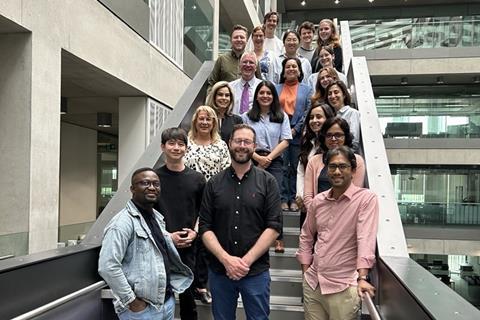
The symposium programme covered diverse areas of applied microbiology, including food microbiology, human health, environmental microbiology, industrial microbiology, and microbial ecology, through keynote lectures, poster sessions, flash presentations, exhibitions, and networking events. One of the highlights of the symposium was the keynote lecture by Dr. Michael Macey entitled “Hypersaline Frontiers: Analogue Environments and the Search for Habitability.”
The presentation demonstrated how microorganisms thrive in extreme hypersaline environments and how these systems can serve as analogues for early Mars. The lecture broadened my appreciation for the versatility of microbiology and its applications beyond traditional biomedical and environmental settings.
Poster presentation
At the symposium, I presented a poster entitled “Biofilm Phenotypic Diversity Among Clinical Clostridioides difficile Isolates.” This work was based on a multicomponent study involving two healthcare systems comprising 14 hospitals in Houston, Texas, conducted between 2017 and 2021. The study included 511 clinical C. difficile isolates obtained from adult hospitalized patients with C. difficile infection who received vancomycin monotherapy.
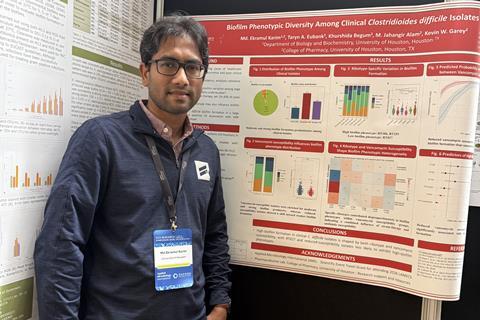
Our findings demonstrated that biofilm formation was highly prevalent, with 93% of isolates producing biofilm and approximately 80% exhibiting moderate-to-strong biofilm phenotypes. We observed that vancomycin-susceptible isolates had a higher probability of forming strong biofilms, whereas isolates with reduced vancomycin susceptibility were associated with weaker biofilm phenotypes.
In addition, a ribotype-dependent relationship between vancomycin susceptibility and biofilm formation was identified, with the hypervirulent epidemic strain RT027 clustering within reduced-susceptible, weak-biofilm states, while RT106 and RT255 were enriched among strong biofilm producers. These findings support a model in which biofilm-mediated persistence is influenced by both bacterial lineage and antimicrobial susceptibility.
Ready, set, network!
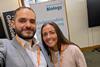
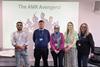
Presenting my research to an international audience provided an excellent opportunity to interact with fellow early-career scientists, graduate students, established investigators, and publishing professionals. The symposium fostered an open and supportive atmosphere that encouraged scientific discussion, networking, and the exchange of ideas.
I was able to establish new professional connections with researchers from several countries, learn about emerging methodologies, and identify potential opportunities for future collaborations. Engaging with scientists working in different disciplines also provided valuable insights into alternative experimental approaches and career pathways within microbiology.
Supportive grants
The AMI Travel Grant had a significant impact on my professional development. As a doctoral researcher, opportunities to present research abroad are invaluable for developing presentation skills, building professional networks, and gaining exposure to diverse perspectives within the global microbiology community.
MICROBIOLOGY ON TAP: Get full access to all The Microbiologist articles from just £2.17 a month
Participation in LAMECS 2026 expanded my scientific knowledge, enhanced my communication skills, and reinforced the importance of interdisciplinary and international collaborations in advancing microbiological research.
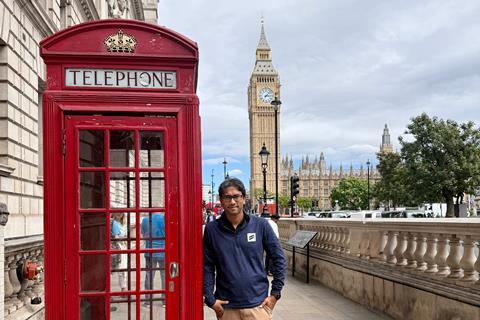
In addition to the scientific programme, I had the opportunity to experience several iconic cultural and historical landmarks in the United Kingdom, including the Parliament area and Tower Bridge in London, as well as Old Trafford Stadium, home of Manchester United. These experiences enriched my visit and provided a memorable balance between scientific engagement and cultural exploration.
Renewed enthusiasm
Participating in LAMECS 2026 reaffirmed my enthusiasm for pursuing translational microbiology research and represented an important milestone in my development as an early-career microbiologist. Sharing my research, interacting with scientists from diverse backgrounds and at different career stages, engaging with publishing professionals, and experiencing the rich scientific culture of the meeting reminded me why collaborative science is both rewarding and essential for advancing microbiological research.
I am deeply grateful to Applied Microbiology International for investing in the professional growth of young researchers and for making this experience possible through the Scientific Event Travel Grant. The symposium strengthened my commitment to advancing research on Clostridioides difficile biofilms and provided renewed momentum as I work toward completing my doctoral studies, publishing my findings, and exploring future career opportunities in microbiology.
Topics
- AMI Scientific Event Travel Grant
- Applied Microbiology International
- Be inspired
- Clostridioides difficile
- Community
- Early Career Research
- Events
- Letters in Applied MIcrobiology
- Letters in Applied Microbiology Early Career Scientist Research Symposium
- Md. Ekramul Karim
- Michael Macey
- UK & Rest of Europe
- University of Houston


No comments yet