
AMI Clean Water Advisory Group member Dr Kwanrawee Joy Sirikanchana outlines how her team has launched a major One Health project in north-eastern Thailand to address an overlooked question: How much does aquaculture contribute to AMR in shared water systems, and what does this mean for people, animals, and wildlife living around them?
Antimicrobial resistance (AMR) is accelerating globally, but its environmental dimensions remain among the least understood.
Our research team has recently launched a major One Health project in north-eastern Thailand to address an overlooked question: How much does aquaculture contribute to AMR in shared water systems, and what does this mean for people, animals, and wildlife living around them?
Our project title is “FarmAquaNet: A One Health framework to assess the risks of antimicrobial resistance in aquatic ecosystems in North-East Thailand and inform mitigation strategies”.
This 3-year project is co-funded by UKRI and Thailand Agricultural Research Development Agency (ARDA). The lead institutions are the University of Glasgow (UK) and Kasetsart University (Thailand), in collaboration with University of Stirling (UK), as well as Thailand institutions: Chulalongkorn University, Chulabhorn Research Institute, Mahasarakham University, and Chiang Mai University. This strong UK–Thailand partnership reflects Thailand’s growing commitment to science-driven aquaculture management and its leadership in One Health AMR research in the region.
Fish and antibiotics
Aquaculture is a vital food production sector across South-East Asia, supporting nutrition, livelihoods, and local economies. Yet, in many areas, fish are raised in open cages directly within rivers and reservoirs. Antibiotics delivered to fish through medicated feed often enter the surrounding environment immediately, without prior treatment. Across the region, farmers routinely use antimicrobials with unknown formulations or drugs developed for humans and terrestrial animals. Many prepare medicated feed without masks or gloves, increasing their own exposure.
Despite these concerns, the actual risks posed by environmental AMR from aquaculture have rarely been examined systematically through a One Health lens. Without understanding the relative contribution of aquaculture to the wider AMR burden in a shared water system, governments struggle to design effective mitigation strategies. Thailand is now taking a proactive role in addressing these knowledge gaps through collaborative research and evidence-based policymaking.
Tilapia farming
We focus on the Pao River watershed in north-eastern Thailand, a system where more than 12,000 tilapia cages operate year-round. Previous work from our team revealed that:
• antimicrobial use is variably regulated,
• farmers often select products based on availability rather than veterinary advice, and
• wildlife such as banteng (wild cattle) show unusually high levels of multidrug-resistant E. coli, suggesting a link between environmental contamination and AMR acquisition.
These observations form the core of our research question: Is current antimicrobial use in aquaculture driving AMR transmission across people, livestock, wildlife, and the environment? By studying this system, Thailand aims to develop sustainable aquaculture models that can serve as examples for other countries in the region.
One Health design
Our study uses a comprehensive One Health design combining environmental microbiology, genomics, field ecology, veterinary science, aquaculture, community and health science, and social science.
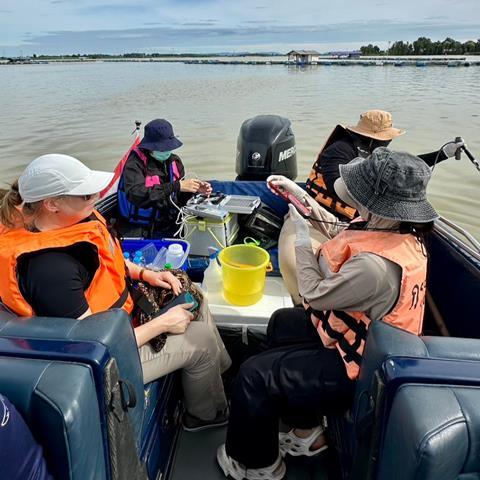
Tracing AMR sources in the watershed: In this project, we have activities including
o Collecting water and sediment samples upstream and downstream of fish cages in an irrigation dam.
o Analysis of antimicrobial residues to determine contamination gradients.
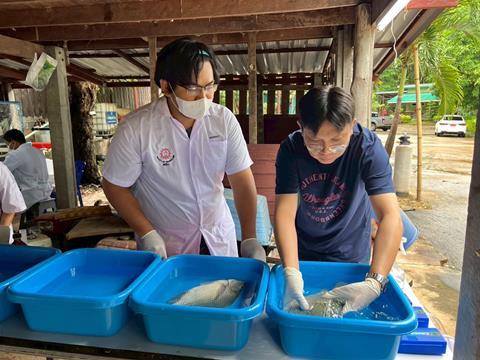
o Extended-spectrum β-lactamase (ESBL)-producing E. coli and Klebsiella are isolated from people, livestock, wildlife, fish, water and sediments.
o Whole-genome sequencing enables us to compare sequence types and resistance profiles across these groups.
Understanding antimicrobial use in aquaculture:
o We will interview farmers, observe treatment practices, and analyse the products they use.
o The quantity, quality, and type of antibiotics are evaluated.
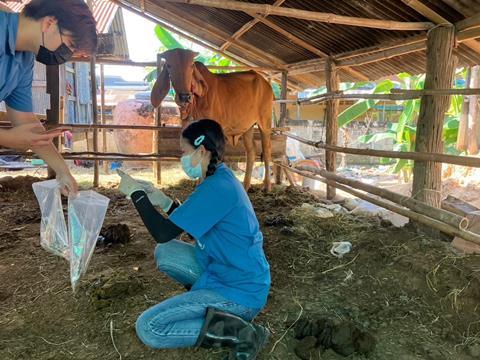
o We collect fecal samples from fish farmers to determine whether occupational exposure increases AMR carriage.
Risk mapping and identifying interventions:
o Human exposure pathways, i.e., drinking water, recreation, irrigation, are assessed through household surveys.
o We will integrate environmental, microbiological, and public health data to map AMR hotspots.
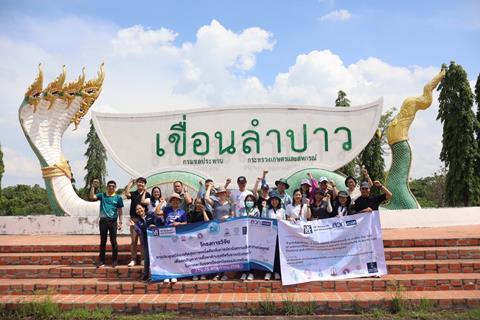
o Finally, we work with local authorities, health departments, and communities to co-develop feasible interventions. This collaborative process ensures that solutions are practical, culturally appropriate, and aligned with Thailand’s long-term sustainability goals.
Early findings
Although the project is ongoing, early findings are emerging:
• Evidence of ESBL-producing E. coli and Klebsiella in water downstream of each caging cluster.
• A wide variety of types and motivations for antimicrobial use in aquaculture, including the use of drugs not approved for fish.
Importantly, farmers and local authorities have expressed strong interest in improving practices, and many have already begun discussing feasible changes as part of our engagement activities.
Why does this matter?
AMR is a One Health issue, and river systems serve as major reservoirs and conduits for resistant bacteria and genes. When aquaculture introduces large quantities of antibiotics into shared waterbodies, the effects may extend far beyond fish farms, impacting people, communities, and ecosystems.
By quantifying these risks, our work will help policymakers target interventions where they are most needed. The final stage of this project will involve the co-development of such interventions.
These findings will also support Thailand’s ongoing efforts to strengthen sustainable aquaculture, protect public health, and serve as a regional model for AMR mitigation.
Dr Kwanrawee Joy Sirikanchana is a Senior Research Scientist at the Laboratory of Biotechnology, Chulabhorn Research Institute, Thailand. Find out more about AMI’s Advisory Groups.
Topics
- AMR in the Environment
- Antimicrobial Resistance
- Applied Microbiology International
- Aquaculture
- Asia & Oceania
- Bacteria
- banteng
- Be inspired
- Chiang Mai University
- Chulabhorn Research Institute
- Chulalongkorn University
- Clean Water
- Community
- Disease in marine aquaculture
- FarmAquaNet
- Healthy Land
- Kasetsart University
- Kwanrawee Joy Sirikanchana
- Mahasarakham University
- One Health
- Pao River watershed
- People News
- tilapia
- UK & Rest of Europe
- University of Glasgow
- University of Stirling





No comments yet