

Rivers are dynamic ecosystems driven by microbial processes that regulate carbon and nutrient cycling, organic matter decomposition, and oxygen consumption. Through the transformation of dissolved organic matter (DOM), microbial communities underpin many of the functions provided by freshwater ecosystems, from maintaining water quality and supporting aquatic food webs to sustaining aquatic flora and fauna. Despite their central role in river health, microbial processes remain mostly invisible in routine water quality monitoring programmes, which continue to focus primarily on physicochemical parameters.
Poor river health in the UK is driven by urban, industrial, and agricultural runoff as well as discharge of untreated sewage and wastewater, issues which are only exacerbated by increasing population, aging infrastructure and climate change (The Rivers Trust, 2024). In England, the Environment Agency (EA) is the primary regulator for assessing river health, although water companies, local authorities, research groups and citizen scientists also collect monitoring data. The EA routinely monitors chemical, ecological and hydromorphological indicators in accordance with water environment regulations. In designated bathing waters, the EA also monitors the faecal indicator bacteria Escherichia coli (E. coli) and intestinal enterococci, which are used to assess faecal contamination and the potential risk of gastrointestinal illness to bathers.
More recently, Section 82 of the Environment Act 2021 introduced a continuous water quality monitoring programme, requiring sewerage undertakers to monitor receiving waters upstream and downstream of storm overflows (combined sewer overflows, CSOs) and wastewater treatment works discharges using multiparameter water quality sondes. These sondes will provide continuous measurements of a limited set of physicochemical water quality parameters. While valuable for identifying changes in water quality, these measurements only provide indirect insight into the biological processes that underpin ecosystem function, leaving key ecological processes that sustain rivers as living ecosystems largely unaccounted for.

Traditionally, for compliance and operational water monitoring, water companies and environmental regulators monitor physical and chemical water quality parameters such as dissolved oxygen (DO), pH, turbidity, conductivity and nutrient concentrations, alongside a limited number of biological water quality parameters including faecal indicator organisms and macroinvertebrate surveys. While these parameters can tell you that a river has been impacted in some way, they provide limited insight into how these impacts affect the microbial processes that underpin ecosystem functioning.
One of the greatest challenges in freshwater monitoring is developing tools capable of assessing microbial ecosystem processes in real time. Increasingly, fluorescence-based measurements of DOM (fluorescent dissolved organic matter; FDOM) are being used to address this challenge. There are two main components of FDOM that are informative for understanding microbial processing: protein-like and humic/fulvic-like DOM.
Protein-like FDOM represents relatively labile, readily biodegradable organic matter and is commonly associated with microbial biomass, extracellular enzymes, algal production and sewage derived organic material. Because these compounds are rapidly utilised and transformed by microorganisms, protein-like fluorescence is often considered a marker of biologically available organic matter and microbial activity.
Humic-like FDOM represents a more recalcitrant fraction of the organic matter. These complex compounds are derived predominantly from terrestrial sources, soils and catchment runoff, although microbial transformation processes also contribute to their formation. Humic-like material is generally more resistant to biodegradation and persists longer within aquatic environments.
The relative abundance of protein-like and humic-like fluorescence can provide insight into both the source and processing state of DOM. For example, protein-like fluorescence is often associated with fresh organic inputs such as those from wastewater effluent, untreated and treated sewage, whereas stronger humic-like signals typically indicate greater terrestrial influence or more extensively processed organic matter.
Many organic molecules possess rigid aromatic ring structures containing conjugated systems that fluoresce when exposed to specific wavelengths of light. During fluorescence, energy is absorbed at one wavelength (excitation) and emitted at a longer wavelength (emission). These characteristic excitation-emission relationships allow specific components of FDOM to be identified and quantified.
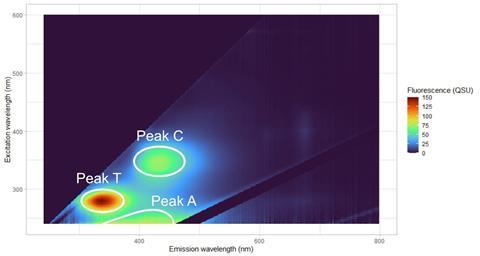
Tyrosine-like fluorescence (Peak B) and tryptophan-like fluorescence (TLF; Peak T) are protein-like fluorophores associated with the aromatic amino acids tyrosine and tryptophan. These fluorophores are typically characterised by excitation wavelengths around 275 nm with emission maxima occurring at approximately 310 nm and 340 nm, respectively. Humic-like fluorescence is represented by Peak C (ex 350 nm, emission peak maxima 420–480 nm) and Peak A (ex 260 nm, emission peak maxima 380–460 nm; Coble, 1996), both of which are associated with terrestrially derived and microbially transformed organic matter.
The use of TLF in water quality testing and monitoring as a marker of microbial processing is becoming increasingly popular, as it provides the strongest fluorescence signal of all aromatic amino acids. Protein-rich DOM from treated and untreated sewage and wastewater is rapidly aerobically biodegraded by microorganisms due to its accessibility, often leading to elevated Peak T fluorescence in affected waters. Numerous studies have reported relationships between TLF, organic pollution, and faecal contamination, highlighting how fluorescence measurements can provide valuable insight into underlying microbial ecosystem processes in freshwater systems. While many microorganisms contribute to TLF, some may contribute more strongly to the overall signal under certain conditions. E. coli has received particular attention in TLF-based water quality monitoring, as it is associated with faecal contamination, and has therefore been widely studied in relation to TLF-based water quality monitoring.
Additional fluorescent pigments can also be monitored to provide insight into ecosystem health and water quality. Chlorophyll-a fluorescence is widely used as an indicator of algal biomass and primary productivity, while phycocyanin fluorescence can be used to assess cyanobacteria abundance and provide early warnings of eutrophication and the development of harmful algal blooms.
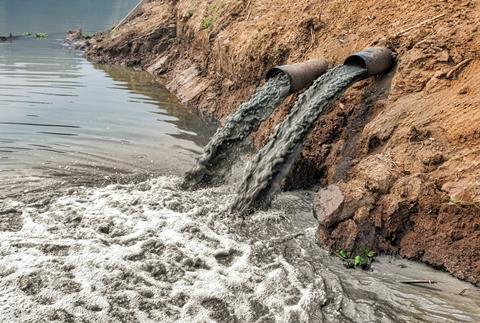
Biochemical Oxygen Demand (BOD) is a well-established method, originating in the early 1900s, used to assess the efficacy of wastewater and sewage treatment processes. The standard BOD test is carried out over a five-day period (BOD5), during which sealed water samples are incubated at 20 °C. After incubation, DO measurements are used to calculate the amount of oxygen consumed by microorganisms during the degradation of organic matter. BOD remains one of the most widely used indicators of biodegradable organic pollution and is routinely used to assess compliance with environmental regulations.
Despite its widespread use, BOD has a critical flaw: its five-day incubation (or adapted three-day test) means results arrive long after short-lived pollution events, such as sewage discharges, have passed — closing the window for preventative action. This has driven demand for sensing approaches that bridge the physical, chemical, and biological gaps in real time. Fluorescence measurements address this need by providing results within seconds, enabling continuous in-situ monitoring, and offering real-time insight into biodegradable organic matter and microbial activity.
How are we addressing the need for biological markers in river health?
To test fluorescence as a real-time indicator of microbial ecosystem processes, we have deployed novel in-situ optical sensors developed by Chelsea Technologies, capable of continuously monitoring tryptophan-like (Peak T) and coloured dissolved organic matter (Peak C) fluorescence using narrow-band excitation and dedicated emission detection wavelengths. Field deployment of fluorescence sensors has long been limited by an inability to correct in situ for optical attenuation (Beer-Lambert Law), restricting reported fluorescence to site-specific relevance rather than quantitative, comparable measurements. Our key innovation is the simultaneous measurement of absorbance and turbidity to correct for this attenuation in situ - improving accuracy and detection range across varying environmental conditions and, crucially, enabling quantitative reporting. Fluorescence outputs are standardised by converting relative fluorescence units (RFU) to quinine sulphate units (QSU), allowing direct comparison of measurements between sites, rivers, and timepoints.
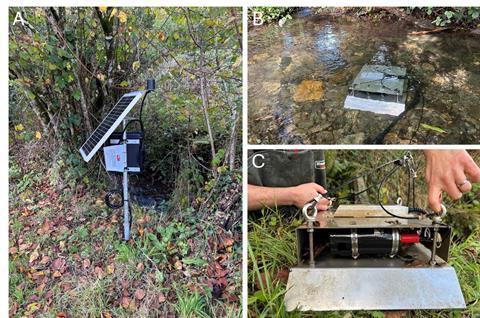
The fluorescence sensors form part of a wider ‘sensing network’ developed with WATR, specialists in telemetry-based environmental monitoring. Sensor measurements are collected every 15 minutes across a series of ‘sensing nodes’ and transmitted to a cloud-based platform, enabling remote access to water quality data in real time.
Regular spot sampling is undertaken alongside continuous sensor measurements to contextualise and validate sensor readings. Water samples are analysed using laboratory-based fluorescence spectroscopy, where full excitation-emission matrices (EEMs) are generated using a Horiba Aqualog spectrofluorometer. A technique known as peak picking is then used to extract fluorescence intensities at the excitation and emission wavelengths targeted by the sensors, enabling direct comparison between in situ and laboratory-derived measurements. Further to fluorescence spectroscopy, water samples are also analysed for total, organic and inorganic carbon, nutrient concentrations (including ammonia, nitrate, nitrite and phosphate), faecal indicator organisms (E. coli, total coliforms and enterococci), heterotrophic bacterial counts and BOD₅. Together, these measurements provide important context for interpreting sensor observations. In addition, DNA is extracted from samples to investigate how microbial community composition and dynamics vary across catchment sites and throughout time.
The high frequency of sensor measurements provides novel insight into the spatiotemporal dynamics of freshwater ecosystems. Unlike traditional spot sampling approaches, which provide only periodic snapshots of river health, continuous fluorescence monitoring allows rapid changes in organic matter composition and microbial processing to be observed as they occur. This allows us to capture the impact of point source events (such as sewage/wastewater discharges) which are likely to be missed by spot sampling alone, as well as longer-duration diffuse source pollution events (such as agricultural runoff).
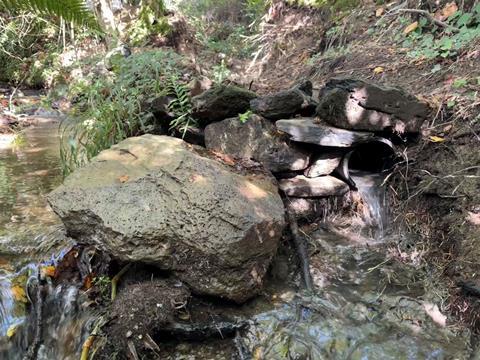
Drawing on The Rivers Trust’s catchment expertise, our ‘sensing nodes’ are positioned along our demonstrator catchment to isolate different river impacts. One at the headwater, others isolating a sewage treatment works and a final ‘node’ following sewage treatment, large stretches of agricultural land, road runoff, and septic tank inputs. Relative comparisons between downstream sites and our ‘dynamic baseline’ headwater allow changes associated with sewage/wastewater inputs, agricultural runoff and other environmental challenges to be identified whilst accounting for natural, rhythmic river variability.
As river ecosystems face increasing pressure from population growth, ageing infrastructure and climate change, there is growing recognition that monitoring programmes must move beyond measuring pollution alone and begin assessing its consequences on freshwater biology. Fluorescence-based sensing offers an opportunity to observe microbial ecosystem processes in real time, providing a bridge between traditional physicochemical monitoring and more resolved, intensive laboratory-based biological analyses.
The research project included in this article was funded by the UKRI Natural Environment Research Council NE/Z503630/1.
Acknowledgements; John Attridge, James Kirkbride, Simon Browning, Lyndon Smith, Izaak Stanton, Richard Haigh, Rosie Perrett, Matt Coombs, Smahan Benaiss.
Further reading





No comments yet