
Antimicrobial resistance is one of the most urgent threats to global public health. In clinical practice, antibiotic treatment sometimes fails even when bacteria are classified as susceptible by conventional antimicrobial susceptibility testing.

One important reason is that traditional tests mainly rely on the minimum inhibitory concentration, or MIC, and may overlook bacterial subpopulations that survive antibiotic exposure, including persistent, tolerant, and heteroresistant populations. These hidden populations can survive under drug pressure and may contribute to treatment failure and the later emergence of stable resistance.
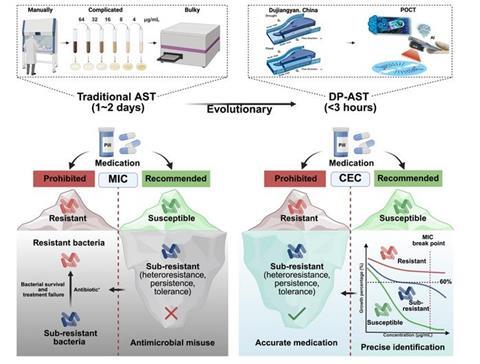
To address this challenge, a research team led by Professor Bi-feng Liu developed a deep learning-based microfluidic rapid phenotypic AST system, named DP-AST. The system was inspired by the “six-four water diversion” principle of the ancient Dujiangyan irrigation system in China, which has long been known for its efficient and self-regulated water distribution. By translating this principle into microfluidic chip design, the team created a hand-driven concentration-gradient generator that can automatically produce multiple antibiotic concentrations in a portable format. The paper is published in Science Bulletin.
Bacterial micro-enrichment area
Unlike many existing rapid AST platforms that rely on colorimetric reagents, professional instruments, or high-end microscopes, DP-AST uses bacterial micro-enrichment area as a phenotypic readout. This design enables the system to calculate bacterial growth activity and generate concentration-effect curves, which describe how bacterial growth changes across different antibiotic concentrations.
By combining MIC, growth activity, and concentration-effect curve analysis, DP-AST provides a more refined view of bacterial drug response and can identify sub-resistant bacterial populations that are difficult to detect using conventional MIC-based testing alone.
The platform also integrates smartphone-based signal acquisition with deep learning image analysis. Bacterial growth signals can be captured using a portable smartphone imaging setup, and the deep learning algorithm automatically analyzes the images and classifies the drug susceptibility results. This combination improves portability and supports low-instrumentation testing, which is especially important for resource-limited clinical settings where access to large laboratory instruments may be restricted.
Biological mechanisms
Beyond platform development, the team further investigated the biological mechanisms underlying sub-resistance. Using integrated proteomic and transcriptomic analyses, they compared a sub-resistant Escherichia coli strain with a sensitive strain.
Although the two strains showed highly similar genomic sequences, they displayed marked differences in gene and protein expression.
The sub-resistant strain showed increased expression of several antibiotic response-related genes and proteins, including outer membrane protein OmpA and efflux system-related components, suggesting that expression-level regulation may help bacteria survive antibiotic pressure even without clear conventional resistance markers.
Intracellular acid regulation
Further multi-omics analysis indicated that many of the transcriptional and proteomic changes in the sub-resistant strain were associated with intracellular acid regulation. The team experimentally identified gadE, a central regulator of acid tolerance in E. coli, as an important factor involved in bacterial survival under antibiotic stress. This finding suggests that acid tolerance-related regulatory networks may contribute to bacterial adaptation during antibiotic exposure and provides a new direction for studying sub-resistance mechanisms.
MICROBIOLOGY NEWS: Register with The Microbiologist for more free articles
Overall, this study establishes a portable, AI-assisted microfluidic platform for rapid phenotypic antibiotic susceptibility testing. DP-AST can provide susceptibility results within 3 hours and, more importantly, enables multi-parameter profiling for the identification of hidden sub-resistant bacteria. The work offers a new technical strategy for more precise antibiotic treatment, improved resistance-risk assessment, and future studies on the early evolution of antimicrobial resistance.





No comments yet