
A new research paper was published in Volume 18 of Aging on August 12, 2026, titled “Indy reduction decreases aging-related dysbiosis in Drosophila.”
The study was led by first author Danielle N. A. Lesperance from the University of Connecticut. Corresponding authors Blanka Rogina and Nichole A. Broderick are affiliated with the University of Connecticut Health and Johns Hopkins University, respectively. Broderick is also affiliated with the University of Connecticut.
The Indy gene—short for “I’m not dead yet”—encodes a plasma membrane citrate transporter in Drosophila melanogaster. Previous research has shown that reducing Indy activity can extend lifespan and preserve metabolic and intestinal health in flies. Because aging is also associated with disruption of the gut microbiota, the researchers investigated whether changes in intestinal microbes contribute to the longevity effects associated with reduced Indy activity.
The researchers compared control flies with Indy heterozygous flies under conventional conditions and axenic conditions, in which microbes were absent. They also examined bacterial load and microbiota composition and performed RNA sequencing of the midgut to investigate molecular pathways connecting Indy, the microbiota, intestinal homeostasis, and aging.
Emerging difference
One of the clearest differences emerged as the flies aged. At 40 days, Indy heterozygous flies had a roughly 10-fold lower bacterial load than age-matched controls. Microbiota composition also differed between the groups, and sequencing analyses showed greater microbial diversity in flies with reduced Indy activity. These findings suggest that Indy reduction limits some of the age-associated microbial changes that characterize dysbiosis in flies.
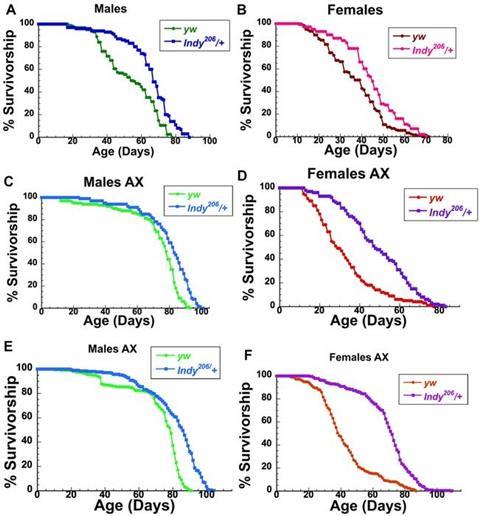
The longevity experiments revealed an important distinction. Indy heterozygous flies lived longer than controls even when raised without microbes, demonstrating that the microbiota was not required for the lifespan-extending effect of Indy reduction. However, removing microbes enhanced longevity under some experimental conditions, suggesting that interactions between Indy-dependent metabolism and the microbiota may still contribute to the overall aging phenotype.
The researchers also investigated the JAK/STAT signaling pathway, which helps regulate intestinal epithelial renewal but can become chronically activated during aging as microbial load and intestinal damage increase. Reduced Indy activity was associated with lower expression of the cytokine-related genes Upd2 and Upd3 in young conventionally raised flies and reduced Stat92E expression in older flies. Other components of the pathway did not show significant changes under the same conditions.
Two pathways
Further evidence came from genetic experiments involving Upd3. Flies carrying reductions in both Indy and Upd3 lived longer than single heterozygous flies, particularly in females, suggesting that the two pathways have partially overlapping but also independent effects on longevity. The authors propose that reduced bacterial overgrowth and altered microbial diversity may contribute to longevity at least partly through JAK/STAT-related mechanisms.
“In summary, here we show that Indy reduction prevents age-related dysbiosis, which typically is associated with an increase in bacterial load and decrease in microbiota diversity.”
The findings add another layer to the relationship between metabolism, intestinal health, and longevity. Previous work has linked Indy reduction with preserved mitochondrial function, reduced reactive oxygen species, improved intestinal stem cell homeostasis, and maintenance of gut integrity. The current study suggests that reduced age-associated dysbiosis may be another component of this broader phenotype.
Next steps
Importantly, the findings come from Drosophila and should not be interpreted as evidence that reducing the human Indy homolog would produce the same microbiota or longevity effects in people. The authors note that the mammalian homolog of Indy, SLC13A5, also functions as a citrate transporter, providing a framework for further investigation of how metabolism and host-microbe interactions influence aging across organisms.
MICROBIOLOGY NEWS: Register with The Microbiologist for more free articles
Overall, the study suggests that reducing Indy activity helps preserve intestinal homeostasis during aging through interconnected metabolic, microbial, and signaling mechanisms. Although changes in the microbiota are not necessary for Indy-associated lifespan extension, reduced bacterial accumulation and greater microbial diversity may contribute to healthier intestinal aging and longer lifespan in flies.
Topics
- aging
- Bacteria
- Blanka Rogina
- Danielle N. A. Lesperance
- Disease Treatment & Prevention
- Drosophila melanogaster
- dysbiosis
- Gut Microbiome
- Healthy Land
- host genetics
- Indy reduction
- Johns Hopkins University
- Nichole A. Broderick
- One Health
- plasma membrane citrate transporter
- Research News
- University of Connecticut
- USA & Canada





No comments yet