
Emory University researchers have provided the first proof-of-concept in a nonhuman primate model for eliminating HIV-infected cells with venetoclax, a clinically approved medication for cancer.
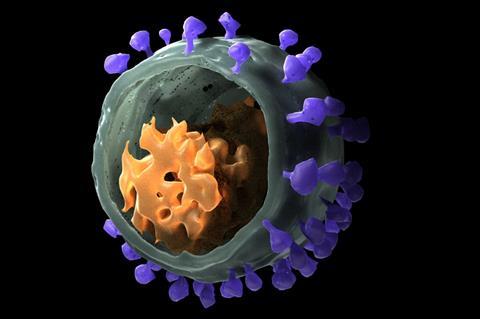
Venetoclax effectively targets and blocks Bcl-2, a protein that not only regulates whether cells live or die but also promotes the survival of cancer cells. Similarly, Bcl-2 is a culprit in sustaining HIV cell reservoirs. The research team determined venetoclax is also effective at reducing simian immunodeficiency virus (SIV) reservoir levels in vivo when given as part of a combination treatment for HIV.
The study results are reported in Nature Microbiology, and two clinical trials are under way to test venetoclax in people living with HIV.
“Eliminating the viral reservoir is a priority in the pursuit of a cure for HIV,” says Mirko Paiardini, PhD, senior author. “Despite many attempts, there hasn’t been a therapeutic strategy able to do this. Our study, however, offers hope for accelerating the timeline to cure by using an approved medication.”
Study background
Paiardini is chief of the Microbiology and Immunology Division at the Emory National Biomedical Research Center (ENBRC) as well as a professor of Pathology and Laboratory Medicine at the Emory School of Medicine (SOM). He is also the contact principal investigator for ERASE HIV, a NIH-funded Martin Delaney Collaboratory for HIV Cure Research. This collaboratory is characterizing key immune system functions that control persistent HIV infection and designing immune-based therapies to eliminate or control the virus in the absence antiretroviral therapy (ART).
Paiardini and his research team sought to determine if inhibiting Bcl-2 with venetoclax could kill infected cells in a nonhuman primate model once ART began.
“To help people impacted by HIV, we need to find ways to eliminate the infected cells, prevent them from becoming part of the long-lived reservoir that persists despite treatment and stop the virus from rebounding if treatment is interrupted,” says Tomas Raul Wiche Salinas, MD, PhD, first author and an ENBRC researcher.
Rhesus macaques
The research team conducted the study with rhesus macaques. “The animals were vital to this work because they are the only preclinical model that fully represents human-based immune responses and harbors latently infected cells that persist during long-term ART,” says Paiardini.
At 14 days post-infection, the researchers gave the animals ART alone or in combination with venetoclax. “We noted the combination of medications reduced the number of SIV-infected CD4+ T cells more rapidly than ART alone,” says Wiche Salinas. “Importantly, the level of infected cells remained lower in the venetoclax-treated animals for months after we stopped administering it but were continuing ART.”
The Paiardini lab is now assessing the effectiveness of a longer duration of venetoclax as well as determining what cellular mechanisms allow survival of infected cells despite blocking Bcl-2.
“For the proof-of-concept study, we only gave venetoclax to the rhesus macaques for 10 days,” says Paiardini. “Based on the encouraging results, our research team believes longer treatments will have a bigger impact on eliminating the reservoir.”
The researchers
Many of the researchers involved in this study are also part of the ERASE HIV team. Team members at Emory include Deanna Kulpa, PhD, and Guido Silvestri, MD. Kulpa is a principal investigator of ERASE HIV as well as associate professor, Department of Pathology & Laboratory Medicine, Emory University SOM, and Co-Director, Advanced Technology and Laboratory Science Core in the Center for AIDS Research at Emory.
MICROBIOLOGY NEWS: Register with The Microbiologist for more free articles
Silvestri is also a principal investigator of ERASE HIV, professor and chair in the Department of Pathology and Laboratory Medicine at Emory SOM, vice president for Basic and Translational Research in the Woodruff Health Sciences Center at Emory, and a Georgia Research Alliance Eminent Scholar in Comparative Pathology.
Additional team members include Andrew Badley, MD, in the Division of Infectious Diseases and the Department of Molecular Medicine at Mayo Clinic in Rochester, Minnesota, and Brad Jones, PhD, in the Infectious Diseases Division, Department of Medicine at Weill Cornell Medical College and the Department of Microbiology and Immunology at Weill Cornell Graduate School of Medical Sciences, both in New York City.



No comments yet