
While scientists have studied how bacteria move towards food using a chemical radar known as chemotaxis, they have only watched single species swim in isolated environments over distances of only a few centimetres.
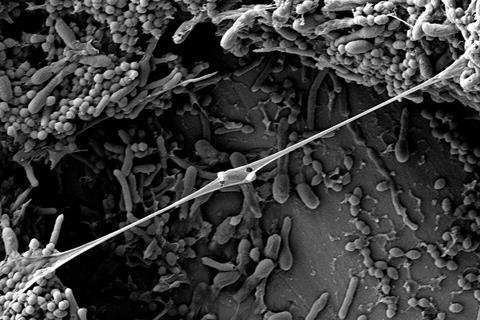
In a new study published in Nature Communications, Flinders University PhD graduates Dr Susie Grigson and Dr Abbey Hutton were part of a research team that examined the migration of microbial communities over long distances, the outcomes of which were rather surprising.
Bacterial migration
The team examined sewage-derived microbial communities in a tube system. They filled garden tubing with a nutrient rich gel, nutrients and a colour changing dye to visually follow the path of migrating bacteria across a full week. Then, by using DNA sequencing, they analysed both their taxonomic composition and genetic profiles.
“Essentially we created a new experimental system for looking at bacterial migration over long distances and time scales – by using garden tubing from a hardware store,” explains Dr Grigson.
The researchers identified that a subset of the original sewage-based community broke away and self-organised into migrating bands that were visible to the naked eye. The researchers discovered that these bands actually increase in speed as they travel. As migration progresses, the harsh journey acts as a natural filter that selects bacteria which are the strongest swimmers and most efficient at accessing nutrients to fuel the microbial community’s forward momentum.
Microbial community
The results of their study also indicated that bacteria migrated over these distances not as solitary swimmers, but in diverse, coordinated communities that also bring along viruses and “hitchhiking” microbes that cannot even swim on their own.
Through mimicking the complexity of natural microbial environments, the new study shows more than 500 bacterial species that co-migrate over metre-scale distances. Along the way, this community constantly reshaped itself. While dominant bacteria frequently turned over and changed, many rare bacteria managed to persist and survive the journey.
“We aimed to determine whether a single species would outcompete all others during migration and whether viruses would persist alongside the migrating community or remain behind,” says Dr Grigson. “Because our setup allowed us to watch the migration unfold in real-time, we could finally study microbial movement as a massive community event rather than just isolated cells swimming alone.”
“Our findings show that bacteria aren’t just swimming to outrun the viruses that infect them,” says Dr Grigson. “Instead, they travel together to hunt for food, bringing along viruses and ‘hitchhiking’ microbes that can’t even swim on their own.”
Medical and Environmental implications
Sustaining this microbial diversity during migration has profound real-world implications. In a medical context, it provides a new framework for understanding how potentially dangerous, non-swimming pathogens could spread through the human body, or through hospitals and water systems, by hitching a ride with highly mobile communities.
Environmentally, the research reveals how ecosystems maintain their biodiversity and resilience, allowing rare but crucial microbes to colonise new habitats, support agricultural soil health and drive wastewater treatment through complex teamwork rather than acting alone.
Topics
- Abbey Hutton
- Asia & Oceania
- Bacteria
- Bacterial motility
- Biofilms
- Clean Water
- Environmental Microbiology
- Environmental Microbiology
- Flinders University
- Medical microbiology
- Medical Microbiology
- Microbial Characterisation
- microbial communities
- Microbial Genetics
- migration
- Research News
- sewage
- Susie Grigson
- Viruses
- Wastewater & Sanitation




No comments yet