
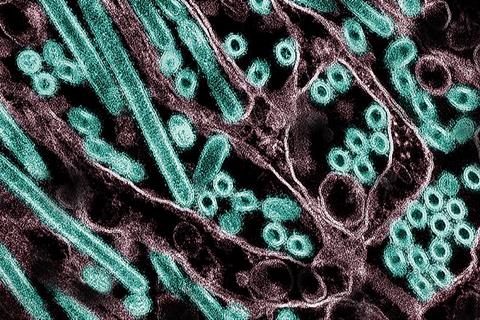
A sudden drop in milk production, thickened milk, and cows under movement restrictions. Since 2024, American farmers have had bitter experiences with the feared bird flu (H5N1), which in several cases has been introduced to cattle – and then spread rapidly among cattle herds. In some instances, humans have been infected as well. The contagious virus is increasingly being transmitted from wild birds to mammals –such as cattle.
The outbreaks in the U.S. raise the question of whether Denmark is sufficiently prepared should the infection spread to Danish cattle.
But now there is good news for both authorities and concerned dairy producers. Researchers from the University of Copenhagen have developed a tool that can predict where and when the risk of infection is highest. The tool is based on infection data from the U.S. outbreaks and adapted to Danish context.
“We have combined detailed data on wild bird abundance with cattle density in the U.S. to calculate how easily the infection can be transmitted from wild birds to cattle,” says You Chang, a postdoc at the Department of Veterinary and Animal Sciences at the University of Copenhagen.
Lessons from the US
So far, bird flu has not been detected in Danish cattle. But the experiences from the U.S., where more than 1,000 herds across 19 states have been infected, show that there is good reason to be prepared.
The recent detection of H5N1 antibodies in several Dutch dairy cows and earlier cases in British sheep, suggests that bird flu may already be spilling over to non-poultry livestock in Europe. The researchers behind the study believe it is likely only a matter of time before Danish cattle test positive for bird flu – and knowledge and preparedness are therefore needed.
“This is the first European study that uses outbreak data from the U.S. to assess the risk of transmission of bird flu from wild birds to cattle, and applies that data to a European context,” says Beate Conrady, professor at the Department of Veterinary and Animal Sciences.
Denmark vulnerable
Several of the outbreaks on American cattle farms are directly linked to wild birds. And because Denmark is located along key migratory bird routes, the country is particularly exposed. With the new tool, researchers have combined wild bird abundance, movement, outbreak in the other EU countries with information on cattle density. This knowledge makes it possible to pinpoint where – and when during the year – the risk of infection is highest.
“This gives Danish cattle farmers the opportunity to be alert if they know they are in a high-risk area and it’s a time of year when the risk is elevated. Then they can keep a closer eye on whether their animals show symptoms. At the same time, the knowledge can help authorities consider targeted surveillance, such as testing milk for early detection,” says You Chang.
Data from the study shows that in Denmark the risk of infection is highest from December to March, and farmers located along the country´s western coasts and on Lolland should be especially vigilant.
Preparedness should be standard
The first confirmed case of infection in cattle was registered in 2024 in the U.S. state of Texas. And the virus doesn’t just spread among animals. In the U.S., 71 people have been infected with the disease, which has primarily manifested as eye infections. It is mainly employees in the poultry and dairy sectors who have been infected.
READ MORE: Current strategies ineffective in controlling Salmonella Dublin in Danish cattle
Although the infection has not yet been detected in Denmark, there is good reason to be prepared. The researchers emphasize that the study focuses on the risk of the virus being introduced from wild birds into cattle herds. Whether the virus would spread further between farms in Denmark remains uncertain and is still under investigation.
“Being ready for a potential launch in Denmark is essential. Preparedness should not be a luxury – it should be standard,” says Beate Conrady.
The study is published in Preventive Veterinary Medicine and can be accessed here:
https://www.sciencedirect.com/science/article/pii/S0167587726000632





No comments yet