
Communication between cells in plants, animals and humans takes place via specialised connecting structures. An international team led by biologists from Heinrich Heine University Düsseldorf (HHU) and involving the University of Tübingen has now discovered how the regulation of very similar structures was already present in multicellular bacteria, implying that this must have originated much earlier in the course of evolution.
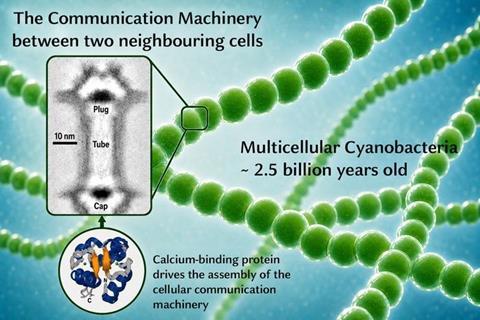
In the scientific journal published by the European Molecular Biology Organization (EMBO), they describe that the exchange of calcium plays a central role in bacteria, just as it does in humans.
Higher, eukaryotic cells – i.e. cells with a nucleus, such as those found in humans and all higher animals – possess structures that connect neighbouring cells. It is known that, among other things, these structures facilitate fundamental communication processes between cells; without them, tissues such as the human heart could not function. Furthermore, nerve cells transmit the signals that control our bodies via these connecting structures. These structures and the communication between cells are regulated through the exchange of calcium ions (Ca²⁺).
Calcium signals
The research group from the Institute of Phototrophic Microbiology led by Junior Professor Dr Khaled Selim has now discovered that similar communication processes and connecting structures in bacteria are also regulated by calcium signals. Bacteria are however more simple cells that lack a nucleus, so-called prokaryotes.
Professor Selim said: “It came as a big surprise to us that one of the earliest life forms on Earth – evolutionarily older and simpler cells – had already developed communication structures regulated by calcium signals similar to those found in the cells of higher organisms, such as animals and humans.”
In The EMBO Journal, the research team reports the presence of such communication structures in multicellular cyanobacteria. “Analogous to the connecting structures in eukaryotes known as gap junctions – traditionally considered a eukaryotic trait – cyanobacteria coordinate their cell-to-cell communication via connecting structures called ‘septum junctions’. The signals regulating this cell-to-cell communication and the formation of septum junctions were previously largely unknown,” says Teresa Müller, doctoral researcher in Selim’s research group within the Cluster of Excellence ‘Controlling Microbes to Fight Infections’ (CMFI) at the University of Tübingen and first author of the study.
Multicellular cyanobacteria
The biologists in Düsseldorf discovered a calcium-binding protein (for short: CSE) found exclusively in multicellular cyanobacteria. Using nuclear magnetic resonance (NMR) spectroscopy, they determined the structure of CSE in its calcium-bound state and demonstrated that it functions as a calcium-buffering protein. Furthermore, using cryo-electron microscopy, the researchers observed that the mutant of the bacterial cells lacking CSE exhibited significantly fewer connecting structures.
MICROBIOLOGY NEWS: Register with The Microbiologist for more free articles
Selim emphasises: “Our research offers new insights into evolution. It suggests that the functional principles of higher organisms were already present in simple, multicellular bacteria that form tissue-like structures, meaning that these cellular connections date back a billion years – before the time when the evolutionary lineages of eukaryotes and prokaryotes diverged.”





No comments yet