
Filamentous fungi can colonise fresh human faeces, and the choice of fungal species shapes how the material changes, according to a new study.
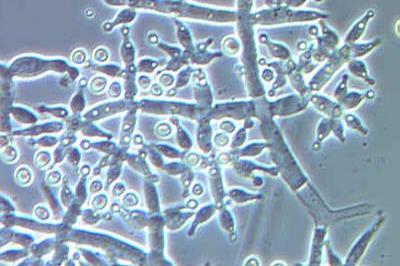
Depending on the species, the fungi accelerated degradation, reduced faecal indicator bacteria, suppressed faecal odour or changed the appearance of the material. No single species did all of this.
The paper by scientists in the Global Health Engineering group at ETH Zurich, ‘Fungal Inoculation of Human Fecal-Woodchip Substrates Produces Species-Specific Effects on Indicator Bacteria and Substrate Degradation’, has been published in Sustainable Microbiology, an Applied Microbiology International publication.
The team develops systems and processes that improve the health of people and the environment, with a focus on low-income countries and on affordable, appropriate solutions that can be applied anywhere.
Scale of sanitation issues
Sanitation remains a field with many unsolved problems, and the scale of the problem is often underestimated. According to the latest WHO/UNICEF Joint Monitoring Programme report, 3.4 billion people lacked safely managed sanitation in 2024, and 354 million people practised open defecation.
While sewer systems are convenient for users, they are expensive to build and maintain, and release nutrients into the environment that could be used as fertiliser. For low-resource settings, remote locations and water-scarce regions, sewers are therefore often not a suitable solution.
Several decentralised sanitation technologies exist, but each has weaknesses. Urine-diverting dry toilets require storage times of one to two years, and the stored material has a low fertiliser value. Composting toilets depend on composting processes that are difficult to control and that frequently fail to inactivate pathogens, degrade chemical pollutants or produce a finished compost within the chamber.
Composting toilets
“Fungi may have advantages over bacteria for the degradation of faecal material in composting toilets,” said corresponding author Jules Peter, a PhD student who designed and carried out the experiments and analysed the data.
“They could grow at lower water activity than most bacteria, their hyphae can bridge gaps in porous materials such as woodchips, and they are important degraders of animal dung in natural ecosystems.
“Fungal enzymes have been shown to degrade pharmaceutical residues, and several fungal species can damage helminth eggs or delay their development.”
A new player
Despite these proven concepts, fungi have so far not been studied to treat fresh human faeces in composting toilets. No published study has described whether filamentous fungi can colonise human faeces at all, or how they affect the degradation process or change parameters of the substrate.1
The aim of this exploratory study was therefore to test filamentous fungi from different habitats and with different specialisations for their ability to colonise fresh human faeces, and to measure how they interact with faecal indicator bacteria, how they change the degradation rate, and the pH of the material, and whether they inhibit spontaneous mould growth, to see if they could be used to steer the degradation process.
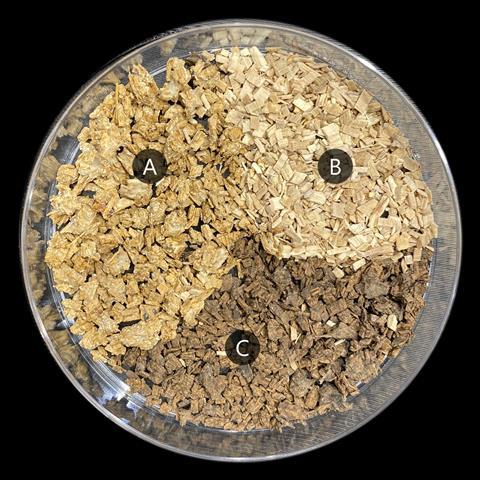
Fresh human faeces from a single donor were mixed with beechwood chips at a 2:1 ratio to represent the material in a dry toilet. The mixture was spread in Petri dishes and inoculated with agar plugs of five fungal isolates from four species: two strains of the oyster mushroom Pleurotus ostreatus, Ganoderma lucidum, Trichoderma harzianum (a fungus used as a biocontrol agent in agriculture), and Sordaria fimicola, a dung fungus that the team isolated from human faeces. Uninoculated dishes served as controls.
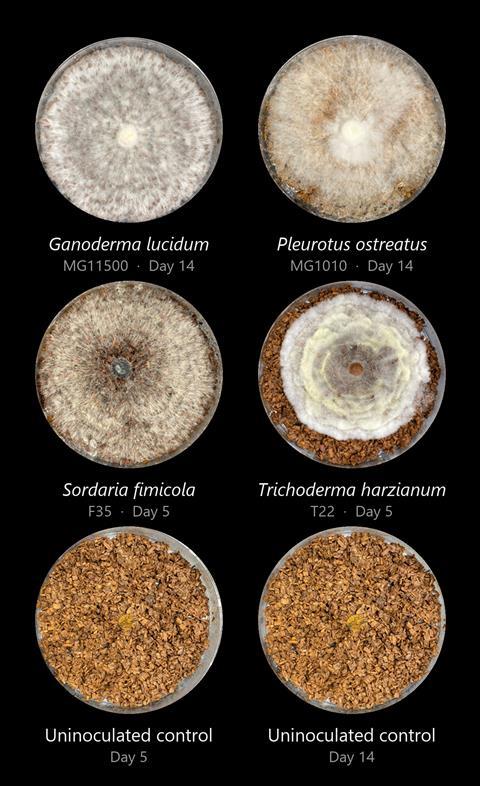
The plates were incubated for 14 days at 25 °C and photographed repeatedly to measure the area covered by the inoculated fungus and by spontaneously appearing moulds. At the end of the experiment the team measured pH, the concentrations of Escherichia coli and Enterococcus spp., and the loss of dry weight in the colonised material. All five isolates were able to grow on the faecal substrate. Colonisation success, growth rate and the effects on the material were species-specific.
How they performed
Sordaria fimicola covered most of every plate within about three days, completely suppressed mould growth, and produced the largest dry weight loss of all treatments, meaning the fastest degradation. At the same time it raised the pH to about 9 and increased the concentration of E. coli by around three orders of magnitude and that of Enterococcus by about one.
Ganoderma lucidum and both P. ostreatus strains kept the substrate acidic, at a pH of about 6, and replaced the faecal odour with a mushroom odour (a qualitative observation). Where G. lucidum established, it reduced both indicator bacteria below the detection limit in most plates, although this may partly be an effect of the acidic pH. P. ostreatus changed the colour of the material from brown to straw-coloured, so that it no longer resembled faeces. These three isolates grew slowly and often failed to establish, so that spontaneous moulds frequently colonised the plates before them. In some plates, however, the inoculated fungus later overgrew the mould.
Trichoderma harzianum grew quickly but died back after eight days and was then overgrown by moulds or stayed as dead mycelium.
Degradation process
Across all treatments, fungal inoculation reduced spontaneous mould growth compared with the uninoculated controls, and the two fastest-colonising species significantly increased the degradation rate. Taken together, the results show that the direction of the degradation process, towards fast degradation or towards lower indicator-bacteria counts, less odour and a visibly transformed material, depends on the fungal species that is inoculated. The authors note that the study used faeces from a single donor at Petri-dish scale over 14 days, so the results now need to be confirmed with more donors and at larger scale.
“Some of the results surprised me,” admits Peter. “The wood-adapted species P. ostreatus and G. lucidum were able to colonise faeces. Their success rate was lower than that of the dung fungus S. fimicola, but they established despite the very small inoculum used, a single 5 mm agar plug. I did not expect them to compete against the native faecal microbiome, which contains high bacterial concentrations and easily accessible nutrients.
”I was also surprised that they managed to control the pH value within their mycelial zone and kept it acidic until the end of the assay.
“Also, I was surprised at how strongly P. ostreatus reduced smell and how it changed the material’s appearance. The P. ostreatus plates really lost the faecal factor while working with it in the lab and had a pleasant mushroom smell.
Faecal indicator bacteria
“I was also surprised by the strength of the suppression of faecal indicator bacteria by G. lucidum, which reduced both E. coli and Enterococcus below the detection limit in most plates it managed to colonise. Also, the growth speed and colonisation success of S. fimicola - it was always the first coloniser, and it tolerated high pH, and very high bacterial numbers. It showed that some fungal species have plenty of potential to reliably and very rapidly colonise fresh faeces and together with bacteria could increase degradation rates.”
To the authors’ knowledge, this is the first peer-reviewed scientific study of how filamentous fungi colonise fresh human faeces, and the first to show that the choice of fungal species can steer how the material changes. Depending on the species, fungal inoculation accelerated degradation, suppressed competing moulds, reduced faecal indicator bacteria, kept the material acidic, suppressed faecal odour and changed the appearance of the material.
“Each of these effects addresses a known weakness of current dry toilets: slow stabilisation, pathogen survival, odour, and a product that still looks like faeces and is therefore poorly accepted. To our knowledge, these are the first published scientific data on fungal growth on human faeces, and they lay the groundwork for myco-sanitation as a research field with measurable outcomes,” said Peter.
Key unsolved problems
“Two of the main unsolved problems in composting and dry toilets are pharmaceutical residues and the highly resistant eggs of the roundworm Ascaris lumbricoides. Some fungal species are known to degrade pharmaceutical residues and several fungal species can attack nematode eggs, including in some cases Ascaris eggs. If a capable fungal species can be established reliably in faecal material it is possible that they contribute to solving both problems.
“With this first study we wanted to open the field of myco-sanitation, and we hope that other sanitation or mycology research groups will take up the topic. Because it is the first study of its kind, many questions remain open.”
Next steps
The next steps are:
- Screening of further fungal species. Candidates of interest are dung-adapted species and species with strong enzyme systems that have been shown to degrade resistant pollutants.
- Testing the successful species on faecal samples from many different donors.
- Testing candidate species against pathogens, particularly the resistant eggs of Ascaris lumbricoides. The group’s own work will now focus on identifying fungal species that can inactivate these eggs and grow on faeces.
- Once suitable candidates have been identified, research on how these fungi can be integrated into existing sanitation systems might become the focus.
The study was led by Jules Peter, PhD student in the Global Health Engineering group at ETH Zurich (Department of Mechanical and Process Engineering, D-MAVT), who designed and carried out the experiments and analysed the data. Adriana Clavijo Daza contributed to the statistical analysis and data management. Professor Elizabeth Tilley, head of Global Health Engineering, co-conceived and supervised the study.
The paper is published in Sustainable Microbiology. The data and analysis code are openly available here.
1. Two earlier design projects placed oyster mushroom mycelium in dry toilets: PooPac (Joshua Urieli, master’s project in design, Zurich University of the Arts, 2015–2016), a paper bag lined with oyster mushroom mycelium for the faeces container of urine-diverting dry toilets to control odour; and the Modular MycoToilet (Biogenic Architecture Lab, University of British Columbia, led by Joseph Dahmen and Steven Hallam), a mycelium insert for composting toilets. Neither published a scientific paper or data.
Topics
- Applied Microbiology International
- Clean Water
- Community
- composting toilets
- Early Career Research
- Enterococcus
- Escherichia coli
- ETH Zurich
- faecal degradation
- Fungi
- Ganoderma lucidum
- Healthy Land
- Jules Peter
- One Health
- Pleurotus ostreatus
- Pollution and Remediation
- richoderma harzianum
- Sordaria fimicola
- UK & Rest of Europe
- Wastewater & Sanitation



No comments yet