
Periodontitis—a chronic inflammatory disease that damages the gums and bones supporting teeth—affects nearly half of adults worldwide. Current treatments often fail because they cannot simultaneously eliminate stubborn bacterial biofilms and calm the runaway inflammation that follows.
Now, researchers have engineered a living bacterium that does both, in the right order.
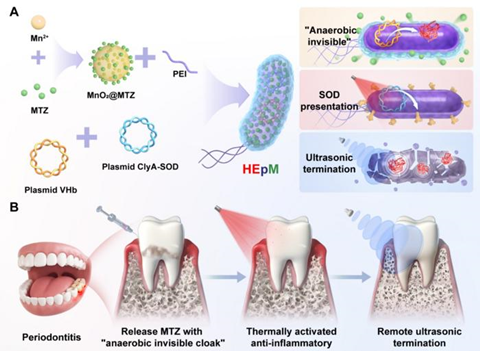
In a study published in Dental Research, a team of researchers from China and Australia started with Escherichia coli Nissle 1917 (EcN), a harmless probiotic, and gave it three clever upgrades. First, they loaded it with nanoparticles containing metronidazole, an antibiotic that only becomes active in the oxygen‑free environment of a diseased gum pocket. Second, they equipped the bacterium with a hemoglobin from a bacterium that loves oxygen (Vitreoscilla). This “invisible cloak” protects the probiotic from its own antibiotic. Finally, they added a heat-sensitive genetic switch that turns on an antioxidant enzyme (superoxide dismutase) only when triggered by a mild warm stimulus.
“We wanted a therapy that respects the natural course of the disease—first clean up the harmful microbes, then resolve the inflammation,” says senior and co-corresponding author Lili Chen. “Our design allows us to remotely activate the anti‑inflammatory phase precisely when the first job is done.”
Two-stage treatment
In a rat model of periodontitis, the two‑stage treatment dramatically reduced the key pathogens P. gingivalis and F. nucleatum and restored a healthy-like oral microbiome. After heat activation, the engineered bacteria lowered oxidative stress and promoted repair of the periodontal ligament and alveolar bone. Single-cell sequencing revealed that fibroblasts became the central hub of tissue‑regenerating signals.
“What if something goes wrong? To that end, we built in a fail‑safe: the same hemoglobin that acts as an ‘invisible cloak’ also serves as a natural sonosensitizer,” shares Chen. “Additionally, we introduced a short, low‑energy ultrasound pulse (1 W/cm², 5 min), which safely lyses the engineered bacteria with no trace left behind.”
“This is the first time a living bacterium has been programmed to execute a temporal, two‑step therapeutic program inside the body,” says co-corresponding author Yuzhou Wu. “The platform could be adapted for other inflammatory diseases where microbial imbalance and oxidative stress play a role.”
Topics
- antioxidant
- Asia & Oceania
- Bacteria
- Bioengineering
- cerium oxide nanoparticles
- Escherichia coli Nissle 1917
- F. nucleatum
- fibroblasts
- Infection Prevention & Control
- Infectious Disease
- Innovation News
- Lili Chen
- metronidazole
- One Health
- Oral Microbiome
- oxidative stress
- P. gingivalis
- periodontitis
- Pharmaceutical Microbiology
- Probiotics, Prebiotics & Synbiotics
- Vitreoscilla
- Yuzhou Wu


No comments yet