
The One Health Microbiome Center (OHMC) in the Huck Institutes of Life Sciences at Penn State has selected Jacques Ravel, professor of microbiology and immunology and director of the Center for Advanced Microbiome Research and Innovation (CAMRI), Institute for Genome Sciences, at the University of Maryland School of Medicine, as the second laureate of the Microbiome Medal. This annual, competitive award honors a scholar or group of scholars who nobly extend excellence, acumen and ingenuity in research, mentorship and service to the global field of microbiome science.
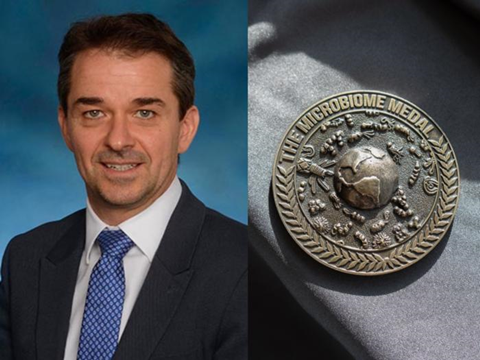
“Ravel has left an enduring and irreplaceable mark on the global field of microbiome science,” said Seth Bordenstein, director of the OHMC, professor of biology and of entomology and Dorothy Foehr Huck and J. Lloyd Huck Chair in Microbiome Sciences.
Widely recognized for his pioneering scholarship and mentorship on the human microbiome — particularly women’s health and the vaginal microbiome — Ravel helped define distinct microbial community types and uncover their links to pregnancy outcomes and susceptibility to infection. This work also helped lay the groundwork for live biotherapeutics designed to shape the vaginal microbiome in ways that could improve pregnancy outcomes and reduce infection risk.
He has led major federally funded research initiatives and played key roles in large-scale microbiome consortia, helping establish genomic and computational standards that continue to shape microbiome science worldwide. Among those efforts, he played a key role in the National Institutes of Health’s landmark Human Microbiome Project.
Women’s reproductive health
“Dr. Jacques Ravel’s foundational characterization of the vaginal microbiome has reshaped our understanding of women’s reproductive health and established a scientific framework driving clinical research worldwide,” said Guy Townsend, associate professor in the Department of Molecular and Precision Medicine at the Penn State College of Medicine, and member of the Microbiome Medal review panel. “His contributions to the microbiome sciences have framed our collective understanding of the mechanisms governing microbial communities and the concepts underlying host-microbial interactions”
The Microbiome Medal was founded on a conviction that the greatest scientists do not merely advance knowledge, they enrich humanity and improve the lives of people they may never meet, according to Bordenstein. The medal aims to connect the Penn State community with these leaders and visionaries who are shaping our microbial world.
“At the One Health Microbiome Center, we speak often of the obligation to pursue not merely what is expedient, but what is noble — and the career of Dr. Ravel embodies that obligation in full,” Bordenstein said. “For more than 30 years, Dr. Ravel’s foundational contributions to our understanding of the human vaginal microbiome, its intimate relationship with women’s health, reproductive outcomes and systemic disease, have done precisely that. He demonstrated what it means to place equal weight on discovery, on mentorship and on service to a global community of scholars — the very three pillars upon which this Medal was built.”
The One Health Microbiome Center at Penn State was itself named by Applied Microbiology International as the 2024 winner of the WH Pierce Global Impact in Microbiology Prize 2024.
Biggest questions
As the Microbiome Medal Laureate, Ravel will receive a custom-crafted bronze medallion, a cash prize and an invitation for a two-day visit to the One Health Microbiome Center at Penn State — an occasion that will celebrate the full measure of enthusiasm and intellectual energy of his career. During the visit, he will deliver public lectures and engage with the biggest questions at the very roots of life, according to Bordenstein. Ravel will visit Penn State University Park and deliver a lecture on Nov. 6 at 11 a.m. in the Animal, Veterinary, and Biomedical Sciences Building, Room 106.
“I am honored that the One Health Microbiome Center has recognized my work in microbiome science with its prestigious Microbiome Medal Laureate,” Ravel said. “Science takes a team, and I’d like to thank everyone in my lab who studies the microbiome’s role in women’s health, as well as our work in translating that science to clinical care through the development of biotherapeutics.”
The inaugural recipient of the Microbiome Medal was Thomas Bosch of Kiel University in 2025. Bosch visited Penn State in December and delivered two public lectures.


No comments yet