
Powdery mildew fungi survive on living plants behind a cell wall that provides both structural support and a shield against host immunity. Researchers have now identified the fungal cell wall assembly protein ECM33, a glycosylphosphatidylinositol (GPI)-anchored protein, as a weak point in that defense.
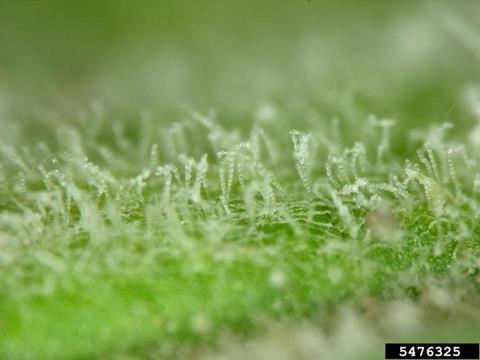
In the cucurbit pathogen Podosphaera xanthii, the protein binds major wall carbohydrates, helps connect the wall’s inner and outer layers, and appears to limit the release of immune-triggering fragments. Silencing the PxECM33 gene disrupted wall organization, slowed fungal growth, and sharply reduced disease on melon plants.
The findings establish ECM33 as a candidate target for spray-induced gene silencing (SIGS), a ribonucleic acid (RNA)-based, nontransgenic approach to crop protection without altering the crop genome.
Widespread crop disease
Powdery mildew is among the most widespread crop diseases, affecting cereals, grapes, cucurbits, tomatoes, fruit crops, and ornamentals in fields and greenhouses. Cucurbit infections are commonly driven by Podosphaera xanthii, an obligate biotroph that can rapidly generate new physiological races and develop resistance to widely used fungicides.
Resistant cultivars and chemical treatments remain central to management, but both approaches can lose effectiveness as pathogen populations change.
MICROBIOLOGY NEWS: Register with The Microbiologist for more free articles
The fungal cell wall is an attractive alternative target because it is essential for growth, environmental sensing, host interaction, and protection from plant defenses. Based on these challenges, there is a need to investigate fungal cell-wall components that can support precise, durable, and lower-input disease control.
Key protein
Researchers from the University of Málaga and the Instituto de Hortofruticultura Subtropical y Mediterránea “La Mayora,” a joint institute of the University of Málaga and the Spanish National Research Council, together with colleagues from the University of León and its Institute of Molecular Biology, Genomics and Proteomics, published (DOI: 10.1093/hr/uhag101) the study on 13 March 2026 in Horticulture Research.
The team combined cell-wall chemistry, protein modeling, binding experiments, gene silencing, microscopy, and greenhouse tests to determine how ECM33 supports Podosphaera xanthii and whether the corresponding gene could be targeted to protect melon plants.
The team first used high-performance anion-exchange chromatography with pulsed amperometric detection (HPAEC-PAD) to profile the fungal wall. Glucosamine, mannose, and glucose accounted for about 40.9%, 30.5%, and 26.1% of detected sugars, respectively, while protein represented 52% of wall dry weight. Structural modeling and molecular docking predicted carbohydrate-binding pockets in PxECM33, and purified PxECM33 protein bound mannans most strongly, followed by chitin and β-glucan.
Testing function
To test function, the researchers applied double-stranded RNA (dsRNA) against the PxECM33 gene to infected melon tissue. Reverse transcription quantitative polymerase chain reaction (RT-qPCR) showed that transcript levels fell by about half, while haustorium counting and quantitative polymerase chain reaction (qPCR) confirmed reduced fungal growth.
Confocal imaging revealed stronger chitin-associated fluorescence, and transmission electron microscopy (TEM) showed the mannoprotein-rich outer wall separating from, or disappearing above, the inner layer.
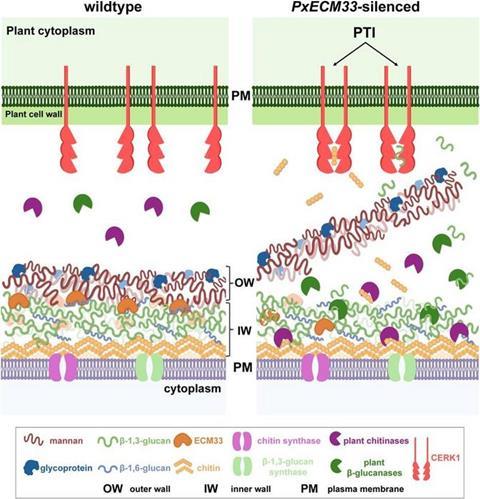
The immune connection emerged when the team simultaneously silenced PxECM33 and the melon chitin elicitor receptor kinase 1 gene (CmCERK1): fungal growth recovered, indicating that wall disruption exposes pathogen-associated molecular patterns (PAMPs) detected through CERK1-dependent immunity. Finally, spray-induced gene silencing targeting PxECM33 reduced powdery mildew severity by approximately 75% in controlled growth-chamber and greenhouse experiments.
Dual function
The authors said the study presents ECM33 as more than a structural component of the fungal wall. Their results support a model in which PxECM33 helps hold wall layers together while concealing chitin- and β-glucan-derived signals that would otherwise alert the plant. They said this dual function explains why silencing the PxECM33 gene both weakens the fungus and makes it easier for melon immunity to detect the infection. Rather than broadly attacking fungal metabolism, the approach targets a specific vulnerability at the host–pathogen interface, where fungal survival and plant recognition meet.
Because ECM33 is highly conserved across ascomycete fungi, especially agriculturally important powdery mildew species, the target may have value beyond melon disease. The absence of reported ECM33 homologues in plants, animals, and bacteria also strengthens the case for fungal-selective control, although specificity and environmental safety must be tested for each RNA design.
Future work will need to optimize RNA stability, delivery, dose, manufacturing cost, and performance under variable field conditions, while assessing off-target effects and durability across pathogen populations. If these hurdles are addressed, PxECM33-directed sprays could complement resistant cultivars and fungicides in integrated programs, reduce chemical inputs, and provide growers with a flexible tool against fast-evolving powdery mildew outbreaks.
Topics
- Agriculture
- Antimicrobial Resistance
- cell wall
- ECM33
- Food Security
- Fungi
- Healthy Land
- Infection Prevention & Control
- Infectious Disease
- Instituto de Hortofruticultura Subtropical y Mediterránea
- Microbial Genetics
- Podosphaera xanthii
- powdery mildew
- Research News
- Soil & Plant Science
- Spanish National Research Council
- UK & Rest of Europe
- University of León
- University of Málaga



No comments yet