
A new Perspective argues the case for an expanded view of the rhizosphere as a dynamic system, paving the way for a vision of sustainable soil management that moves beyond simply adding more fertilizers, microbial products, or other inputs.
Scientists at the Institute of Soil Science, Chinese Academy of Sciences, developed their ideas in a new paper, ‘Optimizing rhizosphere metabolic circular economy towards sustainable ecosystems’, has recently been accepted for publication by Sustainable Microbiology, an Applied Microbiology International publication.
“Our perspective paper proposes an expanded framework for understanding the Rhizosphere Metabolic Circular Economy (RMCE). We argue that the rhizosphere is not simply a site of rapid exchange between living plants and microorganisms, but a dynamic system in which metabolic processes are generated, persist over time, are spatially organized, and are actively restored following environmental disturbance. This expanded perspective provides a conceptual basis for improving soil health, crop resilience, and ecosystem sustainability under climate change and intensive agriculture,” said corresponding author Professor Haiyan Chu, Professor for Soil Microbiology at the Institute of Soil Science.
The rhizosphere is central to nutrient cycling, plant health, and soil functioning, but its metabolic networks are increasingly disrupted by intensive agriculture and environmental stresses such as drought, salinity, soil acidification, compaction, nutrient imbalance, and soil-borne diseases. These pressures can impair nutrient cycling, reduce plant resilience, and contribute to soil degradation.
“Existing RMCE concepts have largely focused on reciprocal metabolic exchanges between living plants and microorganisms. We therefore asked whether this framework could be expanded to better explain how rhizosphere metabolic functions persist beyond individual organisms, how they are organized at very small spatial scales, and how they recover after environmental disturbances. We also wanted to explore how these insights could be translated into practical, scenario-based approaches for sustainable soil and agricultural management,” said Professor Chu.
Four interconnected dimensions
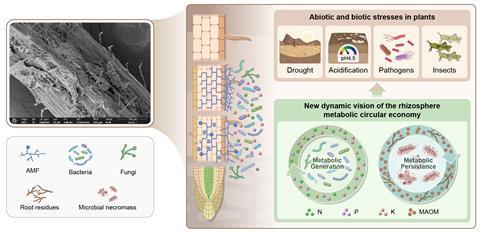
The paper integrates findings from recent research across rhizosphere ecology, plant-microbe interactions, microbial necromass, soil carbon cycling, spatial ecology, and plant responses to environmental stress. Based on this synthesis, the team expanded the RMCE framework into four interconnected dimensions:
- First, metabolic generation describes the reciprocal exchange between plants and microorganisms: plants provide carbon-rich root exudates, while microorganisms transform these resources and mobilize nutrients and bioactive compounds that benefit plants.
- Second, metabolic persistence extends RMCE beyond living organisms by incorporating microbial necromass, root residues, and stabilized soil organic matter into longer-term carbon and nutrient cycling.
- Third, spatial organization recognizes that the rhizosphere is highly heterogeneous, with distinct microzones such as the rhizoplane, rhizosheath, and hyphosphere that create specialized niches and facilitate complementary microbial functions.
- Finally, adaptive restoration describes how plants and their microbiomes can dynamically reconfigure metabolic interactions under stresses such as drought, salinity, soil acidity, and pathogen attack.
Reinforcing cycle
“Together, these four dimensions form a reinforcing cycle: metabolic generation initiates resource exchange, persistence maintains resources over time, spatial organization optimizes their distribution and use, and adaptive restoration helps rebuild disrupted metabolic networks,” said Professor Chu.
“We further proposed a scenario-based management framework in which interventions are matched to the dominant ecological bottleneck—for example, optimizing root exudation and microbial consortia in nutrient-deficient soils, restoring spatial heterogeneity in compacted soils, and promoting stress-responsive plant-microbiome interactions under drought or pathogen pressure.”
One particularly striking insight was the importance of the “dead” component of the rhizosphere, he added.
“We often think of plant-microbe interactions primarily in terms of living organisms, but microbial necromass and root residues can become important reservoirs through which metabolic products and nutrients persist after the organisms themselves have died.
Microbial necromass
“For example, previous studies synthesized in our perspective indicate that microbial necromass contributes substantially to global soil organic carbon, while root-derived carbon can be stabilized into mineral-associated organic matter much more efficiently than aboveground litter.
“This suggests that the rhizosphere is not simply a short-lived exchange hub between living organisms. It can function as a longer-term, self-reinforcing system in which biological activity, dead biomass, soil structure, and mineral interactions collectively maintain carbon and nutrient cycling.”
The new framework suggests that sustainable soil management should move beyond simply adding more fertilizers, microbial products, or other inputs. Instead, management should identify the specific process that is limiting rhizosphere metabolic circularity and target that bottleneck.
For example, breeding or selecting crops with flexible root-exudation traits could help plants recruit beneficial microbial functions when nutrients or water are limited. Functionally complementary microbial consortia could support nutrient mobilization and recycling, while conservation tillage, crop diversification, and localized amendments could preserve the microscale soil structures that support metabolic interactions. Under drought, salinity, or pathogen pressure, management could aim to strengthen the plant-microbiome feedbacks that naturally restore disrupted functions.
Next steps
The broader goal is to develop agricultural systems that are simultaneously productive, nutrient-efficient, carbon-retaining, and resilient to environmental change, rather than optimizing crop yield independently from soil ecosystem functioning.
However, several important challenges remain before the expanded RMCE framework can be fully tested and translated into practice, Professor Chu said.
“First, we need to quantify metabolic persistence across the live-dead continuum, particularly how microbial necromass production, decomposition, stabilization, and reuse contribute to carbon and nutrient flows. Stable-isotope tracing, metabolomics, and necromass biomarkers could help quantify these processes.
“Second, advanced spatial approaches—including imaging mass spectrometry, microfluidic rhizosphere systems, spectroscopy, and spatial multi-omics—are needed to determine how metabolites, microorganisms, and necromass are distributed across rhizosphere microzones.
Field experiments
“Third, long-term field experiments are needed to understand how plant and microbial communities dynamically restore metabolic networks under changing environmental conditions and what trade-offs this creates for crop yield and carbon investment.
“Finally, multi-site field trials should integrate plant genotype, microbial consortia, and soil management and establish standardized RMCE performance metrics that include yield stability, nutrient-use efficiency, microbial necromass accumulation, and soil carbon sequestration.”
MICROBIOLOGY NEWS: Register with The Microbiologist for more free articles
The study was conceptualized by Prof. Haiyan Chu and Dr. Kunkun Fan at the Institute of Soil Science, Chinese Academy of Sciences. Dr. Kunkun Fan led the writing of the original manuscript, which was subsequently reviewed and edited by Prof. Haiyan Chu, Dr. Kai Sun, and Dr. Zhihui Xu. The work was supported by the National Natural Science Foundation of China (42207364 and 42230511) and the Strategic Priority Research Program of the Chinese Academy of Sciences (XDA28020202).
‘Optimizing rhizosphere metabolic circular economy towards sustainable ecosystems’ is published in Sustainable Microbiology.






No comments yet