
The human body possesses the fascinating ability to heal itself. To do so, it replaces millions of old cells with new ones every day. However, some diseases can hinder these healing mechanisms – such as diabetes mellitus, a condition that affects over 500,000 people in Switzerland alone. If diabetes is left untreated or is inadequately treated, high blood sugar levels damage blood vessels and nerves, resulting in poor blood flow to the feet.
This, in turn, can trigger diabetic foot syndrome: Even a small pressure point inside a shoe can cause wounds on the feet. While in healthy people such a wound heals within 1–2 weeks, it can become chronic in those with diabetes – meaning it does not heal within four weeks despite proper care.
Treatment of chronic wounds is typically managed by a multidisciplinary team comprising specialists in dermatology, surgery, and nursing. The wound requires frequent monitoring and changing dressings at least every three days – often for up to a year. That’s why chronic wounds represent a serious economic burden on the healthcare system.
Controlling drug delivery with light
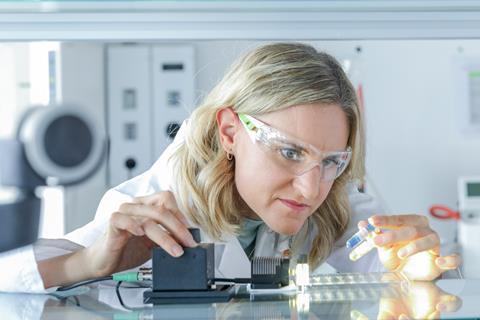
To reduce these costs and ease the burden on healthcare professionals, researchers at Empa are working on innovative treatment methods for chronic wounds. The team led by Luciano Boesel and Giorgia Giovannini from the Biomimetic Membranes and Textiles laboratory in St. Gallen has developed a material that releases active ingredients in a controlled manner when exposed to light, which could improve the effectiveness of treatment and reduce its side effects.
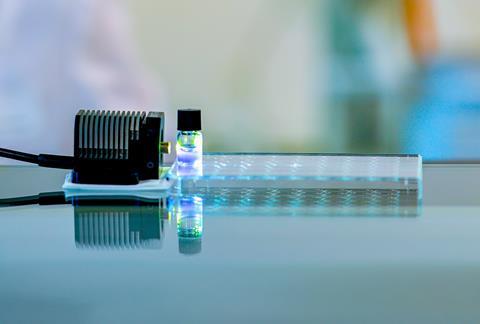
To achieve this, the researchers loaded silica nanoparticles with chlorhexidine, a commonly used wound disinfectant. They then coated these nanoparticles with a polymer shell containing special molecular photoswitches. When these photoswitches are exposed to visible LED light, they change their structure, causing the polymer coating to swell and become more permeable to water. This allows chlorhexidine to escape from the silica core. When the light is turned off, the polymer molecules contract and return to their original, watertight form.
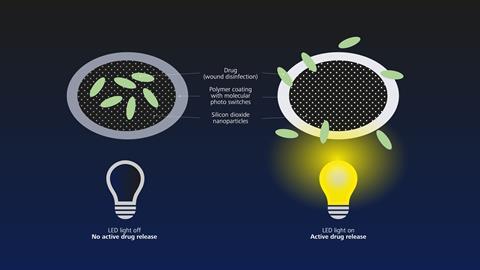
“When incorporated into a wound patch, this system enables controlled wound disinfection,” explains Luciano Boesel. “The timing and dose of the released active ingredient can be controlled by varying the duration or intensity of the light exposure and the wavelength of the light.”
Enabling personalized wound treatment
The system releases the active ingredient in a controlled manner. This gives it an advantage over other patches in that it delivers the medication in precise doses – thereby reducing the risk that bacteria in the wound will develop resistance.
“Ideally, we could combine this new system of light-controlled drug delivery with a wound sensor that continuously determines the amount and type of bacteria present in the wound,” adds Luciano Boesel.
A wound sensor, such as the one developed by Empa in 2025, would enable further development of the patch: Silicon dioxide nanoparticles can be loaded not only with a wound disinfectant but also with other therapeutic agents, and the polymer coating can be equipped with different photoswitches. Depending on the wavelength of the light used to irradiate the patch, different photoswitches are activated. The wound could thus be treated specifically with exactly the active ingredient needed at any given moment based on the detected bacterial infection.
“That would be an important step toward personalized wound treatment,” Boesel emphasizes. He sees a major drawback of current standard wound care in the fact that wounds are always treated in roughly the same way, regardless of which bacteria are present.
From the test tube to clinical practice
It is not yet clear how and when this system for light-controlled drug delivery can actually be used in practice. Luciano Boesel’s team developed it in the lab and has so far tested it exclusively in test tubes. The next step is to adapt it to clinical needs.
“We are in contact with various hospitals that would be interested in such a system,” says Boesel. He is currently looking for interested doctoral students who could further develop the system as part of their dissertation. Afterward, the system will have to undergo several phases of clinical trials before it receives approval in Switzerland as part of a medical device.
MICROBIOLOGY NEWS: Register with The Microbiologist for more free articles
So even if all goes well, people with diabetic foot syndrome will still have to wait for a few more years until they will be able to benefit from the high-tech patch with light-controlled drug delivery. If successful, though, it would spare them numerous trips to the hospital. Not least, it would also ease the burden on the healthcare system: Even if the patches were more expensive to manufacture than a conventional one, they would more than offset these costs by reducing staffing requirements.
The project was supported by the OPO Foundation (the “STERILISE” project) and the Swiss National Science Foundation (SNSF).





No comments yet