
Fusarium wilt is a major threat to global watermelon production, especially under long-term monoculture practices. Traditionally, research has focused on how pathogens invade or how certain beneficial microbes can suppress them. But emerging studies highlight a much more complex picture—where microbial communities interact dynamically, and their balance or imbalance can tip the scales between health and disease.
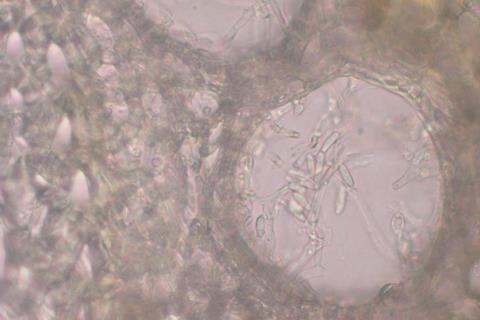
Among them, phagotrophic protists—long overlooked soil predators—are now seen as central influencers in shaping microbial ecology. Their feeding behaviors can shift entire bacterial populations, indirectly enhancing or undermining plant resistance. Due to these complexities, deeper investigations into the ecological roles of these protists are urgently needed to better understand and manage soil-borne diseases.
In a new study (DOI: 10.1016/j.pedsph.2023.12.014) published in Pedosphere in March 2025, scientists from Ningbo University and collaborating institutes uncovered how phagotrophic protists—microscopic soil dwellers—team up with beneficial bacteria to suppress watermelon Fusarium wilt.
Through microbial sequencing and ecological network analysis, they found that nutrient imbalance—especially excess potassium—disrupts these partnerships, allowing the fungal pathogen to spread. The research sheds new light on the delicate microbial relationships that influence plant disease outbreaks and provides a fresh perspective on how farming practices can harness microbiome dynamics for healthier crops.
High-wilt fields
The study focused on watermelon fields in Shanghai that had undergone seven years of continuous cultivation, some with wilt rates as high as 81%, others as low as 6%. Soil analysis revealed that high-wilt fields had significantly more available potassium and phosphorus, but less nitrate—conditions that correlated with greater abundance of Fusarium oxysporum.
Using microbial DNA sequencing, the researchers analyzed the structure and diversity of bacteria, fungi, and protists. They found that in low-wilt fields, beneficial phagotrophic protists such as Cercomonas and Colpoda had positive interactions with Bacillus bacteria, forming a symbiotic defense network. In contrast, high-wilt soils hosted more harmful protists that suppressed beneficial bacteria, weakening disease resistance.
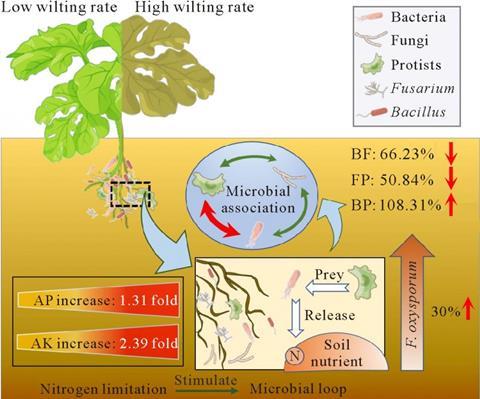
Co-occurrence network modeling showed a 2.08-fold increase in bacteria-protist connections in diseased soils, suggesting a breakdown in microbial balance. Structural equation modeling confirmed that available potassium, protist community structure, and F. oxysporum abundance were the top drivers of disease. These findings point to a new paradigm: that maintaining soil nutrient balance can steer microbial interactions toward suppressing pathogens naturally, even under the pressure of continuous cropping.
Hidden complexity
“Our study highlights the hidden complexity of soil microbial ecosystems and how managing these microscopic interactions can profoundly impact plant health,” said Dr. Tida Ge, the study’s corresponding author. “We’ve long known that beneficial bacteria help protect plants, but now we see that their partnerships with protists—shaped by soil nutrients—are just as crucial. Understanding and manipulating these relationships could unlock new eco-friendly ways to control soil-borne diseases like Fusarium wilt.”
The insights gained from this research open the door to sustainable, microbiome-based strategies for managing plant diseases. Rather than relying on chemical treatments or breeding disease-resistant cultivars alone, farmers could improve disease resistance by optimizing soil nutrient profiles to favor beneficial microbial interactions.
Future research may focus on isolating key protist-bacteria pairs and testing them in controlled environments to validate their protective roles. Ultimately, this work lays the foundation for developing precision soil health solutions—such as microbial inoculants or tailored fertilization regimes—that can be adapted across crops and regions to reduce the burden of soil-borne pathogens.


No comments yet