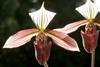
Paphiopedilum purpuratum, an endangered orchid species with critical conservation value, faces severe challenges in ex situ adaptation despite successful reproductive output.

Paphiopedilum_purpuratum_Orchi_2012-10-17_015

Source: Orchi

Paphiopedilum purpuratum

A novel study published in Biological Diversity reveals the integrated physiological and symbiotic adaptation mechanism underlying its ex situ conservation, led by Dr. Qifei Yi from the South China Botanical Garden, Chinese Academy of Sciences.

Using a combined framework of physiological assays, stable isotope analysis, and high-throughput fungal sequencing, this research systematically compared wild and ex situ P. purpuratum populations. Results demonstrated that ex situ conservation significantly elevated seed-set rate by 52%, yet incurred clear physiological trade-offs: declined photosynthetic capacity and enhanced oxidative stress.

Root-associated fungi exhibited distinct dual adaptive strategies. Mycorrhizal communities maintained compositional stability while restructuring into multi-cluster networks to enhance resilience; non-mycorrhizal fungi underwent substantial species turnover, shifting toward beneficial taxa with pathogen-suppressing potential. Host nitrogen metabolism was identified as the dominant driver reshaping fungal community assembly.

Balancing resources

These findings illustrate that P. purpuratum balances resource allocation between reproduction and stress tolerance under ex situ conditions, relying on a “stable mycorrhizal core plus dynamic non-mycorrhizal periphery” microbial strategy.

Low-Res_Graphical abstract (2)

Source: Yong Tan, Junxi Liang, Wentao Wang, Jianing Tian, Qifei Yi

Paphiopedilum purpuratum mediates adaptation via a dual-fungal strategy: Confronting a physiological trade-off (↑seed set vs. ↓photosynthesis), Paphiopedilum purpuratum restructures its root microbiome. Mycorrhizal fungi stabilize into a resilient core network, whereas non-mycorrhizal fungi shift to a dynamic beneficial periphery. This synergy defines a “core-periphery” framework for ex situ conservation.

This study establishes a new theoretical framework for orchid ex situ conservation, shifting management focus from survival assurance to integrated regulation of host physiology and symbiotic microbiomes. The team proposes optimized strategies including targeted mycorrhizal inoculation, precise microenvironmental regulation, and reproductive dependency resolution.