
Metabolic dysfunction-associated steatotic liver disease (MASLD) is an independent risk factor for cardiovascular disease (CVD). While gut bacteria have been linked to CVD, the role of intestinal fungi in subclinical coronary atherosclerosis (SCA) remains unclear. In this study, researchers aimed to investigate the association between the gut mycobiome and SCA in MASLD.
A cross-sectional study was conducted among 103 MASLD patients without established CVD. Fibrosis and steatosis were assessed using magnetic resonance elastography (MRE) and proton density fat fraction, respectively. SCA was defined by coronary artery calcification (CAC). Fecal fungal composition was analyzed via internal transcribed spacer sequencing.
Mean age was 60.8 ± 11.2 years; 51.5% were men; 20.4% had cirrhosis. CAC correlated with MRE (r = 0.489, p < 0.001), interleukin-6 (r = 0.407, p < 0.001), and tumor necrosis factor-α (r = 0.254, p = 0.018), but not proton density fat fraction. Cirrhosis patients had higher CAC than F0–F3 (456.9 vs. 205.9, p = 0.033).
Candida albicans (C. albicans) abundance was greater in cirrhosis and correlated with CAC (r = 0.403, p < 0.001) and MRE (r = 0.212, p = 0.032). In multivariate analysis, older age, diabetes, obesity, cirrhosis, and enriched C. albicans independently predicted CAC ≥ 100 AU in MASLD.
The findings
Our findings highlight the importance of evaluating SCA in patients with MASLD and advanced liver disease, even without overt clinical symptoms of CVD. Indeed, this is the first report of gut fungal dysbiosis associated with the severity of MASLD and SCA. Specifically, an increased abundance of fecal C. albicans was observed in patients with cirrhosis and high SCA burden.
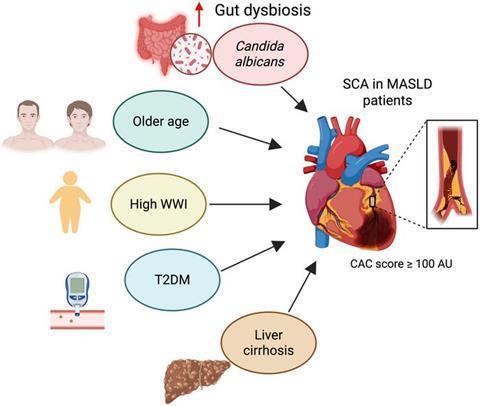
These data emphasize the essential role of specific fungi in the pathogenesis of both MASLD and CVD, which may offer promising avenues for developing novel, non-invasive diagnostic and prognostic biomarkers.
Moreover, further investigations are needed to determine whether integrating gut mycobiome data into clinical practice could facilitate personalized prevention and potential new therapeutic strategies for these critical cardiometabolic disorders.
The study was recently published in the Journal of Clinical and Translational Hepatology.




No comments yet