
The bacterium Xanthomonas oryzae pv. oryzae (Xoo for short) infects rice plants, causing the disease known as “bacterial blight”. While the infection mechanism is understood, it was not known how the pathogen spread within the plant.
This question is being examined at the Institute for Molecular Physiology at HHU headed by Professor Dr Wolf B. Frommer. The plant genome is reprogrammed so that the plant exports sugars from its cells, which the bacterial cells then feed on; this in turn causes the rice plants to lose valuable nutrients.
Tracing how bacterial blight spreads
A research team from Düsseldorf headed by Professor Frommer has now made two important discoveries, which they present in two articles in the scientific journals BMC Microbiology and Phytopathology.
The researchers surmise that Xoo infects rice plants via the leaves. To date, however, it has not been possible to exclude the potential mechanism of infection via the roots at the germination stage – for example via infected irrigation water – and subsequent spread to the shoots. The research findings have now established that this infection route is unlikely. There seems to be a barrier at the transition point between root and shoot, as they describe in Phytopathology.
Laura Redzich, lead author of the two studies and a former member of Professor Frommer’s Institute: “In fact, the infection spreads through the root vascular system until the so-called coleoptile nodes. We traced the induction of the sugar transporters the pathogen hijacks along the root vascular system. We did not find induction of sugar transporters beyond these nodes and the leaves of the young plants also showed no signs of the disease despite having infected roots.”
In members of the family of grasses, the coleoptile nodes are found at the base of the seedlings, from which the lateral shoots of the plant develop. Cells at these nodes, which play an active role in transporting substances into the xylem, seem to prevent the bacteria from passing through.
“Our findings expand our understanding of Xoo infection routes,” says Professor Frommer: “In addition, the method we have developed also provides a valuable tool for resistance testing and pathogen surveillance.”
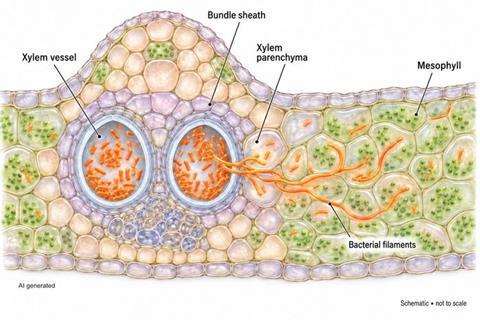
In the article in BMC Microbiology, the researchers report that the bacteria are capable of entering the plant cells in the leaf interior from the xylem. To do this, the bacteria must overcome various physical barriers, immune responses and the hydraulic xylem flow. For the purposes of the research, the bacteria were tagged with a fluorescent protein. The analyses showed that the bacteria take on filamentous, multicellular forms and traverse from the xylem into the neighbouring cells.
Different bacterial forms aid colonisation
Laura Redzich: “In the laboratory, we noted for the first time that the bacteria can assume a filamentous morphology. We also found greater numbers of rod-shaped Xoo cells. Both forms were particularly prevalent during the colonisation phase.”
The rod-shaped Xoo cells appear to attach to xylem pits as the infection progresses and enter the cells from that point. The filamentous form traverses the xylem to bundle sheath and subsequently (presumably) mesophyll cells.
Professor Frommer: “It is therefore likely that the lesions on the leaves and cell necrosis are not solely attributable to the fact that Xoo interrupts the flow of nutrients through the xylem. Rather, the bacteria also damage the plant tissue directly, leading to cell death.”
“We thus assume that Xoo differentiation into various forms during host colonisation plays a key role for virulence,” says Redzich, outlining the hypothesis the research team has derived from the study findings.
MICROBIOLOGY NEWS: Register with The Microbiologist for more free articles
The formation of filaments is also an important mechanism in other pathogens, not least in human pathogens such as the plague bacterium Yersinia pestis or the gut bacterium E. coli. Frommer: “In the case of bacteria harmful for humans, filamentation is a response to antibiotic treatment. By contrast, the Xoo filaments seem to be part of the development programme of the plant bacterium. This could be a potential starting point for tackling Xoo dispersion within the plant.”


No comments yet