
Apple replant disease (ARD) develops when apple trees are replanted in soil with a history of apple cultivation. Affected trees often show damaged roots, stunted shoots, and reduced fruit yield and quality, with reported losses of 20% to 50%. The disease is associated with shifts in soil microbial communities, but its severity also varies with soil properties, orchard history, and apple genotype.
Existing countermeasures, including soil disinfection, crop rotation, tolerant rootstocks, microbial inoculants, and biofumigation, can be costly, impractical, or inconsistent across locations. Previous transcriptomic studies also examined relatively few soils, limiting the search for universal diagnostic signals. Because of these challenges, in-depth research is needed to identify biomarkers that can diagnose ARD consistently across diverse soils.
Researchers from the Julius Kühn Institute (JKI) – Federal Research Centre for Cultivated Plants, Leibniz University Hannover, the University of Bayreuth, and Goethe University Frankfurt reported the study in Horticulture Research on 16 April 2026. The team used high-throughput quantitative polymerase chain reaction (qPCR) to measure the expression of 90 candidate genes in the roots of ARD-sensitive ‘M.26’ apple plants grown in soils from 151 German sites. They also examined leaves from plants grown in a subset of 18 soils, allowing a direct comparison of belowground and aboveground molecular responses.
Paired treatments
For each site, the researchers divided the soil into paired treatments: untreated soil represented the potentially ARD-affected condition, while gamma-irradiated soil served as a disinfected control with largely comparable physical and chemical properties. Plants were grown for six weeks, after which root and leaf samples were collected and analyzed. The team assessed each gene according to qPCR performance, the strength and consistency of its expression increase, and its correlation with reductions in shoot and root growth.
In roots, 72 of the 90 genes were significantly upregulated under ARD conditions, compared with only 11 in leaves. Twelve genes—ACO, B4Hb, BGIA, BIS3, BZL, CHS, CYP98A3, LAC7, MNL2, OMT1, PLP2, and TOPA—performed well across all selection criteria and were classified as the most promising root biomarkers. All 12 showed significantly higher normalized expression in ARD-affected roots than in controls (p < 0.001).
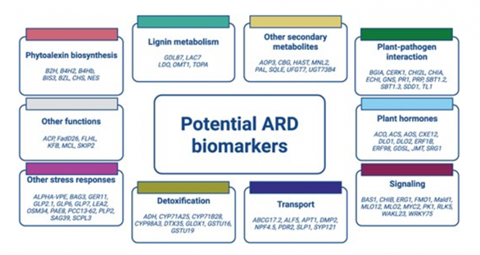
Their functions span antimicrobial phytoalexin production, cell-wall reinforcement through lignin, ethylene metabolism, detoxification, cyanide-related defense, and programmed cell death. Four genes—B2H, CHS, OSM34, and PCC13-62—were the strongest leaf candidates, but the smaller and less consistent leaf responses suggest that roots currently offer the more reliable diagnostic tissue.
Range of orchard environments
The authors said the value of the study lies in moving beyond results from a few individual soils and testing molecular responses across a broad range of orchard environments. They said the 12-gene root panel captures several connected defense processes rather than relying on a single pathway, which may make ARD assessment more robust. At the same time, they stressed that the markers should be viewed as promising diagnostic candidates, not a finished field test, because their specificity must still be examined under other stresses, in additional rootstock genotypes, and at different stages after planting.
MICROBIOLOGY NEWS: Register with The Microbiologist for more free articles
The biomarker set could support a standardized greenhouse assay for estimating how strongly apple plants respond to soil affected by ARD. Such a tool could help growers and nurseries compare prospective planting sites, evaluate rootstock tolerance, and test whether soil treatments reduce disease pressure before establishing a new orchard. It could also give researchers a common molecular framework for studying why ARD severity differs among soils.
However, the present results were obtained under controlled conditions with the susceptible ‘M.26’ rootstock, and leaf-based diagnosis remains less sensitive. Future work should validate the panel against unrelated biotic and abiotic stresses, test more apple genotypes, simplify sampling and analysis, and determine whether gene-expression scores reliably predict orchard performance under field conditions.
Topics
- apple replant disease
- Agriculture
- biomarkers
- Food Security
- Goethe University Frankfurt
- Healthy Land
- Julius Kühn Institute (JKI) – Federal Research Centre for Cultivated Plants
- Leibniz University Hannover
- M.26 rootstock
- Research News
- Soil & Plant Science
- soil microbial communities
- UK & Rest of Europe
- University of Bayreuth


No comments yet