
Sulfamethoxazole (SMX), a sulfonamide antibiotic, is frequently detected in environmental systems and remains a persistent contaminant in water, sediment, and soil. The removal of SMX in sewage treatment plants is ineffective, and its presence poses a serious ecological threat.

Constructed wetlands have become a critical strategy for treating such pollutants, yet their efficiency is limited by complex microbial interactions. Viruses, particularly bacteriophages, are abundant in these systems and influence microbial community dynamics. However, the role of viruses in degrading antibiotics and mitigating antibiotic resistance remains underexplored. This study investigates how viruses regulate microbial responses to SMX contamination and contribute to bioremediation.
A team of researchers from Qingdao University and several other institutions published (DOI: 10.1016/j.ese.2026.100698) a study on April 5, 2026, in Environmental Science and Ecotechnology, examining the role of viruses in SMX removal in constructed wetlands. The research demonstrates that the addition of phage-concentrated solutions (PCS) enhances the degradation of SMX by enriching SMX-degrading bacteria.
The study also highlights how lytic viruses reduce antibiotic resistance genes (ARGs) by lysing resistant bacteria. This work underscores the ecological significance of bacteria-phage interactions in wetland systems and their potential for improving bioremediation efforts.
Phage-concentrated solutions
The study focused on the impact of PCS on SMX removal in wetland sediments. The researchers observed a 35% increase in SMX removal efficiency when PCS was added compared to the control. PCS enriched bacterial populations capable of degrading SMX, particularly in the Proteobacteria and Firmicutes phyla, which are known for their role in antibiotic degradation. Additionally, the presence of PCS altered extracellular polymeric substance (EPS) production, enhancing biofilm formation, which plays a critical role in pollutant removal.
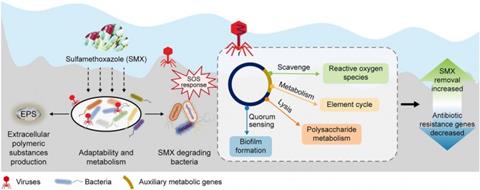
The study also revealed that lytic viruses, which destroy bacterial cells, significantly reduced the abundance of ARGs in the microbial community. These lytic viruses were found to be more abundant than lysogenic viruses in PCS-treated systems, indicating that viral predation on resistant bacteria was more influential than gene transfer via lysogeny. This study sheds light on how viruses can regulate microbial community structure and function, promoting efficient bioremediation of antibiotic contaminants while curbing the spread of resistance.
Antibiotic removal
“Our findings highlight the crucial role of viruses in enhancing antibiotic removal in wetland systems,” says Dr. Xiaohui Liu, the corresponding author. “By enriching SMX-degrading bacteria and limiting the spread of ARGs through lysis, viruses provide an innovative approach to bioremediation. The ability to regulate viral populations in constructed wetlands could offer a sustainable solution for managing environmental antibiotic contamination and reducing the global health threat of antibiotic resistance.”
This study paves the way for improving the efficiency of constructed wetlands in treating pharmaceutical contaminants, particularly antibiotics like SMX. By harnessing the natural ability of viruses to modulate bacterial metabolism, these findings suggest that engineered control of viral communities could optimize pollutant degradation processes in wetland systems. These results offer significant implications for the development of more sustainable and effective bioremediation strategies. Additionally, the study provides valuable insights into the role of viruses in controlling antibiotic resistance, potentially informing future efforts to mitigate the health risks posed by antibiotic-resistant bacteria.
Topics
- AMR in the Environment
- antibiotic resistance genes
- Antibiotics
- Antimicrobial Resistance
- Asia & Oceania
- Bacteriophages
- Biofilms
- Bioremediation
- Clean Water
- constructed wetlands
- extracellular polymeric substance
- Firmicutes
- Healthy Land
- lytic viruses
- phage-concentrated solutions
- Pollution and Remediation
- Proteobacteria
- Qingdao University
- Research News
- sulfamethoxazole
- Viruses
- Wastewater & Sanitation
- Xiaohui Liu





.jpg)
No comments yet