
The MLSFF Steering Committee explores the sustainability problem that plagues equity initiatives in STEM - and the solutions presented by the infrastructure partnership that delivers Europe’s only conference for minoritised life scientists.
Equity initiatives in STEM face a sustainability problem. This is not a problem of ideas, as there is no shortage of them, but of infrastructure. Across the UK’s higher education and the learned society landscape, grassroots groups working on diversity, inclusion, and representation routinely hit the same wall.
They have the expertise, the networks, and the moral urgency, but lack the organisational infrastructure to deliver at scale. Volunteer energy burns out. Coordination happens via email chains, WhatsApp groups, and goodwill. The work either stays small or collapses.
The life sciences sector has invested significantly in widening participation over the past two decades. Despite progress, the ‘pipeline’ still leaks at each ‘joint.’ Women remain underrepresented in senior scientific leadership. Disabled scientists face barriers to progression that institutional strategies have failed to remove. Ethnic minority researchers are disproportionately lost at each career transition. LGBTQ+ scientists report workplace climates that force them to weigh visibility against career safety, with many concealing their identity or considering leaving the profession entirely. For those who sit at the intersection of more than one of these identities, the barriers do not just add up; they multiply, narrowing the pipeline faster than any single dimension of disadvantage would predict.
Where it starts
This problem begins before university. At 16-18, subject choices, shaped by stereotyping, limited career guidance, and unequal access to laboratory experience, already narrow the pool of those who see themselves as future scientists. At each subsequent stage - from undergraduate to postgraduate, from early-career researcher to lecturer, from lecturer to professor, from bench scientist to senior professional in industry and policy - talent from marginalised backgrounds drops away. The cumulative effect is a discipline that does not reflect the society it serves. The Minoritised Life Scientists Future Forum (MLSFF) exists to intervene across this pipeline: to create the connections, visibility, professional development, and sense of belonging that help minoritised scientists stay, progress, and lead.
Funded by the Medical Research Council (MRC) and Wellcome and delivered through a partnership between our Steering Committee and Applied Microbiology International (AMI), the Forum has grown rapidly. The inaugural event in Birmingham in 2025 drew nearly 500 delegates from more than 125 organisations across 11 countries.
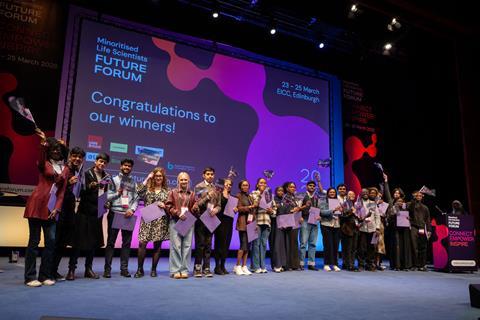
The second, held at the Edinburgh International Conference Centre in March 2026, brought together 480+ delegates from 128 institutions across 16 countries and featured more than 200 hours of scientific sessions, professional development workshops, and mentoring. The question we are most often asked is not why we created the Forum, as the pipeline data answers that. It is how we deliver it. The answer lies in an infrastructure partnership. What follows explains how and why the model matters beyond MLSFF.
The MLSFF model - and learned societies
MLSFF has a Steering Committee of seven people, comprising academics, researchers, and professionals working across UK higher education and the life sciences sector, and a partnership with AMI that enables conference delivery. AMI provides the operational backbone: website management, event registration, abstract submission systems, press and communications infrastructure, venue logistics, and the professional conference-organising capacity that turns a programme on paper into a three-day event for hundreds of delegates. The Steering Committee sets the strategic direction, including the intellectual agenda, programme themes, community partnerships, and the equity principles that shape every design decision, from speaker honoraria and branding to the conference dinner.
This division of labour matters because it addresses the sustainability problem that undermines most grassroots equity work. The people with the deepest understanding of what minoritised life scientists need are typically not the people with access to event management platforms, communications teams, or institutional budgets. Learned societies have all of these.
The harder step is deploying those resources to support agendas shaped by the communities they serve, rather than by society itself. AMI’s commitment to MLSFF goes beyond a grant, a one-off sponsorship, or a diversity session bolted onto an existing conference programme. It is an ongoing operational partnership in which the society provides its organisational capacity while the community retains strategic ownership. That distinction between providing infrastructure and setting direction is what makes the model work.
Beyond the conference
A conference that works becomes a platform that sparks further activity. Undergraduates and early-career researchers who gave their first conference presentations have since presented at disciplinary meetings with greater confidence. Researchers who met at MLSFF25 have launched collaborative projects.
The RSB Bioscience Awarding Gap Network now runs dedicated sessions within the MLSFF programme, extending its reach to a wider audience. These are the network effects that justify investment in infrastructure. They cannot be planned, but they require the conditions that professional grade delivery creates.
An example of this ecosystem growth comes from the Biochemical Society, which is offering five paid internships to attendees of MLSFF 2026. These four-week placements span marketing and communications, academic publishing, equity and inclusion strategy, outreach, and conference management.
This is another model of conference sponsorship: A learned society using its own operational structure to create tangible career development pathways for people who attended MLSFF. It converts three days of connection into weeks of professional experience within one of the sector’s most established organisations. Five internships from one society is a great start. Five internships from ten societies become a pipeline.
Reimagining partnerships
We are not naive to institutional constraints. Learned societies answer to their members, manage competing priorities, and operate within governance frameworks that do not always move quickly. However, the MLSFF experience suggests three practical, achievable steps.
First, recognise that funding is not the only contribution that matters, nor is it always the most impactful. When budgets are constrained, operational infrastructure becomes the more valuable offering: event platforms, communications capacity, registration systems, and staff expertise. These are assets that most learned societies already have, but that grassroots equity initiatives rarely do.
Second, create structured pathways from conference attendance to career development. The Biochemical Society’s internship programme is a model, as it leverages existing capacity and teams already engaged in marketing, publishing, and outreach to open doors that would otherwise remain closed. Every society with professional staff has the same opportunity.
Third, commit to partnerships in which the community sets the agenda. Integrating equity work into existing programmes is a reasonable first step, but pipeline challenges across career stages and institutions require models specifically designed for this purpose. What makes MLSFF distinctive is that the people it serves decide what it does. Learned societies that want to support this kind of work need to be comfortable providing the engine without steering the vehicle.
An invitation
A conference can run on momentum for a year or two. Sustaining a movement requires infrastructure that outlasts any single event. AMI understood this early. The Biochemical Society is demonstrating it differently. We know what one partnership can achieve. We are curious about what five could.

We are often asked what makes MLSFF work. The answer is not complicated. It works because a learned society chose to put its infrastructure behind a community-led agenda, and because a group of people who understood the problem was trusted to design the solution; that combination is replicable. We did not wait for permission to build the Forum. What made it work was a partner who did not wait to be asked.
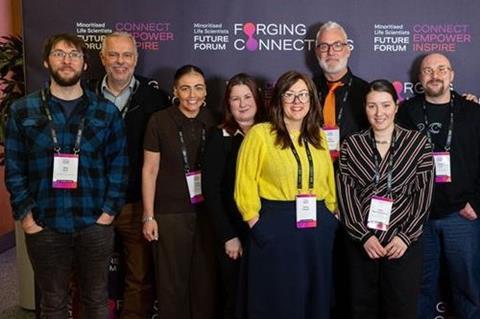
We are grateful for AMI’s support. A special thank you to the members of the AMI team who serve on the MLSFF Committees, namely Paul Sainsbury (Steering); Steve Brading and Linda Stewart (Marketing & Outreach); and Tina Sellwood and Emma Prissick (Finance).
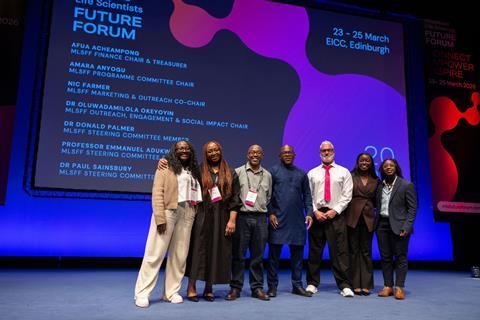
The MLSFF Steering Committee – Oluwadamilola Okeyoyin, Amara Anyogu, Emmanuel Adukwu, Afua Acheampong, Nic Farmer, Shana Owen, Donald Palmer






No comments yet