
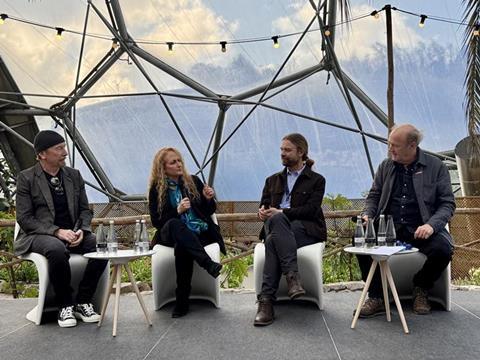
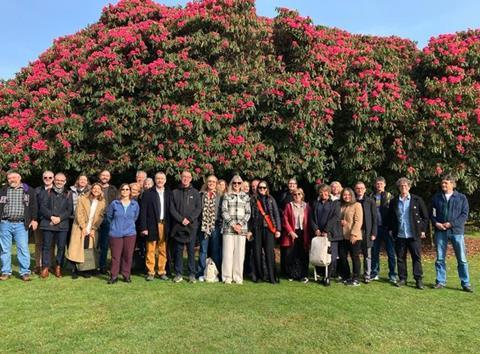
The Soil Stars network, hosted by Applied Microbiology International (AMI), brought together experts from across science, agriculture, policy, business and communications at the inaugural Soil Stars Heligan Summit in Cornwall in March 2026.
The gathering brought together an unusual mix of expertise and perspectives, including U2’s The Edge, author Philip Marsden, Eden Project co-founder Sir Tim Smit, and soil microbiologist Professor Jo Handelsman, Director of the Wisconsin Institute for Discovery.
The outcomes of the summit are now documented in a new meeting report, ‘Developing global goals for soil health research and action: Report on the “Soil Stars Heligan Summit”, The Lost Gardens of Heligan, UK, March 2026’ which is published in Sustainable Microbiology, an AMI publication.
At the heart of the initiative is a simple but urgent question: can the microscopic life beneath our feet help us restore the world’s soils?
Soil is fundamental
Soil is fundamental to food production, freshwater, carbon storage and biodiversity. Yet more than 40% of the world’s soils are now degraded, while the Food and Agriculture Organization estimates that 1.7 billion people live in areas where crop yields are declining because of soil degradation.
Soil Stars chair Dr Janet Jansson said: “Soil is the thin biological skin between the Earth’s bedrock and atmosphere, and the foundation on which the terrestrial food system, freshwater supply, terrestrial carbon stock, and most aboveground biodiversity depend.”
The crisis comes at a time when the agricultural model that delivered huge productivity gains during the second half of the 20th century is facing growing challenges. The Green Revolution brought major increases in crop yields through synthetic fertilisers and pesticides, but the report notes that yield gains have plateaued and are beginning to decline in many regions.
Biology under pressure
At the same time, soil biology is under pressure, with the microorganisms that underpin nutrient cycling, carbon storage and healthy soil ecosystems affected by degradation and intensive agricultural practices.
Lead author Professor Jo Handelsman said: “Although microbial technologies offer potentially transformative solutions, their wider deployment has been limited to date by inconsistent performance, inadequate measurement systems, regulatory barriers and weak incentives. We now need actionable, transformative advances in soil health to address this growing crisis.”
Seven challenges for healthier soils
The Heligan Summit was designed to move towards practical solutions. Through a combination of a grand-missions hackathon and expert roundtables, participants developed the first draft of the Heligan Grand Challenges – seven XPRIZE-inspired challenges with ambitious, measurable targets intended to be achievable within 24–36 months. The challenges cover both intervention and validation.
They include developing biological approaches to:
- lock more carbon into stable soil pools;
- increase the amount of water degraded soils can retain;
- reduce the movement of contaminants such as nitrate and phosphate into waterways;
- reduce soil erosion;
- reduce reliance on synthetic fertilisers without reducing crop yields;
- develop rapid, affordable tests capable of measuring overall soil health; and
- measure changes in the biological integrity and complexity of soils.
The challenges
The Carbon Lock Challenge seeks biological pathways that drive plant- and microbially-derived soil carbon into durable, slow-turnover pools that are not sensitive to rapid mineralization. The illustrative winning threshold is the identification of five carbon-lock molecules, and pathways to facilitate their increase, with measurable increases in the corresponding soil pools over 24 months, and credible evidence of stability within 36 months and predicted stability over decades to centuries.
The Water Sponge Challenge asks for either a 30% increase in soil water-holding capacity or a 20% reduction in irrigation demand in agricultural systems without yield or environmental penalty, validated across at least three soil types and climate regions within 24 months.
The Water Purification Challenge asks teams to reduce leaching of a target contaminant (nitrate, phosphate, or a degradable agrochemical) into streams and groundwater by ≥50% across at least three soil types and climate regions within 24 months.
The Save Our Soils (S.O.S.) Challenge asks for a 20% reduction in soil erosion, demonstrated by practices adopted across at least forty growers in three managed land systems within 24 months.
The Biological Fertilizers Challenge asks teams to demonstrate a 25% reduction in synthetic fertilizer use and accompanying nitrous oxide emissions, across three crop systems and two cropping seasons, with no yield penalty.
The Soil Health Diagnostic Test Challenge asks innovators to develop a rapid, affordable assay (results available within one week at low cost), validated across at least thirty farms, three regions and three soil types. The assay must serve as an integrative measure of soil health rather than any single property; therefore it must predict at least four of five core soil-health indicators spanning the physical, chemical and biological dimensions of function, each with greater than 70% accuracy, and remain applicable across major soil orders.
The B.I.O.M.E. (Biological Integrity, Observation, Monitoring and Evaluation) Challenge addresses the biological complexity of soils directly. It asks teams to develop a biocomplexity metric and demonstrate a >10% movement toward a regionally defined high-biocomplexity reference state within 24 months.
The summit also identified five factors that will be essential if promising solutions are to move from research into widespread use: validation infrastructure; scalability; regulation and biosafety; economics and policy alignment; and public engagement. The emphasis is on solutions that can work beyond the laboratory – under real farming conditions, across different soils and climates, and in ways that are affordable, practical and trusted by farmers and wider society.
From ideas to action
The Heligan Challenges are intended as a starting point rather than a finished framework. The Soil Stars will now work towards a formal peer-reviewed framework paper, a public-facing platform for the individual challenges, coordinated funding opportunities and international demonstration networks.
The next phase will also involve broader consultation with researchers, farmers, industry, policymakers and other stakeholders to test and refine the proposed targets.
“Soil recovery is no longer a scientific aspiration but a deployable agenda. What remains is a coordinated, mission-led architecture in which solvers can converge. The Heligan Challenges are a first attempt to build that architecture,” Dr Jansson said.
MICROBIOLOGY NEWS:Register with The Microbiologist for more free articles
The Soil Stars hope the challenges will provide a shared framework for researchers, innovators, funders and policymakers to work towards measurable advances in soil health – and help turn growing concern about soil degradation into coordinated action.
‘Developing global goals for soil health research and action: Report on the “Soil Stars Heligan Summit”, The Lost Gardens of Heligan, UK, March 2026’ is published in Sustainable Microbiology.







No comments yet