
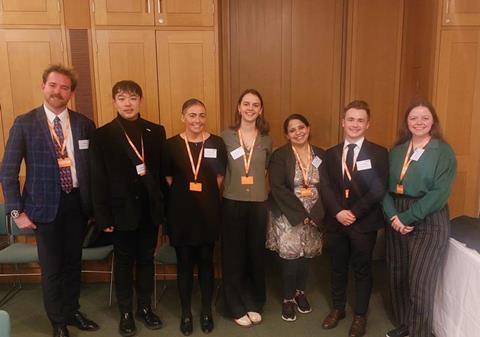
Earlier this year, Suparna Mitra and Alan Koh took part in the Royal Society of Biology’s Voice of the Future event at Parliament, representing AMI. Here they reflect on the experience and what they took away from it.
Dr. Suparna Mitra is Microbiome and AMR Research Lead in LMICs (India and Bangladesh) and Lecturer in Bioinformatics at the University of Leeds.
As I walked into the Attlee Suite at Portcullis House in the Houses of Parliament for Voice of the Future 2026, I felt a mix of excitement and curiosity. As researchers, we often work within our own scientific environments—labs, datasets, and field sites—but this was different. This was a space where science met policy, and where research connected directly to decisions shaping society.
I am an interdisciplinary researcher working at the interface of microbiome science, antimicrobial resistance (AMR), and global health, with a background in mathematics and data science. My work focuses on understanding how antimicrobial resistance genes circulate across human, environmental, and community systems, particularly in low- and middle-income countries such as India and Bangladesh, where antibiotic use is often widespread and unregulated at the community level.
AMR is not a problem confined to one country. The UK remains closely connected to global AMR dynamics through travel, migration, and shared environmental systems. My research therefore integrates metagenomic data, environmental exposures, and behavioural factors to support more context-specific surveillance and prevention strategies within a One Health framework.
Rare opportunity
I was drawn to Voice of the Future because it offered a rare opportunity to engage directly with policymakers and understand how scientific evidence is translated into decision-making. It was also an opportunity to represent microbiology and highlight the importance of areas such as AMR and the microbiome, which are often underrepresented in broader policy discussions.
The networking sessions were particularly valuable. I had inspiring conversations with Professor Catherine Ross FRSB, Chief Scientific Officer for Scotland, and Victoria Heath FRSB, Chief Healthcare Science Officer for Wales. Their insights into science communication and public engagement strongly resonated with me, particularly in relation to public trust in vaccines and biomedical research following the pandemic.
Both speakers emphasised that effective science communication is not simply about delivering information, but about fostering meaningful engagement. Victoria Heath highlighted the importance of co-production—working with communities rather than communicating to them—and ensuring healthcare science remains accessible, visible, and trusted.
Trust is fundamental
Professor Catherine Ross captured this powerfully when she said: “Trust is a resource—it needs to be protected and replenished.” In microbiology and AMR, where public behaviour directly affects outcomes, trust is fundamental. The discussions reinforced how communication must be proactive, transparent, and continuous—not only during crises but as part of routine engagement between science and society.
Another discussion that stood out focused on preparing for winter pressures, particularly influenza. Rather than reacting to seasonal surges, the approach described involved year-round planning and learning from global trends. Anticipating influenza patterns observed in Australia enabled vaccination programmes in the UK to be launched earlier, helping over half a million children receive vaccines in time. It was a strong example of how data, foresight, and timely communication can translate into meaningful public health impact.
The issue of misinformation also featured prominently. Concerns were raised about the influence of unreliable information sources, including social media and AI-generated content, highlighting the need for scientists to take a more active role in public communication and engagement.
Long-term stability
Discussions around research funding and early-career researchers were equally insightful. Emily Darlington MP spoke about the importance of long-term stability within research careers, while representatives from scientific societies highlighted the disconnect that can sometimes exist between government ambitions and the financial realities experienced within universities. Questions around talent retention also recognised the value of international experience while emphasising the need to strengthen opportunities for researchers within the UK.
One particularly interesting discussion involved the work of the House of Lords Numeracy Select Committee, which examines the causes and impacts of low numeracy. What resonated with me most was the idea that fear and lack of confidence in mathematics can become greater barriers than a lack of innate ability. This closely reflects what I observe among students from biology backgrounds, who often feel intimidated by quantitative approaches.
Through my teaching practice, I have found that clear explanations, strong foundational support, and simple real-world examples can significantly reduce this barrier, gradually transforming hesitation into confidence. This approach has also been recognised through my Fellowship of the Higher Education Academy (FHEA).
Thought-provoking discussion
A particularly thought-provoking discussion related to diet and health in the context of microbiome research. While interventions such as supermarket vouchers initially appeared promising in encouraging healthier eating, wider structural barriers—including transport limitations and access to fresh food—often influenced outcomes. These conversations reinforced the importance of designing policies that are grounded not only in evidence, but also in the lived realities of communities.
Overall, attending Voice of the Future strengthened my interest in working at the science–policy interface. It reminded me that impactful science is not just about generating evidence, but about ensuring it reaches the right people, in the right way, at the right time.
As I left Parliament that evening, one thought stayed with me: science has impact not only through discovery, but through dialogue. And if we want that impact to grow, we need to be present where those conversations are happening.
——————————————
Dr. Alan Koh is a research scientist at the MRC Laboratory of Medical Sciences and Imperial College London, where he studies rare human diseases.
My background is in microbiology, where I studied how bacteria develop antibiotic resistance and survive in hostile environments. More recently, I moved into working with the nematode Caenorhabditis elegans, a widely used animal model that allows researchers to study fundamental biology and model human disease at the level of the whole organism.
By combining microbiology with C. elegans disease models, I am interested in understanding how microbes and microbial communities influence health and disease. In the long term, I hope to use this system to explore how the microbiome contributes to rare human diseases and to identify microbial based approaches that could lead to new treatments for conditions where options are currently limited.
The Voice of the Future event is a rare opportunity for scientists to speak directly with policymakers who shape the UK research landscape. For me, it was a chance not only to raise questions that matter to researchers, but also to hear the perspectives of others across the life sciences community.
Moving towards real-world applications
My question focused on how the UK Government plans to ensure that research institutes have the facilities, infrastructure and long-term support needed to move discoveries from the laboratory into real-world applications. This is something I care deeply about because my work looks at potential treatments for rare human diseases, where the ability to translate discoveries efficiently could make a real difference for patients who often have very limited therapeutic options.
The discussion highlighted the increasing recognition of life sciences as key national infrastructure for the UK, underlining the sector’s importance for both health and innovation. While this acknowledgement was encouraging, it also made me reflect on how these ambitions will translate into practical support for researchers on the ground.
It left me thinking about what more could be done to support long-term, high-risk research and how scientists working across disciplines can be better supported to turn fundamental discoveries into therapies that benefit patients.
Taking part in the event has encouraged me to explore science policy further. It reinforced how important it is for scientists to engage with policymakers. Researchers bring first hand insight into the realities and challenges of doing science. These perspectives can help shape policies that will better support the research community and enable discoveries to make their way beyond the laboratory.






No comments yet