
Triple-negative breast cancer (TNBC) is an aggressive breast cancer subtype characterized by limited targeted treatment options, a high propensity for distant metastasis and variable responses to immune checkpoint blockade. Increasing evidence indicates that the tumor microbiome can influence cancer progression and therapeutic responses, yet the mechanisms through which intratumoral bacteria reshape the TNBC microenvironment remain poorly understood.
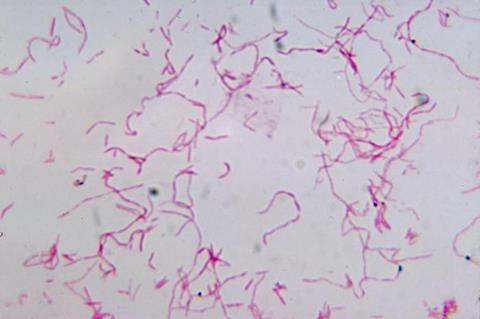
Fusobacterium nucleatum, a Gram-negative anaerobic bacterium associated with several cancers, has been detected in breast tumors and linked to metastatic progression, but its contribution to metabolic and immune regulation in TNBC has remained unclear.
A new study in Genes & Diseases by researchers from Chongqing Medical University, Chongqing Hospital of Traditional Chinese Medicine, and The First Affiliated Hospital of Chongqing Medical University identified F. nucleatum as a key driver of tryptophan metabolic reprogramming, immunosuppression and lung metastasis in TNBC.
Fluorescence in situ hybridization (FISH) analysis using specific probes, combined with confocal microscopy of human breast cancer tissues, revealed that F. nucleatum was more abundant in TNBC than in estrogen receptor-positive or HER2-positive breast cancer and was enriched in metastatic tumors. Experimental studies further demonstrated that F. nucleatum adhered to and invaded TNBC cells and promoted tumor growth, invasion and pulmonary metastasis in mouse models. These effects were accompanied by reduced infiltration and functional activity of CD8+ T cells, indicating that F. nucleatum contributes to an immunosuppressive tumor microenvironment.
Tryptophan metabolism
Transcriptomic analysis revealed activation of tryptophan metabolism and JAK–STAT signaling following F. nucleatum exposure, with marked induction of IL4I1, a tryptophan-metabolizing enzyme distinct from the classical enzymes IDO1 and TDO2. IL4I1 was elevated in breast cancer tissues and associated with poorer survival in TNBC. Genetic suppression of IL4I1 substantially reduced F. nucleatum-induced invasion, tumor growth, and lung metastasis, while restoring CD8+ T-cell infiltration and antitumor activity, identifying IL4I1 as a critical downstream mediator of the bacterium’s effects.
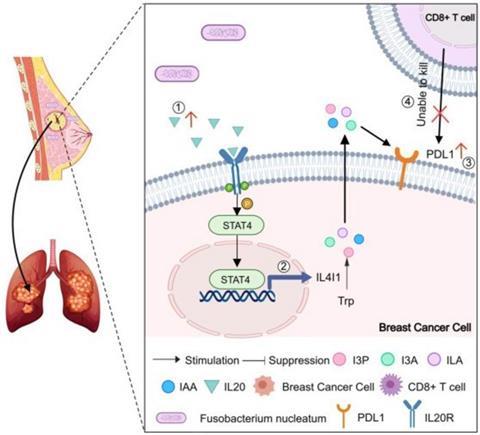
Mechanistically, the study demonstrated that F. nucleatum promotes IL4I1 expression through the IL20–JAK–STAT4 signaling axis. F. nucleatum increased IL20 secretion by TNBC cells, which activated JAK–STAT4 signaling and enhanced IL4I1 transcription. Promoter analyses and ChIP assays established STAT4 as a direct transcriptional regulator of IL4I1. Pharmacological inhibition of JAK–STAT4 signaling reduced IL4I1 expression and suppressed the pro-invasive effects of F. nucleatum.
Production of metabolites
LC-MS/MS further demonstrated that F. nucleatum enhanced the production of IL4I1-derived tryptophan metabolites, including indole-3-pyruvate (I3P), indole-3-acetic acid, indole-3-aldehyde and indole-3-lactic acid. I3P activated the aryl hydrocarbon receptor (AHR) pathway, promoted TNBC cell invasion and increased PD-L1 expression, providing a mechanistic link between bacterial metabolic reprogramming, tumor aggressiveness and immune escape. In mouse models, F. nucleatum also impaired the antitumor effects of anti-PD-1 therapy, increased tumor progression and lung metastasis, and reduced CD8+ T-cell activity.
MICROBIOLOGY NEWS: Register with The Microbiologist for more free articles
Overall, this study establishes an IL20–JAK–STAT4–IL4I1 cascade through which F. nucleatum reprograms tryptophan metabolism to promote immune evasion and metastatic progression in TNBC. These findings identify IL4I1 as a potentially actionable immunometabolic checkpoint and provide a mechanistic framework linking the tumor microbiome with metabolic and immune determinants of immunotherapy resistance.
Topics
- Asia & Oceania
- Bacteria
- Cancer Microbiology
- Chongqing Hospital of Traditional Chinese Medicine
- Chongqing Medical University
- Disease Treatment & Prevention
- Fusobacterium nucleatum,
- Immunology
- immunosuppression
- Infectious Disease
- lung metastasis
- One Health
- Oral Microbiome
- Research News
- The First Affiliated Hospital of Chongqing Medical University
- triple-negative breast cancer
- tryptophan metabolic reprogramming




No comments yet