
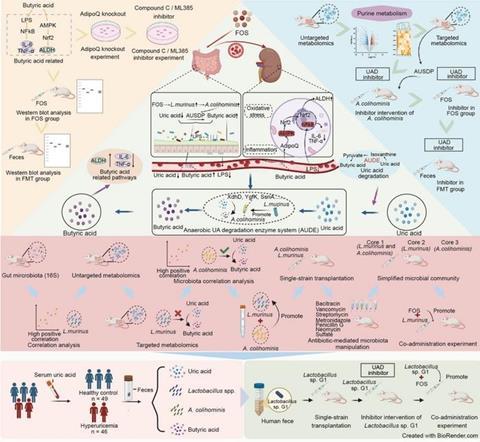
Scientists have systematically elucidated the complete mechanism through which the fructooligosaccharide-induced Ligilactobacillus murinus-Anaerotruncus colihominis axis reduces uric acid (UA) levels and protects the kidneys.

They revealed for the first time that FOS does not directly promote the growth of UA-lowering bacteria but instead acts indirectly by influencing the interactions among species within the ecosystem. Their study proposes an indirect “bacterium-regulating-bacterium” mechanism in which L. murinus modulates the gut microbiota to selectively enrich A. colihominis, a bacterium capable of direct UA degradation.
They demonstrated FOS alleviated oxidative damage to the kidney by activating the circulating butyrate-mediated ADIPOQ-AMPK-Nrf2-ALDH pathway. This study offers a new therapeutic rationale for employing prebiotics in the management of hyperuricemia (HUA) and related metabolic disorders.
Professor Wang Qi’s team has long been engaged in interdisciplinary research focusing on gut microbiota, metabolic diseases, and the preventive and therapeutic effects of traditional Chinese medicine. This study further elucidates the functional links between prebiotics, gut microbiota interactions, and uric acid metabolism.
This work was supported by the U40 (Scientific Research Innovation Capability Support Project for Young Faculty, SRICSPYF-ZY2025112), the National Key Research and Development Program of China (2024YFC3506304), the Taishan School Foundation of Shandong Province (NO. tsqn202312184), and the High-level Key Discipline of the National Administration of Traditional Chinese Medicine - Traditional Chinese Constitution Medicine (No.zyyzdxk-2023251).



No comments yet