
Increasing evidence suggests that our species emerged through interactions between populations living in different parts of Africa, rather than from a single birthplace. Until now, however, most explanations for how those populations were distributed across the continent have focused on climate alone. The new research shows that disease—specifically malaria—also played a crucial role.
In a paper published this week in Science Advances, researchers from the Max Planck Institute of Geoanthropology, the University of Cambridge, and colleagues investigated whether Plasmodium falciparum induced malaria shaped human habitat choice between 74,000 and 5,000 years ago, the critical period before humans dispersed widely beyond Africa and before agriculture dramatically altered malaria transmission.
The study shows that malaria, one of humanity’s oldest and most persistent pathogens, influenced habitat choice by pushing human groups away from high-risk environments and separating populations across the landscape. Over tens of thousands of years, this fragmentation shaped how populations met, mixed, and exchanged genes, helping create the population structure seen in humans today. The findings suggest that infectious disease was not simply a challenge early humans faced: it was a fundamental factor shaping the deep history of our species.
Mosquito complexes
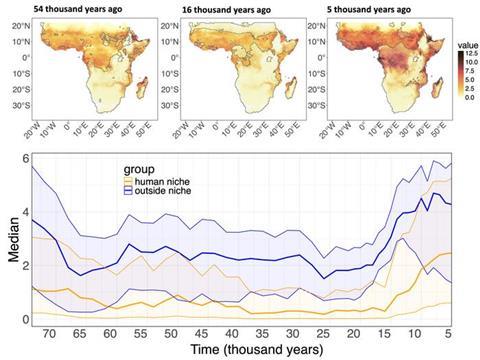
“We used species distribution models of three major mosquito complexes together with palaeoclimate models,” explains lead author Dr Margherita Colucci of the Max Planck Institute of Geoanthropology and the University of Cambridge. “Combining these with epidemiological data allowed us to estimate malaria transmission risk across sub-Saharan Africa.”

The researchers then compared these estimates with an independent reconstruction of the human ecological niche across the same region and time period. The results show that humans strongly avoided, or were unable to persist, in areas with high malaria transmission risk.
“The effects of these choices shaped human demography for the last 74,000 years, and likely much earlier,” says Professor Andrea Manica of the University of Cambridge, one of the senior authors of the study. “By fragmenting human societies across the landscape, malaria contributed to the population structure we see today. Climate and physical barriers were not the only forces shaping where human populations could live.”
Human evolution
“This study opens up new frontiers in research on human evolution,” adds Professor Eleanor Scerri of the Max Planck Institute of Geoanthropology, also senior author of the study.
“Disease has rarely been considered a major factor shaping the earliest prehistory of our species, and without ancient DNA from these periods it has been difficult to test. Our research changes that narrative and provides a new framework for exploring the role of disease in deep human history.”



No comments yet