
Fungal mycelium is a promising renewable material, but conventional processing generally eliminates the living activity that could support growth, repair and environmental response.
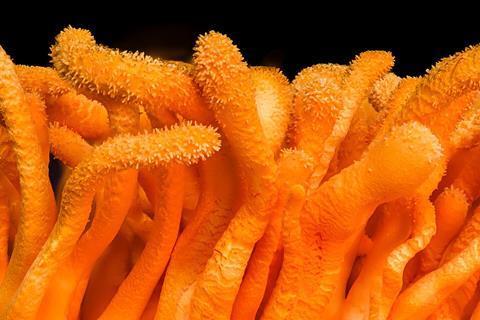
Recently, a study published in Science Advances and led by Zhong Chao from the Shenzhen Institutes of Advanced Technology (SIAT) of the Chinese Academy of Sciences developed a flexible living textile based on caterpillar fungus, or Cordyceps militaris.
Fungal textile
The researchers grew caterpillar fungus in liquid culture, where it formed spherical mycelial pellets composed of intertwined fungal filaments. After being collected and placed into molds, the pellets naturally bonded during mild drying to form free-standing sheets without additional scaffolds or adhesives.
Glycerol treatment reduced the brittleness of the dried sheets, allowing them to be folded, cut and sewn. A rope twisted from four narrow strips could support a one-kilogram weight.
READ MORE: Under the Microscope: Microbes in fashion
The researchers assembled the functionalized sheets into a prototype dress, demonstrating that the material could be shaped and sewn into larger structures. Further work is needed to improve manufacturing consistency, washability, abrasion resistance and control over biological activation.
Self-colouring, self-cleaning and self-repairing clothes
The team also introduced additional biological functions. Engineered yeast cells generated pale blue, red, orange and purple colors, while nutrient-induced aerial hyphae enabled patterned growth and self-cleaning surfaces.
Melanin-rich aerial hyphae from Aspergillus niger further provided ultraviolet protection. Under humid, nutrient-rich conditions, some cells could become active again, enabling regrowth and repair; in soil composting tests, the material almost completely degraded in just over 40 days.
MICROBIOLOGY NEWS: Register with The Microbiologist for more free articles
As the authors noted, “Beyond textile analogs, this paradigm provides a foundation for the broader development of adaptive, living material platforms across biomedical, environmental, and architectural domains.”
Topics
- Asia & Oceania
- Aspergillus niger
- Bioengineering
- biomaterials
- caterpillar fungus
- Cordyceps militaris
- Economic Equality
- fashion
- fashion industry
- Fungi
- Healthy Land
- Innovation News
- leather alternatives
- Microbial Biotechnology
- mycelium
- mycelium leather
- Mycology
- Natural Products
- Sustainable Microbiology
- textile industry
- textiles
- Zhong Chao



No comments yet