
Microplastics and nanoplastics are tiny plastic particles that result from the breakdown of larger plastic products due to sunlight, waves, and other environmental conditions. In recent years, these particles have been increasingly detected in aquatic environments, raising concerns about their potential harmful effects on aquatic life and ecosystems. Even though awareness of this issue is growing, there is still no safe, practical, and established method to filter these particles from polluted water.
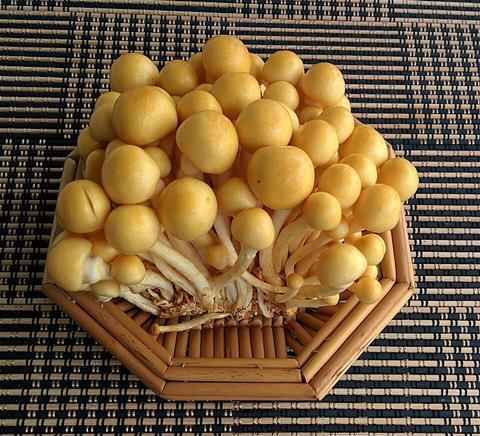
In this context, a team of researchers at Shinshu University led by Professor Hiroshi Moriwaki from the Department of Applied Biology, along with student Kurumi Ono and Professor Yoshitake Akiyama from the Department of Mechanical Engineering and Robotics, Faculty of Textile Science and Technology, Shinshu University, Japan, investigated safe, natural methods that could help address this increasing environmental challenge.
Their study, made available online in the journal Chemosphere on March 28, 2026, and published in Volume 401 on May 1, 2026, explores the use of natural mucilage obtained from an edible mushroom (nameko) for efficient removal of microplastics from water.
Slippery surface
Nameko mushrooms (Pholiota nameko) are widely consumed in Japan and are well known for their characteristic slippery surface. Their sliminess derives from mucilage, which is rich in polysaccharides, particularly pectin—a naturally occurring plant-based compound—which is known for its particle-binding properties. By relying on these properties, the researchers explored whether the use of pectin-rich nameko mucilage could be an effective water treatment strategy for microplastic pollution.
“We chose nameko mushrooms because they are inexpensive and widely available in Japan,” says Prof. Moriwaki. “Moreover, their mucilage is safe and non-toxic, making it a sustainable solution.”
To investigate its use, the team prepared a mucilage solution by immersing and shaking the mushrooms in water for five minutes. Once prepared, they used this mucilage solution along with a solution of iron (Fe(III)) ions to treat contaminated water. When these two solutions were added to suspensions containing microplastics of polystyrene, the plastic particles in the water rapidly began to clump together and form visible fibrous flocs within just a few minutes.
Pectin forms a gel with iron ions
“The pectin in the mucilage forms a gel with iron ions, which helps bind the plastic particles into removable flocs through Coulombic forces,” explains Prof. Moriwaki.
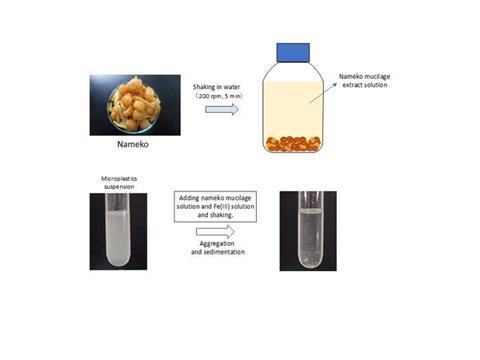
The method achieved a 95.3% removal rate for microplastics with a size of 1.0 μm. When tested on nanoplastics (polystyrene, ~100 nm in size), the removal rate was 87.4%, demonstrating both speed and efficiency. Additionally, when researchers used wastewater generated from washing the nameko mushrooms, the removal rate for microplastics was 98.4%. This interesting finding could open the door to repurposing industrial wastewater from nameko processing plants, turning a disposal challenge into a sustainable water treatment resource.
The impact of this work is significant for both society and industry. The nameko mucilage offers a safe and highly practical alternative compared to conventional chemical flocculants. Additionally, the residues (flocs) resulting from the treatment are also biodegradable, which minimizes the overall environmental impact. Looking ahead, the researchers believe this technique could advance wastewater treatment and large-scale water purification, paving the way for a safer and more sustainable future.







No comments yet