
Severe acute respiratory syndrome coronavirus 2 (SARS-CoV-2) remains a significant global health threat, largely due to its rapid evolution and high mutation rate, which often compromises the performance of existing molecular diagnostics.

While conventional double-antibody sandwich immunoassays are widely used for rapid testing, their effectiveness is frequently hindered by structural steric hindrance and limited sensitivity when detecting small viral components like the nucleocapsid (N) protein.
New research, published in the Genes & Diseases journal by a team from Hunan University, Texas A&M University Colleges of Medicine and Pharmacy, Baylor College of Medicine, and The University of Texas, investigated a novel DNA aptamer, NP14, and developed an innovative dual-mode biosensing platform to achieve highly sensitive, mutation-resilient viral detection.
Using a computer-assisted X-aptamer Systematic Evolution of Ligands by EXponential enrichment (SELEX) strategy, the researchers successfully identified NP14, a high-affinity DNA aptamer that specifically targets the N-terminal domain of the SARS-CoV-2 N protein. Comprehensive molecular docking, targeted mutagenesis, and structural analyses revealed that the nucleotides C24 and G27 within the P1 region of the aptamer act as critical determinants for its exceptional target recognition.
Robust binding mechanism
Building upon this robust binding mechanism, the research team engineered an advanced multicolor dynamic light scattering-enhanced enzyme-linked aptamer-antibody assay (MD ELAAA). This system seamlessly synergizes two complementary detection techniques: non-aggregative plasmonic colorimetry for rapid naked-eye visual screening and dynamic light scattering (DLS) for ultrasensitive quantitative analysis. Within this platform, alkaline phosphatase-catalyzed reactions trigger the highly localized deposition of silver onto specialized gold nanoflowers (AuNFs), robustly amplifying both the optical colorimetric and light scattering signals.
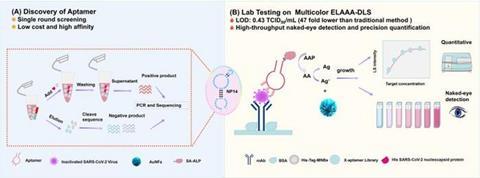
Remarkably, rigorous analytical testing confirmed that this integrated dual-mode platform exhibits broad-spectrum recognition across multiple diverse SARS-CoV-2 variants and achieves an astonishingly low limit of detection of 0.43 TCID50/mL. This remarkable performance represents a striking 47-fold sensitivity improvement over traditional antibody-based detection methods, successfully allowing for the precise quantification of trace, low-abundance antigens in virus cultures.
Critical advantage
While these collective data robustly highlight the critical advantage of combining customized aptamer-antibody interactions with localized plasmonic signal amplification, additional real-world clinical diagnostic studies are necessary to fully integrate this dynamic system into routine point-of-care settings.
In conclusion, deploying the high-affinity NP14 aptamer within the sophisticated MD ELAAA platform offers a powerful, dual-action diagnostic strategy to simultaneously overcome the rigid limitations of viral mutation evasion and low target antigen concentration. This profound finding positions dual-mode aptamer-driven biosensors as incredibly compelling technological candidates for the next generation of highly reliable infectious disease diagnostics and high-throughput global pandemic surveillance.






.jpg)
No comments yet