
Even though sugars are often framed as simple sources of energy, they also serve as structurally complex and functionally diverse molecules that mediate interactions between organisms. Among these, β-1,2-glucans, which are a class of glucose-based polymers, stand out for their varied and sometimes subtle roles.

Found across a wide range of organisms, these molecules are implicated in processes such as bacterial survival, host infection, and symbiosis. For example, the pathogen Brucella abortus deploys cyclic β-1,2-glucans to prevent its own destruction inside host immune cells, shielding itself from the host’s defenses.
Similarly, plant pathogens in the genus Xanthomonas rely on these compounds to establish infection in plants such as Arabidopsis thaliana and Nicotiana benthamiana. Understanding how bacteria produce, use, and traffic these molecules is therefore quite relevant to plant health and infection biology.
Research into β-1,2-glucan biology has accelerated in recent years, particularly concerning enzymes that degrade these sugars. However, the question of how bacteria actually import and export β-1,2-glucans across their membranes has received little attention.
Transport is a critical step and a core element of survival strategy; without it, bacteria cannot access extracellular β-1,2-glucans as resources, leaving the full metabolic picture incomplete. To date, only a few of the bacterial transport systems associated with β-1,2-glucans have been studied, and the limited data available suggest these systems differ considerably from one another. This implies that substantial diversity in β-1,2-glucan transport biology has yet to be discovered.
Molecular machines
To tackle this open question, a research team led by Associate Professor Masahiro Nakajima from the Faculty of Science and Technology, Tokyo University of Science (TUS), Japan, and Professor Hidetaka Torigoe from TUS, alongside Associate Professor Hiroyuki Nakai from Niigata University, Japan, identified and structurally characterized a new type of β-1,2-glucan-binding protein.
Their study, published online in The FEBS Journal on May 10, 2026, focuses on a solute-binding protein (SBP) of an ABC transporter, a class of molecular machines that use energy to import specific molecules into cells, obtained from the anoxygenic, phototrophic bacterium Chloroflexus aurantiacus Y-400-fl.
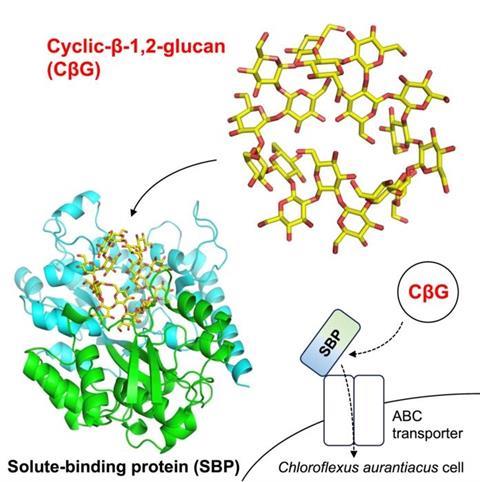
The SBP protein in question, called Chy400_4166, sits within a gene cluster encoding multiple putative β-1,2-glucan-processing enzymes in C. aurantiacus. The researchers first used gel shift assays to test whether Chy400_4166 binds β-1,2-glucans. Then, they applied isothermal titration calorimetry (ITC), a method that measures the heat released or absorbed during molecular binding, to quantify binding strength and thermodynamic properties across a range of linear and cyclic β-1,2-glucans of different sizes. Finally, they investigated the three-dimensional structures of Chy400_4166 in complex with β-1,2-glucans using X-ray crystallography, achieving atomic-level resolutions from 1.27 to 1.95 Å.
The findings
Chy400_4166 exhibited strong binding to both linear and cyclic β-1,2-glucans but not to a structurally different β-glucan derived from barley, confirming the protein’s selectivity. Crystal structures revealed that 10 consecutive glucose units (designated as units A–J) form the core-binding interface shared across all substrates tested. One unit (unit G) in particular is tightly anchored by highly conserved amino acid residues, pointing to this region as central to the protein’s function.
Moreover, unlike the only previously characterized β-1,2-glucan SBP (from Listeria innocua), which grips the end of short oligosaccharide chains, Chy400_4166 binds to the middle segment of a longer glucan chain, which is a suitable segment for acting on cyclic β-1,2-glucans. Chy400_4166 also displays an interesting degree of structural flexibility, containing a residue that can shift its conformation to accommodate cyclic glucans of varying sizes.
“These findings are intriguing in that they imply a remarkable diversity among β-1,2-glucan-associated binding proteins,” highlights Dr. Nakajima.
Why it matters
The identification and characterization of Chy400_4166 have direct implications for understanding how bacteria interact with β-1,2-glucans in ecological and host-associated contexts. Since cyclic β-1,2-glucans are used by multiple pathogens to manipulate host biology, proteins capable of binding to these molecules represent potential points of intervention in infection processes.
By competitively administering cyclic β-1,2-glucans to plants, it may be possible to interfere with the infection process of pathogens that rely on these molecules to cause an infection. Ultimately, this approach could neutralize the pathogen’s ability to invade the host, leading to the development of biological pesticides and offering a sustainable and eco-friendly alternative for crop protection.
Moreover, because cyclic β-1,2-glucans can encapsulate other substances within their ring structure, the transport system described in this work could serve as a basis for probing how these sugars move and function inside living organisms, which could guide the development of drug delivery systems. Also, understanding the transport system of bacteria could have potential applications in the fields of environmental remediation and food technology.
“Through the search for enzymes and proteins that act on glucans, we are trying to shine a spotlight on glycans that have not yet received much attention and elucidate their roles in nature and potential uses,” concludes Dr. Nakajima. “The discovery of this novel β-1,2-glucan transport system provides a crucial stepping stone toward understanding the relevance of β-1,2-glucan, which is rare yet widespread in nature.”
Topics
- Asia & Oceania
- Bacteria
- bacterial transport systems
- Brucella abortus
- Chloroflexus aurantiacus Y-400-fl
- Chy400_4166
- cyclic β-1,2-glucans
- Food Security
- Healthy Land
- Hidetaka Torigoe
- Hiroyuki Nakai
- Infection Prevention & Control
- Infectious Disease
- Masahiro Nakajima
- Niigata University
- One Health
- Research News
- Soil & Plant Science
- Structural Biology
- Tokyo University of Science
- Xanthomonas



No comments yet