
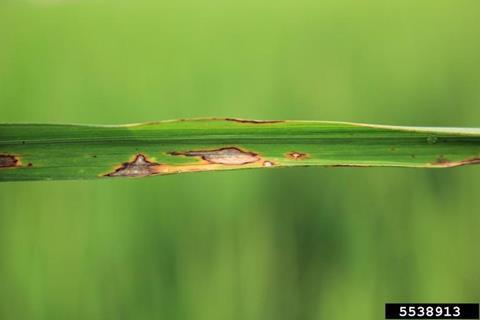
Rice blast is a major disease of rice and a persistent threat to food security. Traditional manual inspection is subjective and slow, making it unsuitable for large breeding programs. unmanned aerial vehicle (UAV) hyperspectral sensing is accurate but expensive, while visible cameras often cannot capture fine leaf and canopy details.
Infrared sensors can detect canopy temperature changes caused by infection, offering complementary information. However, combining visible and infrared data remains difficult: models must adaptively balance both modalities, preserve local and global representations, and avoid costly multi-scale fusion. Because of these challenges, further research is needed to develop accurate, efficient and field-ready visible-infrared phenotyping for rice blast resistance.
Researchers from Guangdong Polytechnic Normal University, Fujian Agriculture and Forestry University, South China Agricultural University, Zhongkai University of Agriculture and Engineering, and Lingnan Normal University published (DOI: 10.1016/j.plaphe.2026.100191) the study in Plant Phenomics in 2026 (article 100191).
The team developed the parallel ResNet-Transformer and cross-modal attention (PRCA) network and built a UAV-based visible-infrared dataset for RBR identification (UVI-RBR) covering 530 rice plots. They compared the method with leading visible-infrared fusion and hybrid vision transformer models, and validated each component through ablation tests.
Three bottlenecks
The PRCA framework addresses three bottlenecks in visible-infrared rice blast resistance (RBR) identification. First, it runs ResNet-50 and Vision Transformer (ViT)-Base/16 in parallel branches, so convolutional local features and transformer global context are learned independently before fusion.
Second, the visible-infrared cross-modal (VICM) attention module includes visible-dominant and infrared-dominant branches, enabling cross-modal collaboration rather than letting one modality dominate.
Third, the lightweight multi-scale feature fusion (LMFF) module uses two-dimensional (2D) adaptive average pooling and concatenation to combine shallow and deep features with no extra parameters and low computational cost.
On the UVI-RBR dataset, which contains 250 light, 228 medium, and 52 heavy disease samples, the model achieved 94.44% OA, 90.56% kappa, 94.71% F1-score, and 95.79% recall. It outperformed state-of-the-art methods including SGIEL, CAFF-DINO, CSDN, MSCMNet, PMFA, R50ViT, SBCFormer, Pest-ConFormer, BMFH-Net, and HTR-VT. Ablation showed visible-infrared fusion improved overall accuracy (OA) by 8.33% over single modalities, while gradient-weighted class activation mapping (Grad-CAM) indicated the transformer branch captured global cues and the ResNet branch focused on local patterns; infrared became more important for heavy severity.
Data lead where they are strongest
The authors said the advance lies in letting visible and infrared data contribute where they are strongest, instead of forcing one modality to lead. They said the parallel branches keep local texture and global context intact, while the cross-modal attention balances color, structure and canopy temperature signals. They added that the lightweight fusion step improves accuracy without adding parameters, which is important for real field use. The authors said this balance makes the network practical for large-scale rice breeding and resistance screening.
MICROBIOLOGY NEWS: Register with The Microbiologist for more free articles
The PRCA method could speed up rice blast resistance screening, help breeders select resistant varieties, reduce reliance on chemical control, and support global food security. Because it uses relatively affordable UAV visible and infrared cameras, it may be easier to deploy than hyperspectral or time-series systems. The authors suggest the same framework could support quantitative inversion of other phenotypic traits, such as canopy temperature and drought tolerance. Future work will focus on knowledge distillation and pruning to reduce model parameters and improve inference speed.
Topics
- Agriculture
- Asia & Oceania
- Food Security
- Fujian Agriculture and Forestry University
- Fungi
- Guangdong Polytechnic Normal University
- Healthy Land
- Infection Prevention & Control
- Infectious Disease
- infrared sensors
- inspection
- Lingnan Normal University
- Research News
- rice blast
- rice blast resistance
- screening
- Soil & Plant Science
- South China Agricultural University
- visible-infrared phenotyping
- Zhongkai University of Agriculture and Engineering




No comments yet