
Cowpea (Vigna unguiculata) supplies dietary protein, livestock feed, and income in tropical and subtropical regions, while its nitrogen-fixing ability adds agricultural value. Genome sequencing has provided researchers with numerous candidate genes, and genetic transformation has enabled studies of traits such as drought and heat tolerance.
However, stable transformation requires extensive preparation and lengthy screening, and its performance depends strongly on plant genotype. Virus-induced gene silencing offers a faster alternative by using viral vectors to trigger the plant’s own gene-silencing machinery. Yet existing approaches have performed inconsistently in cowpea, leaving researchers without a dependable, broadly applicable method for rapidly linking genes to biological functions.
A study published in Tropical Plants on 08 October 2026 by Ying Zhou’s team, Zhejiang University, reports sustained gene silencing across seven cowpea varieties and demonstrates the system’s utility for investigating jasmonate regulation during leafminer infestation.
Adapting a vector
The researchers adapted a CPSMV vector previously used in soybean, inserting 300-base-pair fragments of selected cowpea genes. They first targeted VuPDS, which encodes phytoene desaturase, using leaf whitening as a visible indicator of silencing. Modified vectors were introduced into young seedlings through Agrobacterium, and two delivery methods were compared: vacuum infiltration after leaf wounding and infiltration with a needleless syringe.
To assess applicability across genetic backgrounds, the team tested seven varieties differing in growth habit, seed coat color, and pod characteristics. Gene expression was measured using quantitative reverse transcription PCR. For functional validation, sequence comparisons and phylogenetic analysis identified four cowpea MYC2 homologs associated with jasmonate signaling. Each gene was silenced separately in the variety ‘Haiyate’.
Four weeks after inoculation, plants were exposed to 20 adult vegetable leafminers, Liriomyza sativae, for seven days. The researchers then measured target gene expression and hormone concentrations using liquid chromatography coupled with tandem mass spectrometry, with three biological replicates per treatment. Needleless syringe infiltration caused less tissue damage and delivered the bacterial suspension more effectively than vacuum infiltration. It also reduced treatment time from 10–15 minutes to 3–5 minutes per seedling.
Whitening in leaves
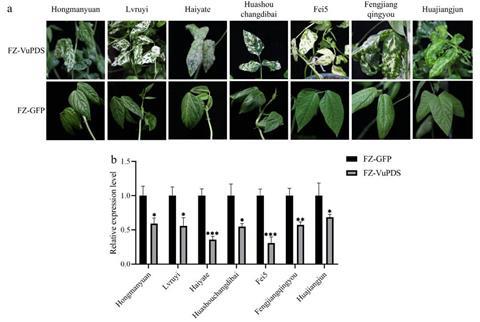
Silencing VuPDS produced whitening in newly formed leaves within two to three weeks, with the phenotype persisting through at least eight weeks after inoculation. All seven varieties responded, although whitening intensity varied: ‘Haiyate’ and ‘Fei5’ showed the strongest responses, whereas ‘Huajiangjun’ showed the weakest.
Molecular measurements confirmed reduced VuPDS expression. In the functional experiments, expression of the four VuMYC2 genes fell by approximately 51.0%–77.7%. Silencing any of these genes significantly reduced jasmonic acid accumulation in insect-infested leaves.
Silencing VuMYC2-4 additionally lowered the jasmonate precursor 12-oxophytodienoic acid and the conjugate jasmonoyl-isoleucine, indicating differences among the homologs in their effects on hormone regulation. Together, these results linked measurable molecular changes to visible and physiological responses.
MICROBIOLOGY NEWS: Register with The Microbiologist for more free articles
The study provides cowpea researchers with an accessible toolkit for moving from candidate genes to experimental evidence of their functions. Its relatively simple delivery method, sustained silencing, and effectiveness across contrasting varieties could support studies of plant development, hormone signaling, and stress responses. Although improved crop varieties remain a future application, the platform offers a practical foundation for identifying genes worth pursuing in breeding programs.






No comments yet