
Two people take the same course of antibiotics to clear Helicobacter pylori, the bacterium behind most stomach cancers. One sees their gastric cancer risk drop sharply; the other gains far less. A study published in The Innovation shows that much of this difference is predictable — written in the host’s own genome.
H. pylori infection is the most controllable major risk factor for gastric cancer, and population “screen-and-treat” programs are a priority for prevention in high-incidence regions. But protection varies widely: some people benefit enormously, others only modestly, and some remain at high risk even after successful eradication. With antibiotic resistance rising and public health budgets finite, the practical question is whom to treat first.
“Receiving the same eradication treatment, different individuals gain different levels of protection,” the team writes in the release accompanying the paper. “We wanted to answer a question closer to real public health practice: under limited resources, who most deserves priority intervention — and who still needs closer long-term risk management after eradication?”
Randomized trials
To answer it, researchers at Peking University Cancer Hospital analyzed two randomized trials in Shandong Province: the Mass Intervention Trial in Linqu (1,740 participants, eradication versus symptom-alleviation treatment) and the Shandong Intervention Trial (1,811 participants, eradication versus placebo). Screening 47,203 genetic variants, they identified 2,045 whose effect interacted with treatment in the discovery trial and confirmed 11 in the independent validation trial. The 11 were combined into a polygenic treatment benefit score (PTBS) — an estimate of how much gastric cancer prevention an individual can expect from eradication, computed with machine-learning methods and independent of conventional genetic risk scores.
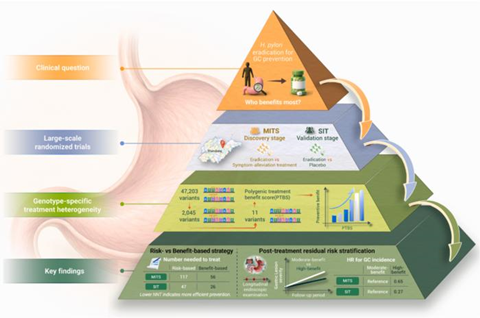
The score proved robust. Among high-benefit individuals, eradication cut gastric cancer risk by 56% in the discovery trial (hazard ratio 0.44) and by roughly 80% in the validation trial (HR 0.20), with numbers needed to treat of 56 and 26. Treating every infected person instead would take 112 treatments to prevent one case; targeting by predicted benefit also outperformed a strategy based on genetic risk alone — high baseline risk, the authors note, does not mean high treatment benefit.
Eradication and aftermath
The score also sorts out the aftermath. After eradication, high-benefit individuals had lower residual risk than moderate-benefit ones (HR 0.65 and 0.27 in the two trials) and slower progression of precancerous lesions — pointing to closer endoscopic surveillance for those with moderate predicted benefit.
MICROBIOLOGY NEWS: Register with The Microbiologist for more free articles
The score was derived and validated in trials from a single high-incidence county in China, so its performance in other populations remains to be tested. The authors provide a web tool for individual calculation and position PTBS as a way to sharpen screen-and-treat programs and post-treatment follow-up — a complement to, not a replacement for, existing clinical indications for eradication.






No comments yet