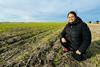
“The microbes under our feet may be tiny — but their collective behavior could shape the planet’s climate trajectory.”

For Dr. Taniya RoyChowdhury, a soil microbial ecologist and biogeochemist at the Woodwell Climate Research Center, a typical day begins before sunrise.

IMG_9231 (1)

After a soft meditation and visualization, she reviews data from experiments, catches up on emails, and mentally maps the day ahead — from setting up laboratory experiments to mentoring interns and connecting research findings to real-world climate solutions.

Morning: soil, microbes and carbon pathways

Her research focuses on linking microbial identity with metabolic function — understanding how different agricultural and land-use practices affect carbon sequestration, soil health, and ecosystem resilience. 

The tasks often involve meticulous, sometimes tedious, and often underappreciated steps that make robust science possible. This could include soil processing like sieving for days and isolation of biomolecules like DNA and RNA with high precision and quality. Or troubleshooting instruments for months.

Midday: from local to global questions

Collaboration defines much of Dr. RoyChowdhury’s work. Meetings with colleagues span projects from salt marsh biogeochemistry in restored marshes to large-scale cover crop adoption outcomes on soil carbon.

“Science is always a team sport,” she says. “No single person can capture the complexity of ecosystems, or translate microbial processes into climate solutions on their own. Collaboration across disciplines, institutions, and communities is what allows us to make meaningful progress.”

Dr. Taniya RoyChowdhury - WCRC Lab - 2024-56

Grantsmanship and fieldwork exemplifies this teamwork. In a new collaboration with the Iowa State University, Dr RoyChowdhury collected soil samples to study the functional potential of the entire microbiome under dynamic cover crop management stages.

“When farmers participate, they don’t just provide data — they become guardians of the land,” she notes. The integration of local knowledge and rigorous microbial science helps bridge scales — from soil microbes to global climate policy.

Afternoon: data analysis, grants and publication

The afternoon is devoted to analysis or focused writing. Soil carbon mineralization rates, microbial community composition, and metabolomics datasets are messy, yet often offer nuanced insights. Some findings confirm hypotheses; others challenge assumptions, sparking new experiments and discussions across the team.

READ MORE: Dr Taniya RoyChowdhury named as winner of the inaugural Christiana Figueres Prize 2023

READ MORE: Winners of Applied Microbiology International Horizon Awards 2025 announced

Grant writing and publication is another team endeavor. Securing funding enables long-term projects and supports cutting-edge research like her ‘Pathways of carbon metabolism under cover crops’ project. The importance of this work was recognized by the Joint Genome Institute in the form of a 2025 New Investigator Award, providing access to high-throughput sequencing and metabolomic platforms.

lab_1

Recognition also comes in the form of awards. In 2023, Dr. RoyChowdhury was the inaugural recipient of the Christiana Figueres Prize from Applied Microbiology International, honoring scientists whose microbiological research contributes meaningfully to understanding and mitigating climate change.

“Receiving this award was humbling. It validates the countless hours spent analyzing soil microbial data, mentoring junior scientists, and translating research into actionable solutions,” she reflects.

Evening: reflection and purpose

As the day quiets down, Dr. RoyChowdhury organizes samples, archives data, and plans for the next steps, the next day. Despite challenges — meticulous work, limited resources, and complex interdisciplinary collaboration — the sense of progress is palpable. Every sample processed, every dataset analyzed, every grant submitted is a step toward understanding and mitigating climate change.

“I’m lucky to work in an environment where teamwork is at the heart of every project,” she says. “From lab colleagues to field partners, from research associates to local farmers, it’s the people around you who transform data into impact.”

Dr. Taniya RoyChowdhury - WCRC Lab - 2024-90

Driving home at dusk, she reflects on why she started this journey — for curiosity, for science, but also for something bigger: a sense of purpose.

“Science is about discovery, but it’s also about collaboration and impact,” she concludes. “If we can harness the smallest components of ecosystems to guide real-world solutions — together — we can help build a more resilient planet.”

Bridging Scales: from microbes to climate action

Dr. RoyChowdhury’s work exemplifies the power of non-profit science: rigorous, interdisciplinary research that spans molecular biology, soil science, ecology, and community engagement.

 By connecting the microscopic world of soil microbes to global climate challenges, she strives to demonstrate how teamwork and collaboration allow science to directly inform land management, agricultural practices, and climate policy.

Her story highlights not only scientific achievement, but also the human element in science: curiosity, mentorship, and the power of working together toward meaningful change.

Find out about AMI’s Advisory Groups.