
Harini Satkunarasa reports back on her AMI-sponsored summer studentship which explored South Asian fermented foods as a source of microorganisms for tyrosinase inhibition, with the wider aim of finding natural ways to decrease fruit browning in foods.
Harini (22), from Leicester, was studying Biomedical Science at De Montfort University when she carried out her placement in the Microbiology labs at the university under the supervision of Dr. Jessica Locker.
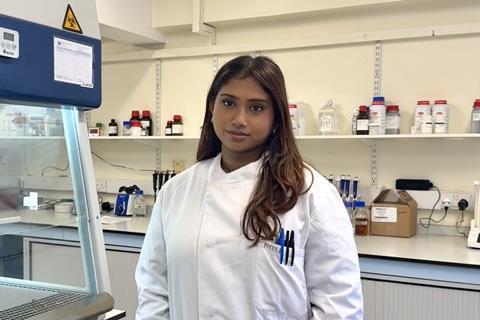
I have been isolating microorganisms from four South Asian fermented foods: idli, dosa, aubergine pickle, and mango pickle. These isolates were grown on both selective and general media, and then screened on a novel agar that I developed.
Colonies showing inhibition (identified by a clear halo where pigment was reduced) were taken forward for further testing. I then ran tyrosinase inhibition enzyme assays and performed kinetic studies to evaluate activity. From these results, the top five microbial candidates were chosen for growth curve analyses to determine the best time point for collecting supernatant samples.
The broader aim of the lab’s work is to find natural microbial solutions to food spoilage, particularly fruit browning caused by tyrosinase activity. This is a significant issue in food production and retail, as browning reduces both shelf life and consumer appeal, leading to waste. My work contributes by identifying promising microorganisms from traditional fermented foods that could provide novel, sustainable inhibitors of tyrosinase.
Microbial metabolites from fermented foods
So far, I have found that several isolates show strong inhibitory activity against tyrosinase, with clear halos on my screening agar and measurable effects in enzyme assays. These findings suggest that South Asian fermented foods are a rich source of microorganisms with the potential to produce natural compounds that inhibit tyrosinase.
If developed further, this could lead to bio-based methods for slowing fruit browning, reducing waste, and decreasing reliance on artificial preservatives. In the real world, this matters not only for the food industry’s efficiency and sustainability, but also for consumer health and preferences.
READ MORE: A festive guide to fermentation
READ MORE: Probiotic bacteria from fermented grain byproduct can battle E coli invasion in mouse gut
Next, I plan to carry out further optimisation of growth conditions for the top candidates and sequence these isolates to identify potential compounds produced by these isolates which display tyrosinase inhibiting properties. This will help determine the nature of the inhibitory substances and their potential applications.
Least favourite job in the lab?! My least favourite part of the project has been waiting during the long incubation periods for growth curve analyses. It can feel slow at times, but it’s a crucial step for identifying when microorganisms produce the most effective inhibitory compounds.
Find out more about AMI’s grants.





No comments yet