
Acid resistance is a crucial property that enterobacteria must possess to withstand host acidic environments during infection, including the gastrointestinal tract and macrophage phagosomes. The facultative intracellular pathogen Salmonella expresses the arginine decarboxylase AdiA, which confers acid resistance by catalyzing an H+-consuming reaction.
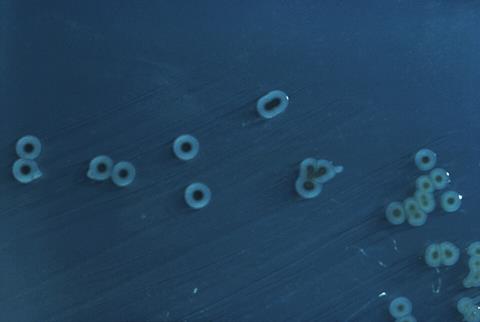
Researchers at University of Tsukuba have discovered that the 3′-untranslated region (UTR) of adiA mRNA is processed by RNase E into a regulatory small RNA, AdiZ.
Using RNA-RNA interactome profiling, transcriptomic analysis, in vitro structural probing, and in vivo validation experiments, the researchers demonstrated that AdiZ directly base-pairs with and negatively regulates ptsG, pykF, and dmsA mRNAs involved in glucose uptake, glycolysis, and anaerobic respiration, respectively.
Metabolic reprogramming
Intriguingly, the induction of AdiZ facilitates Salmonella’s survival within macrophages, where acidic and hypoxic stresses prevail. Thus, simultaneous expression of AdiA and AdiZ from a single mRNA links arginine-dependent acid resistance to metabolic reprogramming of Salmonella in host intracellular niches.
This research group has previously demonstrated that RNAs with novel functions are generated from UTRs of bacterial mRNAs. These findings further suggest that far from being passive sequences, UTRs can serve as sources of regulatory RNAs. Such hidden RNA fragments might play critical roles in pathogen adaptation and could become new therapeutic targets to combat bacterial infections.
READ MORE: New molecular movie reveals how antibiotic resistance to fusidic acid works
This study was supported by JSPS KAKENHI grant numbers JP22K14809 and JP22KJ0376 to T.K, and JP19H03464, 19KK0406, and JP24K01661 to M.M; and by international collaboration grants from JSPS-CAS Bilateral Joint Research Project (JPJSBP120237201, 176002GJHZ2022022MI) and National Key R&D Program of China (2022YFE0111800) to Y.C and M.M. T.K. was supported by JSPS Postdoctoral Fellowship, IFO scholarship for young researchers (Y-2022-2-028), and Kato Memorial Bioscience Foundation (2023B-101), and is currently supported by JSPS Overseas Research Fellowship. Research in the Miyakoshi lab is supported by Mishima Kaiun Memorial Foundation, Asahi Group Foundation, and Takeda Science Foundation.





No comments yet