
This study is led by Professor Guanghua Huang at Fudan University, in collaboration with a team led by Professor Haiqing Chu at Tongji University. Shuaihu Li, a PhD candidate from the School of Life Sciences, Fudan University, performed most of the experiments in this study.

To define the causal role of agricultural azole fungicides in driving clinical azole resistance in the major human opportunistic fungal pathogen Candida tropicalis, researchers conducted a systematic study integrating experimental evolution, genomic characterization, and transcriptomic profiling.
Using serial passaging under stepwise increasing concentrations of four globally prevalent agricultural azoles (difenoconazole, diniconazole, flutriafol, and hexaconazole), the researchers generated stably azole-resistant evolved strains from an initially azole-susceptible C. tropicalis isolate.
In vitro antifungal susceptibility assays confirmed that all evolved strains exhibited stable high-level resistance to the corresponding agricultural azoles, as well as broad-spectrum cross-resistance to first-line clinical azoles, including fluconazole, itraconazole, voriconazole, and posaconazole. Notably, the minimum inhibitory concentration (MIC) of fluconazole in some evolved strains was up to 64-fold higher than that of the parental wild-type strain, directly verifying that agricultural azole exposure is a key environmental driver of clinical azole resistance in C. tropicalis.
Agricultural azoles
Genomic analyses revealed that all azole-resistant strains harbored stable aneuploid karyotypes, with universal whole-chromosome gains or segmental chromosomal amplifications. Distinct agricultural azoles induced characteristic, azole-specific aneuploidy patterns, and all amplified genomic regions were highly enriched with core azole resistance genes, including key ergosterol biosynthesis genes and drug efflux pump-encoding genes. The researchers confirmed a direct causal link between aneuploidy formation and azole cross-resistance, establishing that aneuploidy is the core genomic mechanism underlying rapid resistance acquisition in C. tropicalis under agricultural azole stress.
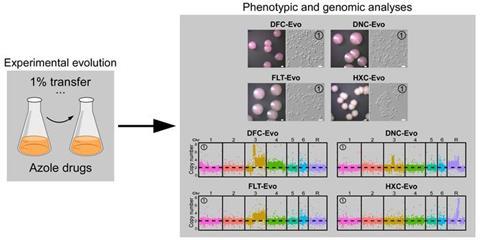
Transcriptomic analyses further demonstrated that significant upregulation of azole resistance genes within amplified genomic regions, driven by gene dosage effects, forms the core molecular basis of the resistance phenotype. Additional copy number-independent transcriptional reprogramming of key resistance genes further amplified the drug resistance effect. The study also revealed that agricultural azole exposure reduced C. tropicalis susceptibility to non-azole echinocandin antifungals, indicating an underappreciated risk of broader multidrug resistance.
These findings highlight the critical role of agricultural azoles in clinical antifungal resistance, providing key experimental evidence for antifungal stewardship under the One Health framework.
The article is published in Mycology: An International Journal on Fungal Biology.
Topics
- agricultural azole fungicides
- Agriculture
- Antimicrobial Resistance
- Asia & Oceania
- Candida tropicalis
- Early Career Research
- Ecology & Evolution
- fluconazole
- Fudan University
- Fungi
- Guanghua Huang
- Haiqing Chu
- Healthy Land
- Infection Prevention & Control
- Infectious Disease
- itraconazole
- non-azole echinocandin antifungals
- One Health
- posaconazole
- Research News
- Shuaihu Li
- Soil & Plant Science
- Tongji University
- voriconazole






No comments yet