
With antimicrobial resistance (AMR) projected to cause more than 39 million deaths and trillions of dollars in economic losses between 2025 and 2050, phage therapy is emerging as a critical solution. In China, phage therapy has already been used across more than 30 hospitals to treat over 500 patients with drug-resistant infections. However, the country currently lacks a dedicated regulatory framework to guide its full clinical translation.

Global phage therapy regulatory frameworks diverge. The European Union (EU, led by Belgium) uses a flexible magistral preparation model, enabling low‑cost, personalized phage therapy without formal drug approval. Meanwhile, the US regulates phages as biologics and provides access via emergency Investigational New Drug (IND) pathways.
The UK allows the import of unlicensed products for compassionate use, while Australia is piloting a three‑year GMP exemption for small‑batch, personalized products. Georgia has a long history of phage use but lacks GMP‑compliant production, limiting international acceptance.
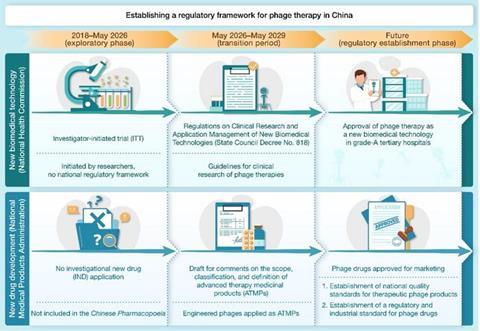
In China, phage therapy commenced under investigator‑initiated trial regulations in 2018. Recent policy signals are encouraging: a 2025 NMPA draft guidance indicates that gene‑edited phages may be classified as advanced therapy medicinal products (ATMPs), and State Council Decree No. 818 (effective May 2026) introduces a filing mechanism for phage therapy as a new biomedical technology. Nevertheless, national quality standards and clear approval pathways remain absent.
Three-pillared approach
Publishing in hLife, the research team advocates a three-pillared approach: “standards first, pathway pilots, and industry cultivation.”
Key recommendations include: (1) National quality guidelines: Develop a technical guideline for phage preparation quality control, building on an existing Shanghai group standard, TSHPPA 028-2024, and ISO/TS 20853:2026.
(2) Phase‑appropriate GMP pilot: Offer a 2–3 year GMP exemption or simplified certification for personalized, low‑risk phage preparations that address urgent clinical needs, allowing qualified hospitals to produce them under ethical review while building GMP capacity.
(3) Clear product classification: Specify that standard phage products follow the biologics pathway, while gene‑edited phage products may qualify for ATMP classification with expedited policies.
(4) Regional centers and reimbursement: Authorize experienced hospitals to establish regional phage therapy centers, supported by integrated pricing, health insurance, and commercial insurance mechanisms.
Pivotal opportunity
Dr. Shuai Le emphasizes that comprehensive international frameworks for phage therapy remain underdeveloped. China now has a pivotal opportunity to transition from a regulatory follower to a global frontrunner. By building a high‑quality, context‑appropriate development pathway, China can advance its “Healthy China” initiative while contributing meaningfully to the global fight against AMR.
This research was completed by a joint team from Army Medical University, The Forsyth Institute, CreatiPhage Biotechnology Co., Ltd., and Fudan University. This work was supported by grants from the National Key Research and Development Program of China (2021YFA0911200 to S.L.).
Author background
Shuai Le, Associate Professor at Army Medical University. His laboratory specializes in deciphering the evolutionary battle between phages and their hosts while advancing synthetic phage design and clinical optimization, bridging the gap between basic research and therapeutic applications.
A key milestone in his career includes co-leading China’s first personalized trial and first RCT clinical trial on bacteriophage therapy, establishing a foundation for evidence-based phage medicine in the country. Dr. Le has authored over 50 SCI-indexed publications in top-tier journals, including Nature Microbiology, PNAS, The EMBO Journal, and hLife.







No comments yet