
The gut microbiome—the trillions of bacteria and other microbes that inhabit the gastrointestinal tract—drives a process vital for protecting the colon against tissue injury, according to the findings of a study co-led by Cedars-Sinai Health Sciences University investigators.
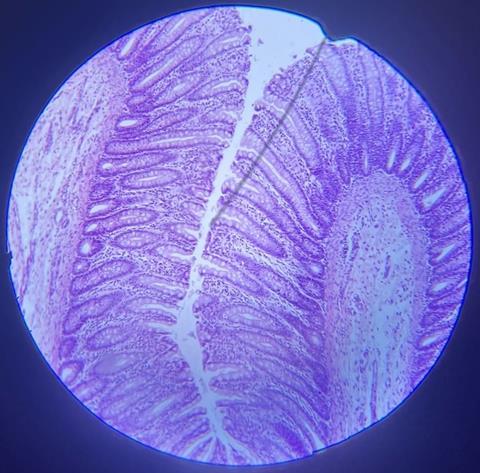
The discovery, published in Cell, has important implications for understanding how a wide variety of intestinal disorders may develop.
“Our research opens the door to treatments that focus on restoring key molecular signals in vulnerable regions of the colon,” said Ophir Klein, MD, PhD, executive director of Cedars-Sinai Guerin Children’s, executive vice dean of Children’s Health, and the David and Meredith Kaplan Distinguished Chair in Children’s Health. Klein is the senior author of the study.
Prior research has shown that the four sections of the colon—ascending, transverse, descending and sigmoid—have different functions and risks for disease, but it wasn’t clear why these variations exist.
Regions of the colon
In this study, the investigators showed that the identity of distinct regions of the colon are regulated by the gut microbiome. They identified nicotinic acid, a molecule produced by certain bacteria in the gut microbiome, as a main driver of these regional differences in the colon’s sections. Nicotinic acid, also known as niacin, part of the vitamin B3 family, helps the body convert food into energy and supports the health of cells.
The researchers compared laboratory mice with and without a microbiome. They found that production of nicotinic acid by bacteria in the upper colon activates a protective mechanism in colon cells. In mice without a microbiome, minimal nicotinic acid was produced, and cells in the upper colon became more vulnerable to damage and disease.
Investigators also studied human colon tissue samples. They found that the different sections of the human colon showed regional characteristics similar to patterns observed in mice. And in samples from human patients with Crohn’s disease— a type of bowel disease in which abnormal immune system activity causes inflammation—this protective mechanism was reduced.
Regional differences
“Our work highlights the importance of studying host microbiome interactions with careful attention to specific colon regions, rather than treating the colon as a uniform organ,” said Jeremie Rispal, PhD, a postdoctoral scholar at the University of California, San Francisco, and the first author of the study. “We learned that the microbiome controls regional differences and tissue protection.”
Further study will be needed to confirm the precise mechanisms behind this protective effect and to determine how these findings might be used in new therapies for intestinal disorders.
Additional Cedars-Sinai authors include Manasa Vegesna, Dedeepya Vaka, and Dario Boffelli.
Other authors include Jasmine R. Garcia, Brisa Palikuqi, Seung Woo Kang, Coralie Trentesaux, Juan Du, Nicola R. Realini, Paige N. Spencer, James M. Gardner, Annika Hausmann, Michael G. Kattah, and Ken S. Lau.




No comments yet