
Most pandemics start when a pathogen spreads from animals to humans. It’s a leading explanation for the COVID-19 pandemic: the SARS-CoV-2 virus, which causes COVID-19, is a cousin to coronaviruses that live in bats.
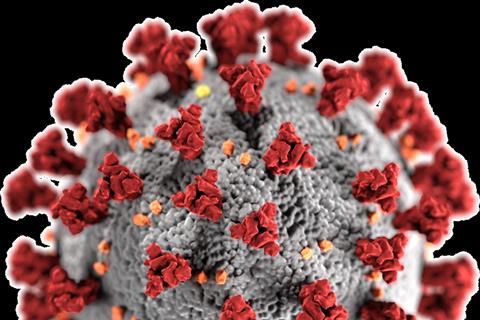
Now, researchers at the UCSF Quantitative Biosciences Institute, Icahn School of Medicine at Mount Sinai, Institut Pasteur, and Fred Hutchinson Cancer Center, report that a single amino-acid change alters how a coronavirus protein interacts with the human and bat immune systems, shifting the body’s response to infection. The study published in Cell Host & Microbe helps explain how benign animal viruses can adapt to humans and cause severe disease.
Viral protein
Researchers looked at SARS-CoV-2 and a related coronavirus called RaTG13, which only infects bats, and compared how each virus interacted with immune proteins in bat and human lung cells. The experiments relied on the first laboratory-grown lung cell line from the greater horseshoe bat.
A viral protein called OrfB9 emerged as a key factor. The SARS-CoV-2 and RaTG13 versions of OrfB9 differ by one amino acid out of roughly 100. In human cells, the SARS-CoV-2 version disabled an immune alarm system, allowing the virus to multiply. In bat cells, the RaTG13 version activated an immune protein that helped suppress the virus.
“The difference between a virus that stays in bats and one that spills over into humans and causes catastrophic disease can come down to remarkably small genetic changes,” said Nevan J. Krogan, PhD, director of QBI and senior author of the study. “By mapping these interactions at the protein level — across two viruses and two species — we can read the molecular signatures that predict spillover risk. It’s the kind of early warning system the world needs.”
Topics
- bats
- coronavirus
- covid-19
- Disease Treatment & Prevention
- Epidemiology
- Fred Hutchinson Cancer Center
- greater horseshoe bat
- Icahn School of Medicine
- Immunology
- Infection Prevention & Control
- Infectious Disease
- Institut Pasteur
- Medical Microbiology
- Nevan J. Krogan
- Research News
- SARS-CoV-2
- UCSF Quantitative Biosciences Institute
- University of California - San Francisco
- USA & Canada
- Veterinary Medicine & Zoonoses
- virology
- Viruses




No comments yet