
Neutralizing antibodies (NAbs) are a key defense against SARS‑CoV‑2 reinfection, yet long‑term NAb dynamics in different populations have remained poorly understood.
Conventional lateral flow immunoassays (LFIA) often suffer from unstable protein activity, poor reproducibility, and short shelf life, limiting their use for large‑scale, real‑world immune monitoring. To address these challenges, a research team developed a novel detection probe based on sodium dodecyl sulfate‑modified selenium nanoparticles (SDS‑SeNPs).
Unlike traditional colloidal gold probes, SDS‑SeNPs stabilize protein conformation through van der Waals and electrostatic interactions, preserving biological activity even after repeated freeze‑thaw cycles and complex storage conditions. Molecular dynamics simulations confirmed that this interaction does not block the functional domain of the ACE2 protein, ensuring reliable performance.
MICROBIOLOGY NEWS: Register with The Microbiologist for more free articles
The team optimized the entire LFIA system, demonstrating excellent sensitivity, specificity, batch‑to‑batch consistency, and storage stability. By integrating smartphone imaging and artificial intelligence analysis, the platform enables automated, quantitative result readout, making it suitable for rapid on‑site testing at the grassroots level.
Long-term follow-up
Using this platform, the researchers conducted a long-term follow‑up of 1,328 vaccinated individuals between 2022 and 2023. Contrary to a simple linear decline, population‑level NAb levels fluctuated in sync with the successive circulation of Omicron subvariants BA.1/BA.2 and BA.5. Notably, the mean inhibition rate increased from 79.2% at month 1 to 84.8% at month 12, driven by variant‑induced immune stimulation.
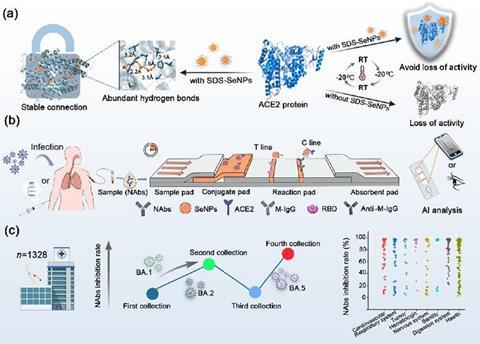
Stratified statistical analysis yielded an important clinical finding: patients with neurological and hematological diseases are key high‑risk groups. Their NAb inhibition rates (88.3% and 87.8%, respectively) were significantly lower than those of healthy individuals and other chronic disease patients (>90%).
MICROBIOLOGY ON TAP: Get full access to all The Microbiologist articles from just £2.17 a month
Moreover, their antibody decline accelerated with age—falling below 70% in those over 60 years—and continued to drop over time, while healthy controls remained above 90% at 12 months.
This easy‑to‑use and highly scalable detection platform can be rapidly adapted to emerging infectious diseases. The work not only provides a deployable on‑site monitoring system for neutralizing antibodies but also delivers critical data to identify high‑risk populations, implement differentiated vaccination strategies, strengthen protection for vulnerable groups, and conduct routine population immune surveillance.



No comments yet