
Beneficial soil microorganisms are increasingly being assembled into synthetic communities, or SynComs, to support crop growth and soil health. Native microbes are attractive candidates because they are adapted to local environmental conditions and can establish themselves around plant roots.
However, their capacity to counter soil acidification remains insufficiently explored. Acidic soils restrict nutrient availability and disrupt microbial processes, while limited organic carbon further constrains biological activity. Developing effective microbial treatments therefore requires identifying organisms that tolerate both acidity and carbon scarcity, establishing their performance in soil, and determining how they influence nutrient cycling and plant development.
A study published in Agricultural Ecology and Environment on 30 July 2026 by Xiaofeng Li’s team, Guangxi University, reports that two native Paracoccus communis strains, delivered on filter mud, jointly improved acidic soil conditions and lettuce growth.
Selecting microbes for acidic soils
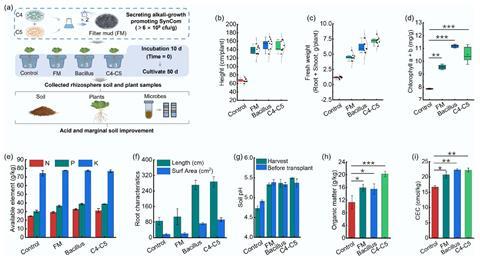
The researchers first enriched microorganisms from acidic red soil collected in Guangxi, China, progressively reducing carbon availability to select strains suited to nutrient-poor conditions. Screening for acid tolerance, alkalizing activity, and production of the growth-related hormone indole-3-acetic acid identified two compatible strains, C4 and C5. Combined in equal proportions, they formed a SynCom whose culture reached pH 8.3 and produced 35.53 milligrams of indole-3-acetic acid per liter.
The team then loaded the bacteria onto composted filter mud, a fibrous residue from sugarcane processing, to create a solid microbial amendment. In a 50-day greenhouse experiment, lettuce received one of four treatments: untreated soil, filter mud alone, filter mud carrying a commercial Bacillus preparation, or filter mud carrying the C4–C5 community. All treatments received the same basal fertilizer, and each treatment had three replicate pots. Measurements of plant growth, root architecture, soil chemistry, enzyme activity, and microbial genetic profiles linked the amendment to changes above and below ground.
Strong effects on lettuce growth
Compared with untreated controls, the C4–C5 treatment increased plant height by 120.60%, fresh weight by 527.83%, and chlorophyll content by 33.80%. Total root length and root surface area also increased, indicating more extensive development of the root system. The treatment raised root-zone pH and increased available nitrogen, while available phosphorus and potassium also rose relative to controls.
MICROBIOLOGY NEWS: Register with The Microbiologist for more free articles
Microbial profiling showed enrichment of Paracoccus, consistent with successful establishment around roots. Higher microbial biomass carbon and dehydrogenase activity indicated greater microbial biomass and metabolic activity. Quantification revealed a 25-fold increase in the carbon-fixation marker gene cbbL. Metagenomic analysis also identified enrichment of genes associated with nitrogen fixation, ammonium production, phosphorus mobilization, and tryptophan metabolism linked to hormone synthesis.
Together, these measurements support a mechanism involving reduced acidity, improved nutrient availability, and microbial influences on root development, while genetic changes indicate functional potential rather than directly measured process rates.
From greenhouse to field
The study presents a strategy for designing soil amendments around locally adapted microbes and an organic carrier. Its findings connect improved lettuce growth with changes in acidity, microbial establishment, and nutrient-related functions. Field trials are still needed to establish durability, performance across crops and soils, and practical application rates before the treatment can be recommended for widespread agricultural use.



No comments yet