
In the search to replace antibiotic growth promoters with effective alternatives in modern swine production, plant-based essential oils are showing potential to provide lasting benefits.
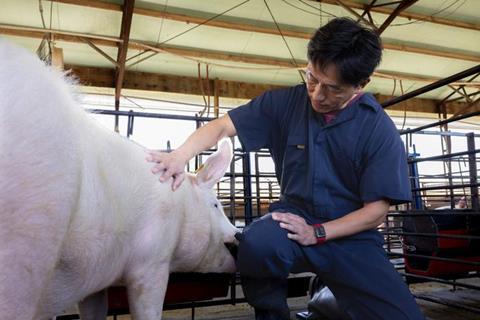
In a rare long-term public study that compared the effects of phytochemicals from rosemary and oregano with antibiotic growth promoters, animal scientists with the Arkansas Agricultural Experiment Station found that the natural agents given to weaned pigs supported favorable gut health and growth performance later in their lives by preserving microbial diversity to improve nutrient utilization.
“This study allowed us to look at the lifetime impact from phytochemical exposures,” said Tsungcheng “TC” Tsai, Ph.D., a program associate in the department of animal science for the experiment station, the research arm of the University of Arkansas System Division of Agriculture. “If you just look into the nursery phase — the first 43 days after weaning — and you don’t see any difference, the study is ended, and you don’t really know the true value of those phytochemicals.”
Tsai is the corresponding author of the study published in the journal Animal Research and One Health.
Analysis of the pig’s microbiome in the study was conducted in collaboration with the University of Arkansas for Medical Sciences.
Antimicrobial resistance, and other concerns
While antibiotic medications have their time and place in veterinary medicine, Tsai said extensive use has accelerated the emergence of antimicrobial resistance and led to bans or restrictions in many countries.
Besides antibiotics, high levels of dietary zinc have also been frequently incorporated into swine diets to mitigate postweaning diarrhea. However, there are also environmental concerns associated with excessive zinc excretion, including heavy metal accumulation in the environment, Tsai noted. Pig waste is commonly used as a fertilizer, which can lead to levels of zinc that are toxic to plants.
Essential oils from plants like rosemary and oregano have been shown in many studies, Tsai said, to have beneficial effects on animal health, including poultry, fish and swine. However, most of the studies have focused on short-term responses, often limited to the nursery phase.
Long-term consequences
The early post-weaning phase is one of the most physiologically and immunologically challenging periods in swine production, Tsai said. During this transition, abrupt dietary and environmental changes, coupled with maternal separation, disrupt gut development and destabilize the microbial ecosystem. Gut health during this stage has long-term consequences on feed efficiency, growth trajectory and overall production outcomes, he added.
To conduct the study, the researchers randomly assigned 192 piglets to four groups after weaning: a negative control in which the pigs were given no antibiotic or phytochemical treatments; a positive control with the antibiotic growth promoter carbadox and high dietary zinc; and two phytochemical-supplemented diets containing extracts from oregano and rosemary plants.
In the phytochemical groups, one group of pigs received oregano extract at 300 grams per ton of feed, and another received a mixture with oregano extract and rosemary extract with sodium humates at 900 grams per ton of feed. Sodium humate is a water-soluble salt derived from a soft sedimentary rock and acts as an anti-diarrheal, antiviral and anti-inflammatory agent.
Commercial operations
Mimicking typical management practices in commercial swine operations, antibiotic and high-zinc supplementation were restricted to the immediate post-weaning period. This practice reflected their conventional short-term use during the critical early stage of piglet development, Tsai said.
Phytochemicals, however, were administered continuously to the separate groups, enabling the researchers to assess their long-term potential as antibiotic alternatives.
Growth performance was monitored throughout the nursery, growing and finishing phases with seven phases in all — three nursery phases, two growing phases and two finishing phases.
Phytochemical patience
Piglets that received antibiotics showed faster growth and higher body weights compared with other groups, but the advantage didn’t persist. Once the researchers removed the antibiotics and zinc from the pigs’ diet, the pigs did not maintain their performance edge.
By day 155, pigs in the phytochemical group with oregano, rosemary and sodium humate achieved the highest final body weight among all groups and had the best gain-to-feed ratio.
“From a production perspective, these patterns may offer complementary or alternative strategies for growth promotion, but their implications should be interpreted cautiously,” the researchers noted in their conclusion.
Although not included in the published study, Tsai said pigs fed with phytochemicals appeared to be less aggressive towards each other.
Under the microscope
Microbial analyses reinforced the growth performance findings on phytochemicals, which enhanced long-term productivity and contributed to restoring a healthier gut microbial profile. The phytochemicals did not appear to have the same adverse effects on microbial composition shifts induced by early life antibiotic and high zinc exposure, the study noted.
For microbiome data, researchers selected one pig from each group for a rectal swab. They sampled the same pig from each group on days zero, 16, 126 and 155, and assessed group differences in microbial features.
In the group that received antibiotics and high dietary zinc after weaning, microbiota profiling revealed reduced diversity and an increased enrichment of potential pathogens. Conversely, bacteria associated with beneficial gut colonization and serotonin-mediated host development significantly increased in the oregano-only phytochemical group relative to the antibiotic and high-zinc group.
“These compounds may not give the instant response producers often see with antibiotics, but over time they appear to help condition the gastrointestinal tract and microbiome, so pigs handle stress better later in life,” Tsai said.
About the researchers
The first author of the published manuscript was Ziyu Liu, a graduate student in the department of animal science in the Dale Bumpers College of Agricultural, Food and Life Sciences at the University of Arkansas.
Co-authors of the study in the department of animal science included postdoctoral fellow Samantha Howe, laboratory technician Alisun N. Watson, Associate Professor Yan Huang, Professor Jiangchao Zhao, formerly with the department, and Professor and Department Head Michael Looper.
Other co-authors included Yang Tian, a postdoctoral fellow in the department of biological and agricultural engineering, Dr. Jason E. Farrar and research assistant Christopher E. Randolph of the Genetics Core in the Arkansas Children’s Research Institute at the University of Arkansas for Medical Sciences, and Álvaro José Uribe and Jaime Andrés Ángel Isaza with Promitec Santander S.A.S. in Colombia.
Randolph and Farrar applied funding from a grant to use the Genetics Core’s Illumina MiSeq machine in the study. Additional support came from Promitec Santander S.A.S.
Topics
- Agriculture
- Antibiotics
- Antimicrobial Resistance
- Antimicrobials
- Arkansas Agricultural Experiment Station
- dietary zinc
- Early Career Research
- Food Security
- growth performance
- Gut Microbiome
- Healthy Land
- Infection Prevention & Control
- One Health
- oregano
- Research News
- rosemary
- Tsungcheng “TC” Tsai
- University of Arkansas
- USA & Canada
- Veterinary Medicine & Zoonoses
- Ziyu Liu




No comments yet