
Researchers from Queen Mary University of London have uncovered a previously unknown mechanism by which HIV-1 can infect resting immune cells. The discovery challenges a decades-old assumption in HIV biology, and opens new avenues for understanding how the virus persists in the body, despite treatment.
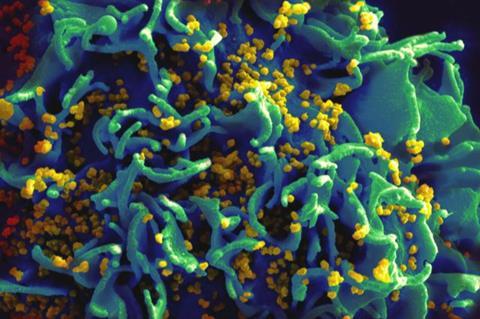
For HIV to successfully infect T-cells, the immune cells it primarily targets, it must deliver its genetic material into a cell’s nucleus. A tightly guarded compartment, the nucleus is surrounded by a structure called the nuclear pore complex (NPC), which acts as a selective gateway controlling what enters and exits. The HIV capsid, the protective shell surrounding the virus’s genetic material, is unusually large, and how it squeezes through this barrier has long puzzled scientists.
This new research, published in Nature, reveals that when HIV spreads directly between T-cells it triggers a molecular signalling chain that temporarily ‘unlocks’ the NPC, allowing the HIV virus and capsid to enter and integrate into the host’s DNA. This process, the researchers found, does not require the T-cell to be activated, overturning a long-standing dogma in the field.
Latent reservoir
The findings carry significant implications for understanding one of the greatest obstacles to a cure for HIV: the latent reservoir, a pool of resting T-cells that harbour dormant HIV. This reservoir acts as a permanent hiding place for the virus and is the main barrier to eliminating the virus from the body, as antiretroviral therapy cannot reach or clear them.
Scientists have long been puzzled by this paradox: while these resting infected cells are readily detected in people living with HIV, resting T-cells have consistently resisted infection in laboratory experiments. This leads to the assumption that cells must first be activated before HIV can take hold and that these cells represent cells that were infected while previously activated but have returned to a resting state.
This study offers a new explanation. By showing that cell-to-cell spread of HIV can render otherwise non-permissive resting T-cells susceptible to infection, the research suggests that the latent reservoir may be established and maintained through a mechanism that has, until now, gone unrecognised. The findings also have implications for treatment, potentially offering a new route by which to destroy the virus and remove the latent reservoir.
Nuclear transport regulation
Beyond HIV, the study reveals a previously uncharacterised mechanism of nuclear transport regulation in T-cells, with potential implications for immunology and the development of novel immunotherapies. A greater understanding of how immune cell signalling shapes fundamental cell biology processes could inform approaches to direct T-cell behaviour for therapeutic purposes.
Professor Clare Jolly, Professor of Virus Cell Biology at Queen Mary University of London, said: “What excites me most is seeing how elegantly HIV-1 exploits the cell’s own machinery and how we can use viruses as molecular tools to make discoveries about how cells work, for example uncovering exciting new biology about regulation of nuclear transport which is a fundamental cellular process.
”The nuclear pore complex is one of the most sophisticated structures in the cell, and HIV-1 has evolved to manipulate it through a very specific pathway of CD4 signalling, CDK1 activation and nucleoporin phosphorylation, all triggered just by the physical act of one cell touching another.
Triggering a switch
”This allows HIV-1 to modify the nuclear import gateway from the outside and trigger a permissivity switch to unlock the door to infection. We expect that other viruses may well manipulate nuclear transport machinery in similarly sophisticated ways to licence infection, it will be fascinating to see how that plays out.
“Our research is basic discovery science, but we expect that by advancing understanding how resting T-cell reservoirs can be established and building on our discoveries, we will reveal new avenues to therapeutically target HIV reservoirs. In the end, that really is the ultimate goal – to improve human health.”
Dr Matt Whelan, Academic lead of Blizard advanced light microscopy at Queen Mary and Wellcome Early Career Fellowship, said: “It has been really exciting to see how imaging allowed us to observe CDK1 dependent remodelling of nuclear pore architecture during HIV-1 infection in primary T-cells. These imaging approaches combining live-cell kinetics, quantitative subcellular localisation, and nanoscale dSTORM reconstruction of NPC structure, provided the mechanistic evidence that no biochemical assay could deliver alone. Revealing not just that the NPC is remodelled but how that remodelling alleviates a key blockade to the HIV1 lifecycle.”


.jpg)
No comments yet